Cash discount programs have exploded in popularity as card processing costs keep climbing. Many businesses are told they can get “zero-fee processing” or “eliminate up to 100% of your fees” by shifting costs to customers.
The reality is more nuanced.
A properly structured cash discount program can reduce or even offset processing fees. But if it’s implemented incorrectly, it can be treated as an illegal surcharge, violate card-brand rules, trigger fines, and damage customer trust.
This guide breaks down how cash discount programs work, the key differences from surcharges, the pros and cons, and what you must do to stay compliant today and in the future.
What Are Cash Discount Programs?
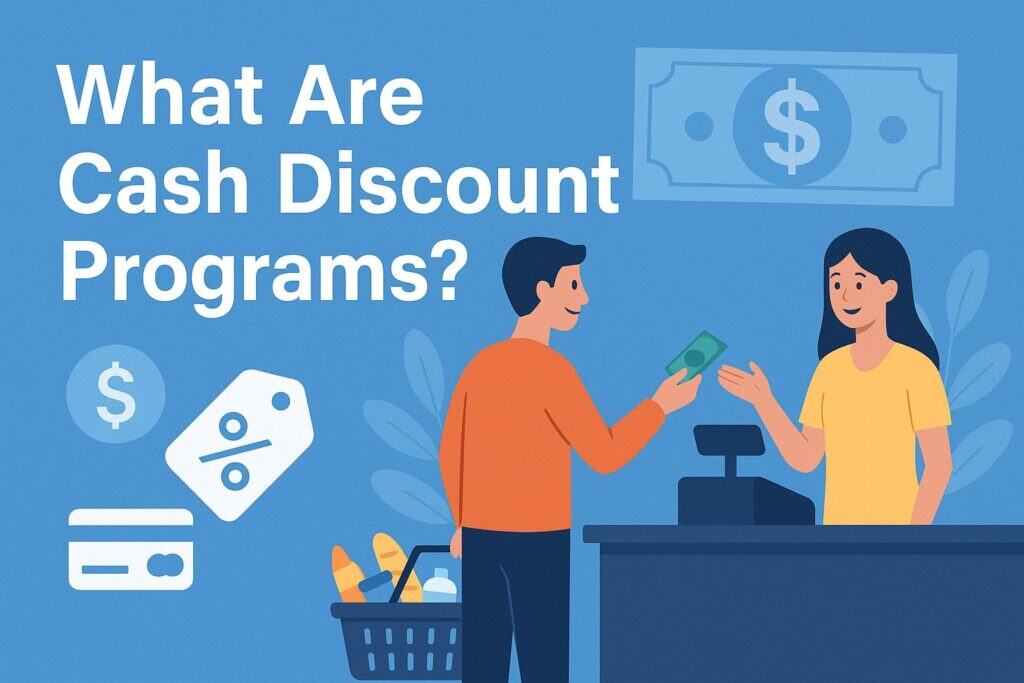
Cash discount programs are pricing strategies where the posted price includes the cost of accepting cards, and customers who pay with cash or other low-cost methods receive a small discount at checkout. In other words, the “standard” price is based on card payments, and the cash customer is rewarded with a reduction in that price.
In a typical cash discount program, a business might raise prices by 3–4% to cover average card processing costs. That higher price is advertised on shelves, menus, websites, or quotes. When a customer pays with a credit card, they pay the posted price.
When a customer pays with cash, debit, or sometimes ACH, the system applies a discount equal to that built-in fee, and the customer sees a lower total on the receipt.
This is different from adding a fee at the end of the transaction. Card brands and legal guidance are clear: if you add a separate fee on top of a displayed price for using a card, that’s a surcharge or service fee, not a cash discount.
Businesses are drawn to cash discount programs because they promise:
- Lower effective processing costs
- More cash payments
- Protection from rising interchange rates
But they only deliver these benefits when implemented as true cash discount programs, with compliant signage, receipts, and pricing methods. Mislabeling a surcharge as a “cash discount” is one of the most common and risky mistakes.
How a True Cash Discount Program Works
A true cash discount program starts with the assumption that card payments are the default. The prices you display already include an allowance for your card processing costs. Then, you offer a reduction for customers who choose a cheaper payment method.
Here’s a simplified example:
- You want to sell an item for $100 net.
- Your average card cost is ~3.5%.
- You set the posted price at $103.50.
At checkout:
- Card customer: pays $103.50.
- Cash customer: receives a “cash discount” of $3.50 and pays $100.
On the receipt, the card customer should see the full posted price (no extra fee added). The cash customer should see the posted price with a clearly labeled discount line item (for example, “Cash Discount -$3.50”). This structure is what card brands typically recognize as a compliant cash discount program.
A true program should also:
- Apply the discount only when a lower-cost method is used.
- Make sure prices shown on shelves, menus, websites, and quotes match the card price, not the cash price.
- Clearly explain the offer to customers in signage and staff scripts.
If your POS simply adds a “non-cash adjustment” or “service fee” to all tickets and then removes it for cash, without ever posting the higher card price in advance, many networks and legal advisors will treat this as a surcharge in disguise, not a cash discount.
Cash Discount vs Surcharge vs Service Fee

A lot of confusion stems from mixing three different concepts: cash discount programs, surcharges, and service or convenience fees. Getting these definitions right is critical because each is regulated differently.
Cash Discount
- The posted price is the card price.
- Customers who pay with cash or similar methods receive a reduction.
- The discount is framed as a reward for cheaper payment methods.
- Generally allowed under card-brand rules when implemented correctly, and supported by federal law permitting discounts for non-card payments.
Surcharge
- A surcharge is an additional percentage or fixed fee added only when a customer pays with a credit card.
- It is displayed as a separate line item (e.g., “credit card fee 3%”) added at checkout.
- Surcharges are heavily regulated by card brands and state laws. Some states restrict or ban surcharging.
Service or Convenience Fee
- Typically a fixed fee charged for using a particular payment channel (for example, paying online instead of in person).
- Often allowed only in specific scenarios and must be applied uniformly to all payment methods within that channel, not just credit cards.
When a business adds a “non-cash fee” or “service fee” to all transactions, then discounts it for cash but never shows the higher price in advance, card brands may still see it as a surcharge and enforce surcharge rules.
For compliance, you must match your actual practice with the correct category. Calling something a “cash discount program” doesn’t matter if the receipts, signage, and price displays prove it’s really a surcharge.
Legal Framework Behind Cash Discount Programs
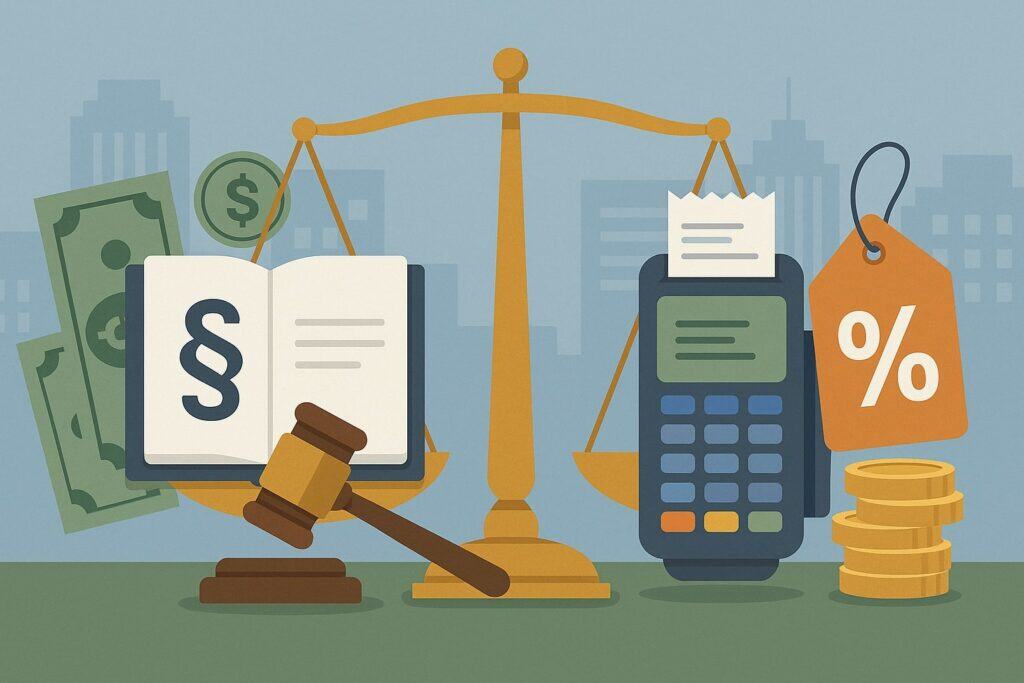
Legally, cash discount programs sit at the intersection of federal law, state law, and card-brand rules. To implement compliant cash discount programs, you must understand all three layers and how they interact.
At the federal level, the Durbin Amendment allows businesses to offer discounts for customers who pay with cash, check, debit, or other low-cost methods instead of credit or debit cards. That’s the legal foundation supporting cash discount programs.
However, state law may regulate how you display prices and whether surcharges are permitted. On top of that, card networks like Visa, Mastercard, Discover, and American Express have their own rules governing surcharging, disclosure, and how fees are presented.
Even if a cash discount program is technically legal under state and federal law, it still must meet card-brand standards. Networks can fine acquirers (and indirectly merchants) or terminate merchant accounts if they detect disguised surcharges or deceptive pricing. Recent enforcement waves show that the networks are actively auditing fee-recovery programs.
The bottom line: cash discount programs are generally legal when structured correctly as true discounts and clearly disclosed. But if you blur the line between discounts and surcharges, you increase your risk of non-compliance and penalties.
Federal Law and the Durbin Amendment
The Durbin Amendment, part of broader financial reform legislation, expressly allows businesses to offer discounts for payment methods other than credit or debit cards. This policy is what makes compliant cash discount programs possible.
Key federal concepts for cash discount programs include:
- Discounts are allowed: Federal law supports offering a lower price for cash, check, or other alternatives compared to the card-inclusive price.
- Transparency matters: Regulators and courts often focus on whether consumers were misled about the total price they’ll pay. Hidden or last-minute fees can be treated as deceptive practices.
- Distinction from surcharges: Federal law as interpreted by courts and regulators has treated surcharges (fees added for card use) more cautiously than discounts framed as savings for non-card payments.
Recent cases around interchange rules and surcharging show that payment-fee regulations are still evolving. For example, decisions questioning how debit interchange caps were set have led merchants to rethink their fee-recovery strategies and look at both surcharges and cash discount programs more closely.
Looking ahead, federal regulators are increasingly focused on “junk fees” and transparent total pricing. Even if your cash discount program is technically allowed, expect more scrutiny on how clearly you display the full card price before purchase, how you describe discounts, and whether any additional fees could be perceived as hidden.
State Laws and Card-Brand Rules You Must Follow
State laws primarily target surcharges, not genuine cash discount programs. However, if your cash discount program is structured or perceived as a surcharge, those state rules can apply.
As of 2025:
- Most states now allow credit card surcharges with conditions like caps (often 3%–4%), disclosure rules, and card-type limits.
- A small number of states and territories still prohibit or heavily restrict surcharging, though these laws continue to evolve through legislation and court decisions.
- Some states layer on additional “total price” or “junk fee” transparency requirements that affect how you show any mandatory charges, including embedded card fees.
Card-brand rules overlap with state law but are not identical. Visa, for example:
- Allows merchants to offer discounts for non-card payments as “discount offers” or “cash discounts.”
- Requires that any surcharge be capped and disclosed with specific language, with advance notice to the acquirer and Visa.
- Has warned acquirers about “service fee” models that look like surcharges but are marketed as cash discount programs, and has threatened fines for non-compliance.
Because state laws and card rules are shifting, future cash discount programs will likely face even more emphasis on:
- Showing the full card price upfront
- Using precise labels for discounts and fees
- Avoiding any structure that effectively “adds” a card fee after the fact
Working with legal counsel and a processor that actively monitors state-by-state rules will be increasingly important.
Benefits of Cash Discount Programs for Merchants
When done correctly, cash discount programs offer real advantages. They can transform card acceptance from a margin drain into a manageable cost, or even a neutral line item.
The core benefit is simple: by building average processing costs into prices and then offering discounts to lower-cost payment methods, you shift more of the card cost burden away from your business and toward card-using customers who value that convenience.
Key benefits include:
- Reduced effective processing costs or even “zero-fee” for many merchants
- Better protection from rising interchange fees and network changes
- Incentives for customers to pay with cash, which can improve liquidity
- Potentially fewer chargebacks and disputes for certain verticals if more payments move to cash or ACH
However, these benefits only materialize if pricing is set thoughtfully. If you simply increase prices by an arbitrary percentage without analyzing your current effective rate and card mix, your cash discount program may not cover costs or could overcharge, damaging competitiveness.
Done well, cash discount programs become part of a broader fee-recovery strategy that balances savings, compliance, and customer experience.
Direct Cost Savings and Higher Margins
The most obvious appeal of cash discount programs is lower processing cost. By wrapping card fees into your posted prices, you reduce your out-of-pocket expense every time a customer pays with a card.
Consider a business that:
- Processes $50,000 per month in card volume
- Pays an average of 3% in fees ($1,500 monthly)
If it adopts a compliant cash discount program and sets the markup at 3–4%, many or most of those fees can be offset by customers paying the card-inclusive price. Cash-paying customers receive a discount, but card-paying customers effectively subsidize the fee through the built-in pricing.
Over time, the savings can be significant:
- Lower total processing fees or even a net-zero effective cost
- Higher margins that can be reinvested in staff, inventory, or marketing
- Reduced sensitivity to future interchange hikes or assessment increases
Because interchange and network fees have trended upward and are under constant legal and regulatory pressure, merchants are looking for more predictable ways to manage these costs. Cash discount programs, when priced correctly, act as a hedge against those uncertainties.
To unlock these savings, you should:
- Analyze your current effective rate and card mix
- Model different discount levels (for example, 3.0%, 3.5%, 4.0%)
- Confirm that the program complies with card-brand and state rules
- Monitor results monthly and adjust your rate if costs or behavior shift
Cash Flow, Chargeback, and Risk Impacts
Cash discount programs can also change your risk and cash-flow profile. When more customers opt for cash or low-cost alternatives, your business holds more funds directly instead of waiting for card settlements.
Potential impacts include:
- Improved cash flow from greater cash or same-day ACH usage.
- Reduced exposure to chargebacks when transactions move from credit cards to cash, checks, or debit, depending on program design and customer behavior.
- Lower dependency on card processors for day-to-day liquidity.
However, there are trade-offs:
- More physical cash can increase risks of theft or handling errors.
- If customers dislike the perceived card price, they may reduce spend or switch to competitors.
- Some high-ticket or professional service businesses might find that their clients strongly prefer credit cards for points and protections.
Future fee-recovery models will likely integrate cash discount programs with options like ACH pay-by-link, digital wallets that route over low-cost rails, and real-time payments. That can preserve customer convenience while still reducing chargeback and settlement risk.
Drawbacks and Risks of Cash Discount Programs
While cash discount programs can be powerful, they are not a magic bullet. There are real drawbacks, especially if you treat them purely as a way to “make customers pay your fees” without considering experience and compliance.
Common risks include:
- Customer pushback and negative reviews
- Perception of “hidden fees” if prices are not clearly displayed
- Non-compliance with card-brand rules or state laws
- Operational complexity in configuring POS systems and signage
In an environment where regulators and card brands are cracking down on “junk fees,” any pricing model that is confusing or looks like an add-on card fee can draw attention.
Before launching a cash discount program, evaluate whether it aligns with your brand, your customer base, and your competitive landscape. For some businesses, a smaller, carefully explained fee-recovery program—or simply negotiating better interchange-plus pricing—may be more appropriate.
Customer Experience and Brand Perception
From the customer’s perspective, cash discount programs can feel like either a fair incentive or an annoying penalty, depending on how they’re presented.
Positive reactions tend to happen when:
- Signage is clear and easy to understand.
- Staff can explain the program in simple terms.
- The discount is framed as a reward for cash rather than a punishment for cards.
- Customers see genuine value in the discount, especially on larger purchases.
Negative reactions tend to happen when:
- The first time a customer learns about the program is at checkout.
- The receipt shows confusing fees or line items that look like hidden surcharges.
- The posted price doesn’t match what the customer expected from ads or menus.
- Staff are unsure how to explain the difference between a cash price and a card price.
In an era where card usage is standard and many people rely on credit card rewards, some customers may choose to pay more for card convenience. But they are much more likely to accept that trade-off if they feel informed and respected.
Over the next few years, as more businesses adopt fee-recovery models and regulators pressure for transparent “all-in pricing,” customers will become more familiar with seeing different prices for different payment methods—as long as those prices are clearly posted. Cash discount programs that are honest and well-communicated will fit more naturally into that landscape.
Operational and Technical Pitfalls
Implementing cash discount programs is not just a pricing decision; it’s an operational project.
Common pitfalls include:
- Incorrect POS configuration: The POS adds a fee line for cards but doesn’t show a true discount for cash, making the program look like a surcharge.
- Inconsistent signage: Some menus or shelf tags show cash prices, others show card prices, and staff are unsure which is which.
- Inaccurate receipts: Receipts don’t clearly show the posted price and the cash discount, or they mislabel the transaction.
- Multi-location inconsistencies: Locations in different states follow different rules, but the POS is not configured to handle those variations.
These issues don’t just confuse customers—they increase the chance that card brands or regulators will flag your cash discount program.
Future-ready fee-recovery solutions are increasingly software-driven: they can recognize card type, apply the correct structure for each state, and automatically handle receipts and reporting. If you operate across multiple jurisdictions, choosing a provider with this capability can reduce manual errors and compliance risk.
Compliance Essentials: Building a Legitimate Cash Discount Program
Compliance for cash discount programs centers on transparency, accurate labeling, and correct math. If you can show that customers see the true card price upfront and that cash customers get a real discount at the register, you’re on the right track.
Core compliance pillars include:
- Proper price posting
- Clear in-store and online signage
- Accurate receipt formats
- Card-brand rule adherence
- State-by-state sensitivity for surcharges and disclosure rules
Many non-compliant “cash discount programs” fail on the basics: they list the cash price on shelves, then add a “non-cash fee” line for card payments. That is adding a fee to the displayed price, and card brands treat it as a surcharge even if the word “discount” appears on the receipt.
To build a legitimate program, you must start from the card-inclusive price and work backwards to the cash discount, not the other way around.
Pricing Structure and Signage Requirements
With compliant cash discount programs, what the customer sees before paying is crucial.
Best practices include:
- Make the posted price (shelf, menu, website, signage) the card price that includes your average processing fee.
- Use clear phrasing such as:
- “All prices reflect a cash discount.”
- “A discount is offered for cash and other low-cost payment methods.”
- “All prices reflect a cash discount.”
- Avoid language that suggests an extra fee for card use, especially if state or card-brand rules treat this as surcharging.
Signage should be:
- Placed at entrances, checkout counters, and on invoices for professional services.
- Legible and easy to understand in plain language.
- Consistent across locations, websites, and marketing materials.
As more states adopt “junk fee” or “all-in pricing” rules, expect regulators to look closely at whether your advertised and posted prices truly include all mandatory charges. If your sign advertises one number but you collect a higher amount at the register through a card fee, you risk being viewed as non-compliant.
Future-proof signage will likely move toward dynamic digital displays and menus that can show both card and cash prices side by side, especially for high-ticket items.
POS Configuration, Receipts, and Reporting
Your POS or virtual terminal is the engine that makes cash discount programs run smoothly. To support compliant cash discount programs, it should:
- Store the card-inclusive price as the standard price.
- Apply the discount automatically when a qualifying payment method is used.
- Clearly print the discount as a separate line item on the receipt (for example, “Cash Discount”) so the customer can see the math.
A non-compliant setup often looks like this:
- The system rings the “cash price” first.
- Then it adds a “non-cash adjustment” as a separate fee for card payments.
- There is no visible evidence on the receipt that a cash customer received a discount from the posted card price.
That pattern resembles surcharging, not a true cash discount, and card networks have specifically warned acquirers about this behavior.
For reporting and accounting, you should:
- Track total discounts given vs total card volume.
- Monitor your effective processing rate each month.
- Ensure sales tax is calculated correctly based on local rules (often on the pre-discount amount).
As fee-recovery tools evolve, more providers are offering configurable logic that automatically handles state caps, card-type rules, and separate tracking for discounts, fees, and tax. This type of automation will become increasingly important as laws and card-brand rules continue to change.
How to Implement a Cash Discount Program Step by Step
Launching cash discount programs is easiest when you treat it as a structured project rather than a quick switch. A thoughtful rollout reduces surprises and customer pushback.
High-level steps include:
- Analyze your processing data and customer mix.
- Consult with your processor and legal counsel about state-specific rules.
- Decide your target discount percentage and which payment methods qualify.
- Configure your POS and receipts for a true cash discount structure.
- Create signage, FAQs, and staff scripts.
- Pilot the program and review results, then optimize.
Carefully designed cash discount programs can be introduced with minimal friction—and in some cases, customers will actually appreciate having a clear choice between saving money and using their preferred card.
Evaluating Fit for Your Business
Not every business is an ideal candidate for cash discount programs. Before you commit, ask:
- What is your current effective processing rate, including assessments and monthly fees?
- What portion of your sales are on credit cards vs debit vs cash?
- How price-sensitive are your customers?
- Do you compete heavily on advertised prices?
Cash discount programs often work best for:
- Small to mid-sized merchants with tight margins and high card usage.
- Service businesses where invoices can clearly show both card and cash totals.
- Industries where customers are used to payment-method differentials (for example, gas stations and some professional services).
They can be more challenging for:
- Highly competitive retail where small price differences are very visible.
- Upscale or luxury brands that emphasize seamless experience over nickels and dimes.
- Businesses with complex bundled pricing where multiple line items make discounts harder to display clearly.
Looking ahead, more businesses will likely pair cash discount programs with loyalty programs, wallet-based ACH options, and subscription-style billing to soften perceived friction and add value to customers who choose low-cost payment methods.
Rolling Out, Training Staff, and Measuring Results
Once you decide to move forward, careful rollout is crucial.
Staff training should cover:
- How to explain cash discount programs in one or two sentences.
- Which payment methods qualify for discounts.
- How to respond to customer questions like “Why am I paying more with my card?”
- What to do if customers dispute the difference.
Provide simple scripts like:
“Our posted prices are based on card payments. If you pay with cash or other low-cost methods, you get a small discount at checkout to help us offset processing costs.”
Measurement is equally important. In the first 60–90 days, track:
- Changes in your effective processing rate
- Shifts in the ratio of cash vs card payments
- Average ticket size and repeat visits
- Customer feedback and reviews
This data will tell you whether your cash discount program is working financially and how it impacts customer satisfaction. If you see a spike in negative feedback or a drop in revenue, you can adjust the discount level, refine explanations, or consider hybrid strategies that use smaller differentials or targeted surcharges where allowed.
Industry-Specific Considerations
Cash discount programs don’t look the same in every industry. The way you display prices, issue receipts, and communicate with customers varies by business model.
Retail and Quick-Service
- Shelf labels and menu boards must clearly show card-inclusive prices.
- Digital menu boards can dynamically show both prices, but must remain consistent.
- Volume of small tickets means that even a small discount can add complexity, so automation is essential.
Restaurants and Hospitality
- Tips add another layer: you need to decide whether discounts apply before or after gratuity.
- Table checks, online ordering, and delivery platforms must align with the same rules.
- Customers may be more sensitive to perceived “fees” in hospitality, increasing the need for careful messaging.
Professional and Medical Services
- Invoices and statements make it easier to show both “card price” and “cash price.”
- High-ticket items mean the discount can be substantial, which some clients appreciate.
- You may combine cash discount programs with financing offers or payment plans.
eCommerce and Remote Payments
- Traditional cash discount programs can be harder online, but some merchants offer ACH or pay-by-bank discounts compared with card checkout.
- Extra care is needed to comply with card-not-present rules and any specific state law about online surcharges.
As technology advances, expect more industry-tailored solutions that integrate cash discount programs with vertical-specific POS systems, especially in fields like auto repair, home services, and healthcare.
Cash Discount Programs vs Zero-Fee Processing Hype
Many offers in the market promise “zero-fee processing” using cash discount programs or surcharging. While some are legitimate, others rely on aggressive marketing and legally questionable structures.
Warning signs include:
- Claims that “laws don’t matter because this is a cash discount program,” even when a surcharge is clearly being added to the ticket.
- POS configurations that charge a fee on all transactions and then “reverse” it for cash, without posting the higher card price.
- Lack of clear guidance on state-by-state rules or card-brand requirements.
- No sample signage, scripts, or compliance documentation.
True cash discount programs can substantially lower your effective processing costs, but there’s no free pass around legal and card-network rules. To protect your business:
- Ask providers to show how the pricing appears on receipts and signage.
- Request written explanations of how their model complies with card-brand rules and state law.
- Confirm whether they actively monitor regulatory changes and update configurations.
Over the next few years, expect regulators and card brands to intensify scrutiny of zero-fee marketing claims. Providers that can demonstrate compliant cash discount programs with clear documentation will stand out, while loosely structured “fee-pushing” models are likely to face more challenges.
Future of Cash Discount Programs and Fee Recovery
The future of cash discount programs is tied to broader payment trends: digital wallets, real-time payments, open banking, and regulatory crackdowns on opaque fees.
Key directions include:
- Greater automation: Software that dynamically applies cash discounts, surcharges, or service fees based on card type, state law, and transaction channel.
- All-in pricing regulations: Laws targeting “junk fees” will push businesses to show total prices upfront, making transparent cash discount programs more acceptable than hidden add-on fees.
- Alternative rails: As real-time payments and pay-by-bank solutions grow, cash discount programs may evolve into “low-fee payment incentives,” rewarding customers for choosing ACH or RTP instead of cards.
- Global influence on local practices: Moves in other regions to cap or even ban surcharges—like proposals in Australia and New Zealand—may inform future policy debates, increasing pressure for simpler, more transparent pricing.
In that environment, cash discount programs that are honest, clearly explained, and technically sound will remain a viable way to manage card costs. Programs that blur into hidden surcharges or confusing “non-cash fees” are likely to face declining tolerance from both customers and regulators.
FAQs
Q1. Are cash discount programs legal?
Answer: Yes, cash discount programs are generally legal when they are structured as genuine discounts from a posted card-inclusive price and when they comply with state law and card-brand rules. Federal law explicitly allows discounts for non-card payments, but you must still follow network requirements and any local disclosure rules.
Q2. What is the difference between a cash discount and a surcharge?
Answer: A cash discount reduces the price when customers pay with cash or another low-cost method, compared with a posted card price. A surcharge adds a fee on top of the listed price when the customer uses a credit card.
Many states and card brands regulate surcharges much more strictly than discounts, which is why correct labeling and receipt structure are so important.
Q3. Can I apply a cash discount to debit card transactions?
Answer: Card rules and state laws often treat debit differently from credit. Some programs offer discounts for cash, PIN debit, or ACH, while others restrict fee-recovery strictly to credit cards. You need to check card-brand rules and local regulations before deciding which payment types qualify in your cash discount program.
Q4. How much can I charge or discount in a cash discount program?
Answer: There isn’t a single nationwide cap for cash discount programs, but many merchants peg their discount to typical processing costs in the 3–4% range.
For surcharging, both card brands and some states impose specific caps, often around 3%. Even if you use a discount format, it’s wise to keep your percentage reasonable and defensible by your actual costs.
Q5. Do I need special signage for a cash discount program?
Answer: Yes. Clear signage is a core expectation in compliant cash discount programs. Signs should explain that posted prices are based on card payments and that a discount is offered for cash or other low-cost methods. This signage should be visible at entrances, checkout, and in any digital or print contexts where prices are listed.
Q6. Can I use a cash discount program online?
Answer: Traditional cash discount programs were designed for in-person transactions, but some merchants now use similar concepts online by offering discounts for ACH, pay-by-bank, or other low-fee methods compared with card checkout. You must be extremely careful with online disclosures and state rules, especially around surcharges and convenience fees.
Q7. What happens if my program is non-compliant?
Answer: If card networks or acquirers determine that your “cash discount” setup is actually an improper surcharge or deceptive fee, they can issue warnings, require changes, assess fines, or even shut down your merchant account. With regulatory pressure rising, non-compliant programs are increasingly likely to attract attention.
Q8. How can I keep up with changing laws and rules?
Answer: Work with a processor or fee-recovery solution that actively tracks state-by-state laws and card-brand bulletins. Review your program at least annually with legal and accounting advisors, and stay alert for news about surcharge and pricing-transparency regulations.
Automated platforms that embed compliance logic directly into your POS and eCommerce tools can also reduce the burden.
Conclusion
Cash discount programs are one of the most powerful tools available to manage rising card acceptance costs. When designed properly, they align your pricing with your actual processing expenses, reward customers who choose low-cost payment methods, and help stabilize margins in a volatile fee environment.
However, these programs are not plug-and-play. To use cash discount programs safely and effectively, you must:
- Understand the legal framework, especially the distinction between discounts and surcharges.
- Follow card-brand rules and state-specific disclosure requirements.
- Configure your POS, receipts, and signage to show a true card-inclusive price and a genuine discount for cash or other low-cost payments.
- Communicate clearly with customers and train staff to explain the program confidently.
If you operate in a competitive market or in states with active “junk fee” enforcement, the quality and transparency of your cash discount program will matter even more over the next few years. Programs that lean into clarity—clear prices, honest language, and accurate receipts—are likely to thrive.
In short, cash discount programs can be a smart strategy if you treat them as part of a broader, compliant payment-acceptance plan rather than a shortcut around the rules.
When in doubt, get advice from knowledgeable processors and legal counsel, and build a program that you’d be comfortable explaining to every customer, every regulator, and every card network.