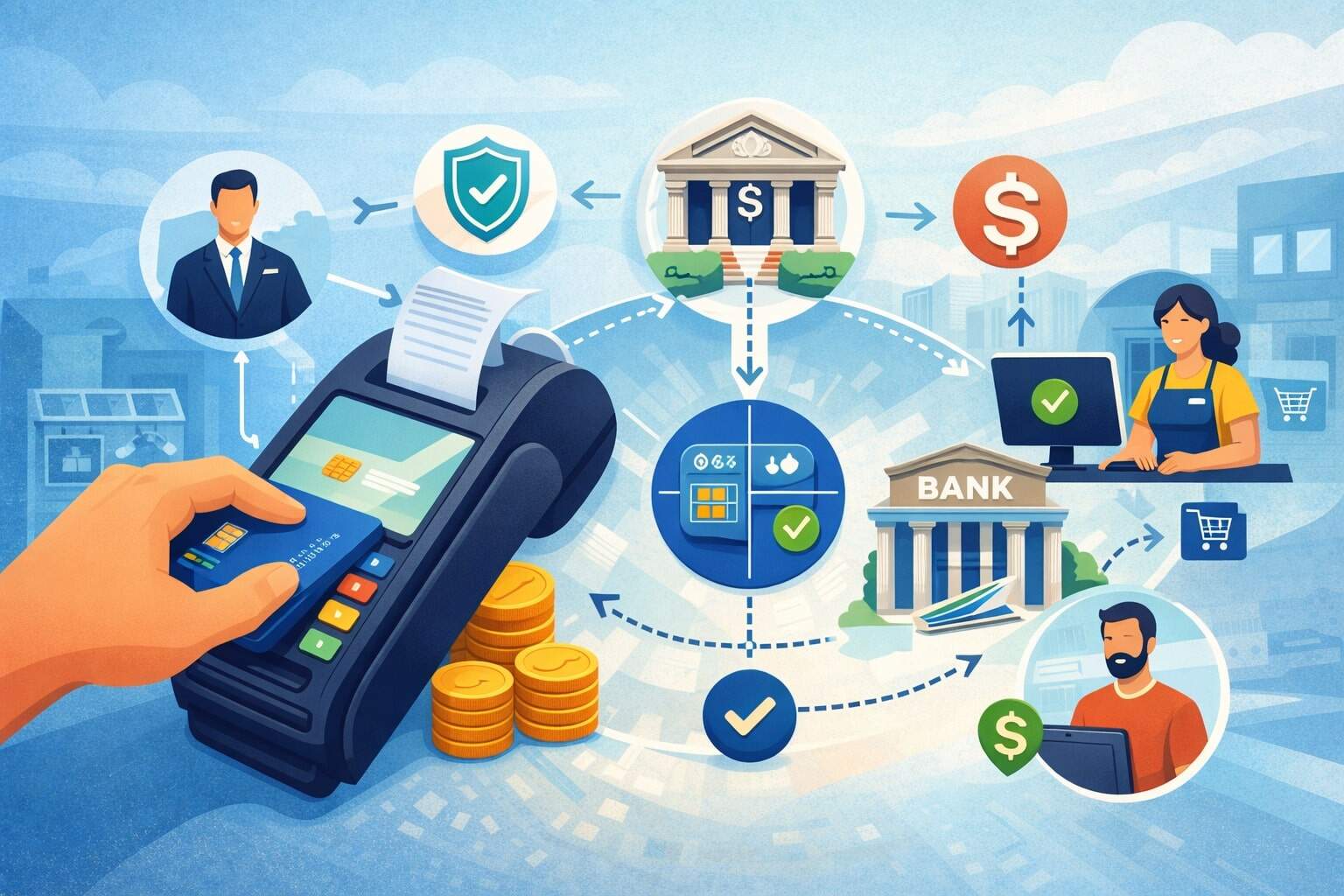
Credit card processing is the behind-the-scenes system that lets a customer tap, dip, swipe, or type a card number and receive an approval in seconds—while money actually moves days later. For a business, understanding credit card processing helps you control costs, reduce chargebacks, improve approval rates, and choose the right payment setup for in-person and online sales.
At a high level, credit card processing connects four main parties: the customer (cardholder), the business (merchant), the customer’s bank (issuer), and the business’s bank partner (acquirer).
Card networks route the message between banks, while payment gateways and processors handle the technical rails. The magic is in the sequence: data capture → secure transmission → authorization decision → clearing → settlement → funding.
Because credit card processing involves sensitive data, it’s tightly governed by security standards (like PCI DSS) and network rules, and it’s evolving fast. The newest generation of credit card processing emphasizes tokenization, stronger authentication, and smarter routing to reduce fraud while keeping checkout friction low.
Throughout this guide, the focus is practical: how credit card processing works step-by-step, what fees mean, how to improve approvals, how to stay compliant, and what’s coming next.
The Credit Card Processing Ecosystem
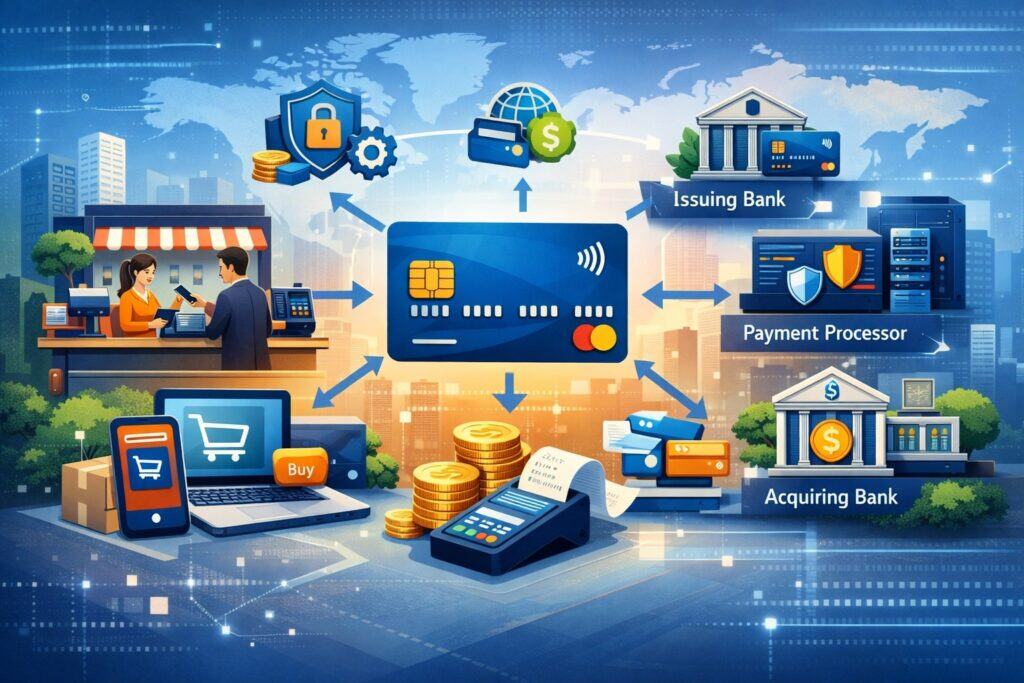
Credit card processing is not one company—it’s a coordinated ecosystem. Most merchants interact with a processor, but several specialized players make the transaction happen. When you understand who does what, you can spot where fees come from, why transactions fail, and what you can optimize.
- Merchant (your business): You accept payment through a terminal, POS, invoice link, or online checkout. Your systems create a transaction request that includes amount, payment method, and risk signals (like device data online).
- Payment gateway (often online): The gateway securely collects and transmits card data to the processor. Think of it as the “secure messenger” and checkout plumbing. Some providers bundle gateway + processing in one platform.
- Payment processor: The processor formats the transaction, applies fraud/risk logic, and sends it to the right network. Processors also manage batching, reporting, and many operational tasks that feel like “credit card processing” day-to-day.
- Acquirer (merchant’s bank partner): The acquiring bank sponsors you into the card network system. It’s the institution that ultimately receives settled funds on your behalf and deposits money into your merchant account.
- Card network: The network (the “rails”) routes authorization messages from acquirer to issuer and routes financial clearing files later. Networks also enforce operating rules that impact refunds, disputes, surcharging, and data security.
- Issuer (cardholder’s bank): The issuer approves or declines authorization requests based on funds/credit availability, fraud models, and account status. The issuer also posts the transaction to the cardholder’s statement.
Credit card processing works best when these roles are clearly defined in your contract stack. If something goes wrong—like high declines or rising chargebacks—you can diagnose whether it’s a gateway checkout issue, processor risk settings, acquirer policies, or issuer/network behavior.
Step-by-Step Flow of Credit Card Processing
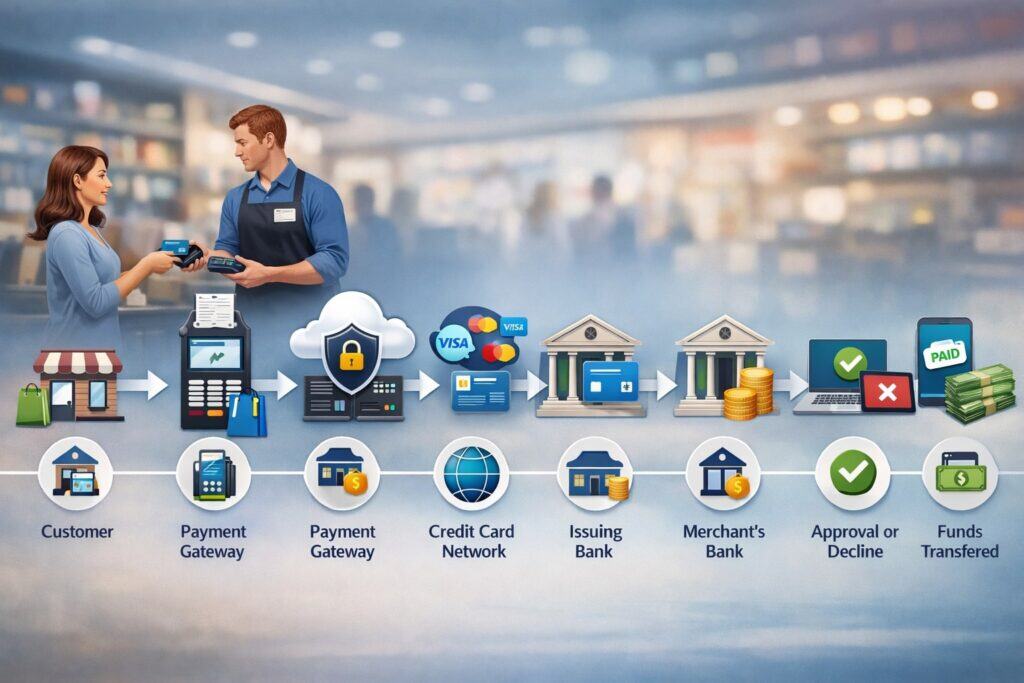
Credit card processing happens in two major phases: authorization (real-time decision) and clearing + settlement (money movement). Merchants often see an approval and assume they “got paid,” but funding is the final step after the transaction is cleared and settled.
Authorization: The Real-Time Approval
In credit card processing, authorization begins when the customer presents a card (tap/dip/swipe) or enters card details online. Your POS or checkout encrypts and sends the request to your processor (and usually through a gateway in ecommerce). The processor forwards the request through the network to the issuer.
The issuer checks multiple items in milliseconds: available credit, account status, fraud patterns, and sometimes extra authentication signals. The issuer returns an approval code or decline reason. That response travels back through the network to the processor and to your terminal/checkout, where the customer sees “Approved” or “Declined.”
A key detail: authorization usually places a hold (an authorization amount) on the customer’s account, but it does not move money to you yet. Also, an authorization can be reversed, can expire, or can be partially captured depending on your business model (especially in hospitality, fuel, rentals, and ecommerce pre-orders).
Good credit card processing setups improve authorization by sending clean data, using updated terminals for chip/tap, and avoiding mismatched fields online (like AVS issues). Tokenization and better risk signals increasingly help approval rates while lowering fraud.
Clearing and Settlement: How You Actually Get Paid
After authorization, credit card processing moves into clearing and settlement—usually at the end of your business day when you “batch out.” Your POS or gateway submits captured transactions to the processor. The processor sends clearing files through the network, and issuers validate and post those transactions to cardholders’ accounts.
Settlement is the bank-to-bank exchange: issuers send funds (minus interchange) through the network to acquirers, and acquirers deposit funds to merchants (minus processing fees).
The timing depends on your processor, risk profile, transaction type, and whether it’s a weekend or holiday. Many merchants see funding in 1–3 business days, but some models offer faster access.
Because clearing and settlement are file-based and rule-driven, mistakes show up here: missing capture, duplicate submissions, late presentment, mismatched amounts, or missing required data for certain card types. Optimizing this layer of credit card processing reduces downgrades, prevents avoidable chargebacks, and improves reconciliation accuracy.
The Technology Behind Credit Card Processing

Credit card processing is built on security controls and messaging standards that protect card data and ensure interoperability. For merchants, the goal is simple: accept payments easily while minimizing risk and compliance burden.
Card Data: PAN, EMV, and Tokens
Traditional credit card processing relies on the PAN (primary account number)—the card number. But storing or transmitting PAN increases risk and compliance scope. That’s why modern systems reduce exposure using encryption and tokenization.
EMV chip transactions generate dynamic cryptograms that make stolen chip data far less reusable than magnetic stripe data. Contactless (tap) uses similar cryptographic principles and is widely considered safer than swipe when implemented correctly.
Network tokenization replaces the PAN with a network-issued token that can be used for processing while protecting the underlying card number.
Tokens are especially important for card-on-file subscriptions, digital wallets, and ecommerce. Networks and major payment brands have been actively pushing broader tokenization to reduce fraud and improve approvals.
For merchants, tokenization can also reduce PCI scope when implemented through compliant providers, because fewer systems touch raw card numbers.
Gateways, APIs, and Payment Orchestration
In ecommerce credit card processing, the gateway is often the “front door” for card acceptance. Modern gateways offer APIs for card entry, digital wallets, subscriptions, and saved payment methods. They also support risk tools like device fingerprinting and behavioral signals.
A growing trend is payments orchestration—routing transactions across multiple processors for higher approvals, redundancy, and cost control. This can matter for high-volume ecommerce, marketplaces, and subscription businesses where a tiny improvement in authorization rates can significantly lift revenue.
Even if you never build custom checkout code, these technologies affect your results. For example, smart retries for soft declines, token-based updating for expired cards, and network tokens for card-on-file can reduce churn and increase approval rates without adding friction.
Credit Card Processing Fees Explained
Credit card processing fees can feel confusing because they combine several layers. The most important thing to understand is that not all processing fees are “processor profit.” Many parts of your cost come from the card ecosystem itself.
Interchange, Assessments, and Processor Markup
In most credit card processing transactions, fees include:
- Interchange: Paid to the issuer; often the largest component.
- Network assessments/fees: Paid to the network for routing and brand services.
- Processor markup: What your processor/acquirer charges for providing service, risk coverage, support, and the processing platform.
Your pricing model affects transparency. Interchange-plus pricing shows interchange + assessments + markup separately and is often preferred for clarity. Flat-rate pricing bundles costs into a single rate, which is simpler but can cost more for certain merchant profiles.
Because interchange is a major cost driver, changes in network rules, litigation outcomes, or legislative proposals can affect merchants.
Recently, there has been continued scrutiny and negotiation around interchange levels and merchant acceptance flexibility, and merchants should keep an eye on evolving rule and policy shifts that can influence credit card processing costs.
What Impacts Your Effective Rate
Your “effective rate” (total fees ÷ total card sales) depends on:
- Card type (rewards, premium, commercial)
- How the card is accepted (tap/chip vs swipe vs keyed)
- Industry risk (chargeback rates, fraud exposure)
- Data quality (AVS/CVV, Level 2/3 data for eligible B2B cards)
- Refund and dispute volume
- Settlement timing and batching behavior
To lower credit card processing costs, focus on what you can control: accept chip/tap, avoid manual key-entry when possible, use proper MCC classification, send the right data fields, and reduce chargebacks. Saving 10–30 basis points through better data and fewer downgrades is often more realistic than hunting “the cheapest rate.”
Security and Compliance in Credit Card Processing
Security is not optional in credit card processing. Even small merchants are targets because fraudsters look for the easiest path. A practical approach is to minimize your exposure to raw card data and rely on compliant tools.
PCI DSS 4.x: What Merchants Need to Know Now
PCI DSS is the baseline security standard for any organization that stores, processes, or transmits card data. The PCI Security Standards Council published PCI DSS v4.0 as a modernization effort and later released PCI DSS v4.0.1 as a limited revision to clarify requirements (without adding new ones).
Many organizations have been working through “future-dated” requirements that became effective in 2025, which puts pressure on merchants and service providers to update policies, logging, authentication practices, and risk monitoring.
If you want simpler compliance, structure your credit card processing so that card data never hits your servers. Using hosted payment pages, tokenization, and compliant POS systems reduces PCI burden dramatically. The best goal is less scope: fewer systems that touch card data means fewer controls to maintain and fewer opportunities for mistakes.
Fraud Prevention: AVS, CVV, 3DS, and Risk Signals
Fraud tooling differs for in-person vs online credit card processing:
- In-person: EMV chip and contactless reduce counterfeit fraud. Use updated terminals and keep them tamper-resistant.
- Online: Use AVS and CVV checks, velocity rules, device intelligence, and—where appropriate—3D Secure (3DS) for stronger authentication.
The key is balancing fraud prevention with approvals. Overly strict rules can block good customers; overly loose rules can spike chargebacks. The strongest setups use layered security: tokens for stored cards, real-time scoring, and step-up authentication only when risk is high.
Tokenization is becoming increasingly central because it reduces the value of stolen data and can make recurring payments more reliable.
Chargebacks and Disputes in Credit Card Processing
Chargebacks are a built-in consumer protection mechanism, but for merchants they are costly and time-consuming. In credit card processing, a chargeback begins when the cardholder disputes a transaction with the issuer. The issuer may issue a provisional credit and then requests evidence through the network back to the acquirer and merchant.
Common chargeback reasons include:
- Fraud (card-not-present disputes)
- “Item not received” or service not delivered
- “Not as described”
- Duplicate processing
- Subscription cancellation confusion
Winning disputes requires strong evidence: proof of delivery, customer communications, refund policy acceptance, signed receipts (when applicable), logs showing device/IP consistency, and clear descriptors that match what customers recognize on statements.
The best strategy is prevention. Improve your billing descriptor, send receipts promptly, use clear return/refund policies, respond fast to customer complaints, and use fraud tools that stop obvious bad transactions before they settle. Also monitor “early warning” alerts if your provider offers them, because you may be able to refund before a chargeback becomes official.
Chargebacks also influence your processing risk profile. High ratios can lead to reserves, delayed funding, higher fees, or even account termination—so managing disputes is not just about winning cases; it’s about keeping your credit card processing stable.
Surcharging, Convenience Fees, and Cash Discounting
Many merchants explore surcharging to offset credit card processing costs. But these programs are governed by a combination of network rules and local legal requirements, and they must be implemented carefully.
What Network Rules Typically Require
Network guidance generally distinguishes credit vs debit. Debit and prepaid are typically not eligible for surcharging under many rule frameworks, even if a debit card is run “as credit.”
For credit cards, networks commonly require:
- Clear disclosure at the entrance/point of interaction and at checkout
- The surcharge amount not exceeding a defined cap (often up to 4% in many rule sets)
- Consistency in application (e.g., applied to credit cards, not selectively by issuer)
- Proper registration/notification procedures with networks/acquirers in some cases
For example, Mastercard publishes merchant guidance including a maximum surcharge cap and disclosure expectations. Visa also provides merchant surcharging guidance, including how prices must be displayed so the customer sees the total card price clearly.
Choosing the Right Program Structure
Surcharging is not the only option. Some merchants use:
- Cash discount programs (posted cash price, card price reflects higher cost)
- Convenience fees (typically for alternative channels like online/phone, subject to rules)
- Service fees (industry-specific and regulated carefully)
The right structure depends on your industry, customer expectations, and operational reality. Done poorly, these programs increase customer complaints and disputes, which can actually raise your total cost of credit card processing. Done well—with transparent signage, accurate receipts, and compliant configuration—they can reduce margin pressure.
Optimizing Credit Card Processing for Higher Approvals
A high-performing credit card processing setup is not just “low rate.” It’s also: high approval rates, low fraud, minimal chargebacks, predictable funding, and clean reconciliation.
Practical Ways to Improve Authorization Rates
To improve approvals:
- Use chip/tap in person; avoid swipe unless truly necessary
- Keep your terminal software updated
- For ecommerce, reduce checkout friction and avoid fields that trigger mismatches
- Send complete transaction data (especially for address and postal code where applicable)
- Use network tokens for stored credentials when available
- Handle soft declines with smart retry logic (time-based, not rapid-fire)
Network tokenization, in particular, is being promoted as a way to reduce fraud and improve transaction success for card-on-file and ecommerce.
Reducing Downgrades and Hidden Cost Increases
“Downgrades” often happen when transactions miss required data elements or settle late. To reduce this:
- Close batches daily
- Use the right transaction type (e.g., authorization + capture vs sale)
- For eligible B2B payments, send Level 2/3 data (tax amount, invoice number, item details)
- Avoid excessive key-entry unless your model requires it (phone orders, invoices)
These operational improvements can lower your effective cost of credit card processing without changing providers—because you’re reducing unnecessary fee inflation and friction.
Future Trends in Credit Card Processing
Credit card processing is shifting toward more secure, more tokenized, and more programmable payments. Merchants who modernize early typically see better fraud outcomes and stronger approvals.
Tokenization Everywhere and “Invisible” Credentials
Network tokenization is expanding beyond mobile wallets into broader ecommerce and card-on-file usage. Industry commentary and reporting in 2025 highlight continued pressure from major networks to increase token adoption due to fraud reduction and performance benefits.
Future-facing credit card processing will increasingly treat the PAN as a fallback credential, not the default. That means merchants will rely more on token lifecycle tools (automatic updates, domain controls, device binding) and less on storing raw card numbers.
More Flexibility, More Scrutiny on Fees
Merchants continue pushing for fee relief and greater acceptance flexibility. There has also been ongoing news about settlements and policy proposals related to interchange and network rules—signals that the economics of credit card processing will remain a major topic for years.
Regardless of where policy lands, merchants should expect more transparency tools, more routing/choice discussions, and more fee optimization products from processors and platforms.
Alternative Settlement Rails and New Forms of Value
While card networks remain dominant, the broader payments landscape is experimenting with faster settlement, account-to-account methods, and even stablecoin-linked settlement initiatives.
Some major payment players have publicly explored stablecoin-related partnerships, suggesting future options where settlement methods diversify even if the card checkout experience remains familiar.
The likely near-term reality: cards stay the front-end experience, while back-end settlement options and risk tools become more varied.
FAQs
Q.1: How long does credit card processing take to fund a merchant?
Answer: Authorization happens in seconds, but funding depends on clearing and settlement. Most merchants see deposits within 1–3 business days, though timing varies by provider, risk profile, transaction type, and weekends/holidays.
If you want faster access, ask your provider about funding schedules, cut-off times, and whether instant or same-day options exist for your setup.
Q.2: What is the difference between a payment gateway and a payment processor?
Answer: In credit card processing, a gateway securely captures and transmits transaction data (especially online), while the processor routes transactions through networks, manages batching, and handles operational processing tasks.
Many modern providers bundle both, but they are different roles. If you change gateways or processors, integration details—tokens, recurring billing, fraud tools—can change too.
Q.3: Why do credit card processing rates vary so much?
Answer: Rates vary due to interchange (which differs by card type and acceptance method), network fees, processor markup, and your business risk profile. Keyed transactions and high-chargeback industries typically cost more. Transparent pricing models help you see what’s “ecosystem cost” vs what’s negotiable markup.
Q.4: Is it legal to surcharge credit card processing fees?
Answer: It depends on network rules and local laws. Networks publish guidance on disclosure and caps, and many implementations prohibit surcharging debit/prepaid while allowing credit surcharges with rules. Mastercard and Visa both publish merchant surcharging guidance that merchants should follow closely.
Q.5: What is tokenization in credit card processing, and why does it matter?
Answer: Tokenization replaces the sensitive card number with a token, reducing the value of stolen data and often lowering compliance scope. Network tokenization specifically uses network-issued tokens and is being pushed broadly to reduce fraud and improve payment performance.
Conclusion
Credit card processing is a fast, layered system: authorization approves the purchase in real time, then clearing and settlement moves funds behind the scenes. Once you understand the ecosystem—merchant, gateway, processor, acquirer, network, issuer—you can make smarter decisions about pricing, security, and performance.
The best credit card processing strategy isn’t just chasing the lowest advertised rate. It’s building a stable acceptance stack that improves approvals, reduces fraud, prevents chargebacks, and keeps compliance manageable.
That means modern terminals for chip/tap, strong ecommerce risk tools, disciplined batching, clean transaction data, and the right approach to fees and surcharging rules.
Looking ahead, credit card processing is becoming more tokenized and security-driven, with networks and major payment brands pushing broader token adoption and more sophisticated fraud prevention.
If you update your systems now—especially around tokenization and compliance—you’ll be better positioned for the next wave of payment changes while protecting margins and customer experience.