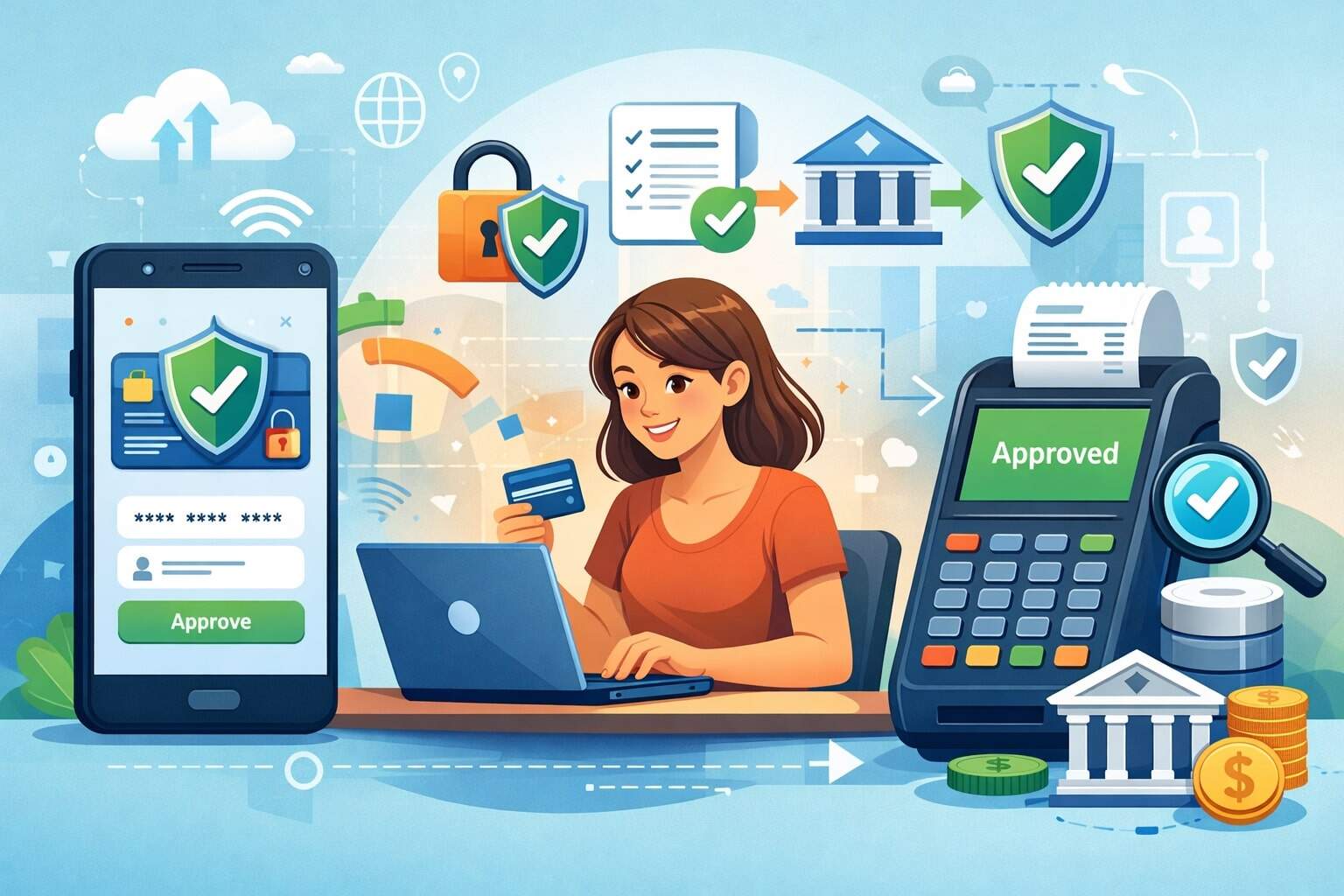
Payment authorization is the behind-the-scenes decision process that determines whether a transaction can go through right now—before money is fully moved and before a sale is considered final.
In plain terms, payment authorization is the moment a customer taps, dips, swipes, or submits payment online and the payment system asks, “Is this valid, and should we approve it?” That “yes” or “no” arrives in seconds, but it relies on multiple systems talking to each other, several fraud checks, and strict rules about data, risk, and timing.
For merchants, payment authorization is where most customer experience wins or losses happen. A smooth paymen01+2-t authorization flow means fewer false declines, fewer abandoned carts, and fewer chargebacks later.
A messy payment authorization flow can create duplicate holds, confusing “pending” charges, or unnecessary declines—even when the customer has funds available.
For customers, payment authorization is often invisible until something goes wrong: an unexpected decline, a hotel deposit hold, a gas station “pre-auth,” or a subscription renewal that fails.
Understanding payment card authorization helps explain why a “pending” transaction can show up, why a final amount sometimes changes, and why a payment might be approved but still later reversed or refunded.
Because payment authorization sits at the intersection of money movement, fraud prevention, and compliance, it’s constantly evolving. New security signals, tokenization, wallet payments, real-time risk scoring, and network-level decisioning are reshaping how payment authorization works.
In the sections below, you’ll learn payment card authorization end-to-end—from participants and message flows to declines, holds, best practices, and what’s next—using clear, practical explanations you can apply immediately.
What Payment Authorization Means in Modern Payments
Payment authorization is the real-time approval step that occurs before a payment is captured (finalized) and before settlement (the actual transfer of funds between financial institutions). When a transaction is authorized, the customer’s issuing bank (or the issuer) agrees that the payment details look valid and that funds or credit are available, and it returns an approval code.
That approval does not always mean the merchant has been paid yet. It means the transaction has passed the initial checks and the issuer is willing to reserve funds or credit for that purchase amount.
Payment authorization also acts like a risk checkpoint. During the authorization decision, the issuer, card network, processor, and merchant systems can evaluate signals such as location, device data, purchase patterns, velocity, address checks, card verification results, and previous fraud history.
This is why payment authorization is central to fraud prevention. It’s not simply a balance check—it’s a decision built from risk, rules, and available funds.
It’s also important to distinguish payment authorization from related terms that often get mixed up. Authorization is the permission step.
Capture is the merchant’s request to finalize the authorized amount. Settlement is the back-end process that moves money through the acquiring and issuing institutions. Refunds and reversals are separate flows that happen after authorization, usually tied to capture status and timing.
In practice, the authorization step can vary by payment method. Card payment authorization is the most widely recognized model. But bank-based payments can also require authorization-like consent and validation steps—especially for recurring debits, account verification, and risk screening.
As payments keep modernizing, payment authorization is becoming more data-rich and more dynamic, with smarter decisioning and fewer “one-size-fits-all” rules.
Key Players in the Payment Authorization Process
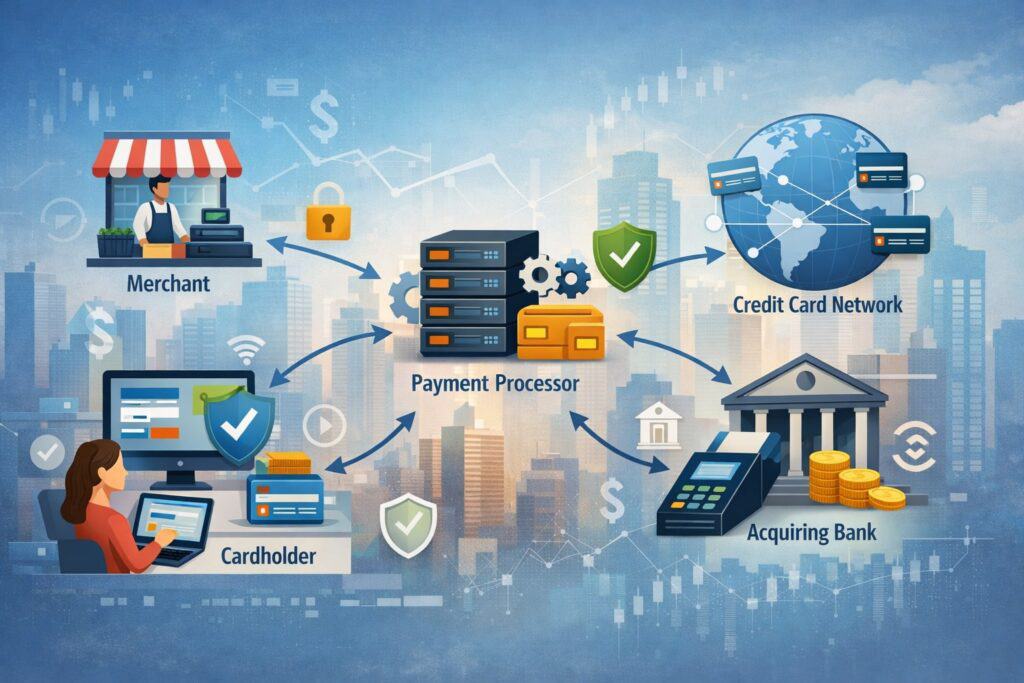
Payment authorization works because several participants coordinate in a precise sequence. Each participant has a different responsibility, and understanding them makes payment authorization far easier to troubleshoot and optimize.
- The customer (cardholder or payer) initiates payment card authorization by presenting credentials—card details, a digital wallet token, or bank account information—along with a purchase amount and merchant context. The customer’s action triggers the payment authorization request, but the customer isn’t the party that approves it.
- The merchant is the business accepting payment. The merchant’s checkout system packages the transaction details and sends them through a payment gateway or processor. Merchants influence payment authorization success through clean checkout design, accurate transaction data, smart fraud settings, and consistent billing descriptors.
- The payment gateway is often the front door for online payment card authorization. It securely transmits transaction data and may add fraud tools, tokenization, and routing logic. Some setups combine gateway and processing into a single platform, but the role remains: safely and reliably move the payment authorization request forward.
- The payment processor connects merchants to the acquiring side of the ecosystem. It formats the payment authorization message properly, applies business logic, and routes requests to the right network and acquiring institution. Processors also handle many technical details like retries, message standards, and response mapping.
- The acquirer (acquiring bank) is the financial institution that supports the merchant’s ability to accept card payments. The acquirer sponsors the merchant into the card networks and ultimately receives the settled funds before depositing them to the merchant account.
- The card network (such as major network brands) is the routing layer that carries payment authorization messages between acquirers and issuers. It enforces standards, supports security programs, and provides rails for authorization, clearing, and settlement.
- The issuer (issuing bank) is the customer’s bank or card issuer that makes the final payment card authorization decision. The issuer checks available funds or credit, validates the credentials, evaluates risk, and returns an approval or decline. The issuer’s decision is the defining moment of payment authorization.
Every successful payment authorization is a coordinated handshake among these parties. When payment authorization fails, the reason usually lives in issuer decisioning, missing data, risk flags, incorrect formatting, or mismatched expectations about the transaction type.
Step-by-Step: How Payment Authorization Works (From Checkout to Approval Code)
A typical payment authorization happens in seconds, but it follows a structured path with multiple checkpoints. Seeing the sequence clearly helps you understand why payment authorization outcomes can vary, even for similar purchases.
- Step 1: Transaction initiation: The customer submits payment at a terminal, mobile app, or website. The merchant collects the amount, currency, transaction type (purchase, pre-authorization, incremental, recurring), and payment credential (card number, token, or wallet data).
At this stage, accuracy matters. Incorrect amounts, mismatched transaction types, or incomplete customer information can reduce payment authorization approval rates. - Step 2: Encryption, tokenization, and secure packaging: Modern systems protect sensitive data using encryption and tokenization. Digital wallets often provide a device-specific token instead of the raw card number.
This can improve payment authorization approval rates because tokenized credentials tend to have lower fraud risk and better data integrity. - Step 3: Routing through gateway/processor to the acquirer: The merchant’s system sends the payment authorization request to the gateway or processor, which then forwards it to the acquiring institution.
The message includes merchant category, entry mode (chip, contactless, e-commerce), and security results (like CVV and address checks) when applicable. - Step 4: Network transmission: The acquirer routes the payment authorization request to the appropriate card network, which forwards it to the issuer. Networks apply rules and may provide network-level risk tools, but the issuer is still the final decision-maker.
- Step 5: Issuer validation and risk decisioning: The issuer checks multiple factors: credential validity, account status, available balance or credit limit, velocity patterns, fraud models, and sometimes customer preferences (such as travel notices or merchant blocks). This is where payment authorization can be approved, declined, or flagged for additional verification.
- Step 6: Response returned to the merchant: The issuer returns an approval code or a decline reason code. That response travels back through the network, acquirer, processor, and gateway to the merchant’s checkout. The merchant displays the result to the customer in real time.
- Step 7: Funds hold or credit reservation: When payment authorization is approved, the issuer typically places a temporary hold (or reduces available credit) for the authorized amount. The customer may see this as “pending.” The merchant still needs to capture the funds later to complete the sale.
This sequence is the backbone of payment authorization. Even small improvements—better data quality, correct transaction types, wallet support, and smart retry logic—can meaningfully increase payment authorization success while reducing fraud.
Authorization vs Capture vs Settlement: What Actually Happens to the Money
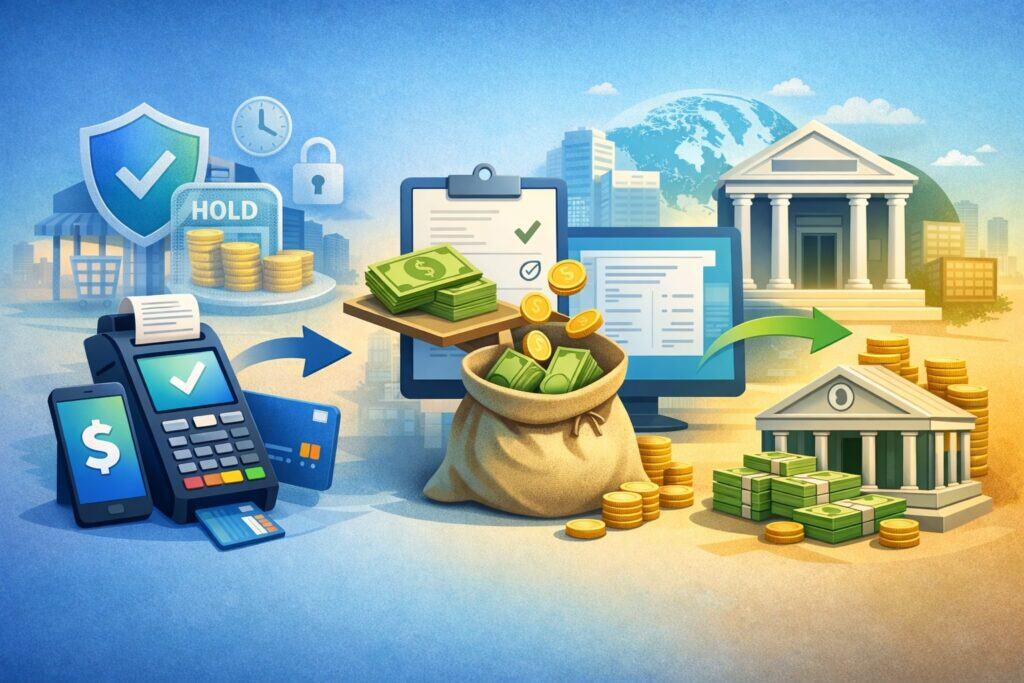
A common misunderstanding is assuming authorization equals getting paid. Payment authorization is only the approval step. The full payment lifecycle includes authorization, capture, clearing, and settlement, and each stage has different rules and timelines.
- Payment authorization is the issuer’s approval and the reservation of funds or credit. At this point, the transaction is “approved,” and the merchant can proceed to fulfill the order. But the merchant has not yet received money. The customer may see a pending charge because the issuer has earmarked funds.
- Capture is the merchant’s request to finalize the transaction. In many retail environments, capture occurs immediately after payment authorization, often automatically. In other cases—like shipping physical goods, adjusting tips, or finalizing hotel stays—capture happens later and can differ from the authorized amount. Capture is where the merchant confirms, “Yes, charge this amount now.”
- Clearing is the stage where transaction details are exchanged in batch files between acquirers and issuers via the network. Clearing validates and reconciles what was authorized and captured. This is where line-item detail is less relevant, but transaction consistency is critical.
- Settlement is the actual transfer of funds through the payment rails, resulting in deposits to the merchant account. Settlement timing depends on processor configuration, risk profile, and banking schedules. Some merchants see next-day deposits; others may see longer windows depending on underwriting, chargeback risk, or transaction type.
Understanding these stages helps merchants reduce confusion, set better customer expectations, and manage fulfillment rules. It also helps diagnose issues like duplicate holds (multiple authorizations) or mismatched captured amounts that can trigger disputes later.
Holds, Pending Charges, and Pre-Authorization: Why the Amount Sometimes Changes
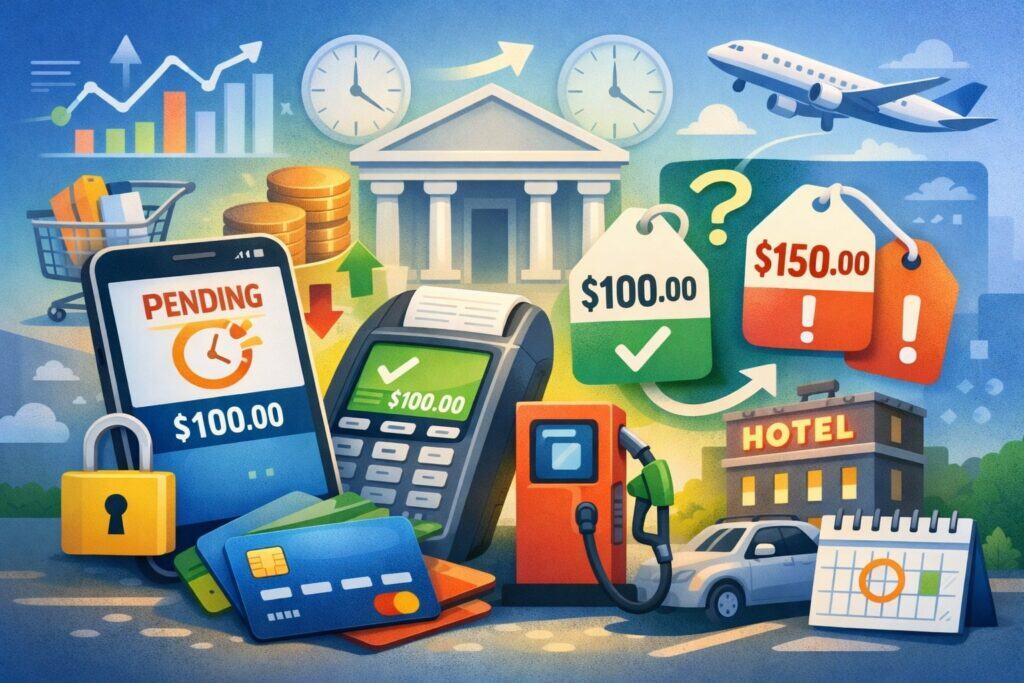
Payment authorization often includes a temporary hold, and this is one of the most visible parts of payment authorization for customers. A hold is the issuer reserving funds or credit for the authorized amount so the customer can’t spend it elsewhere while the merchant prepares to capture.
Certain industries rely heavily on pre-authorization (also called “pre-auth”). Examples include hotels, car rentals, fuel dispensers, and some delivery services. In these cases, the merchant may not know the final amount at the time of payment authorization.
A hotel might authorize an estimated stay total plus incidentals. A gas station might authorize a larger amount before fueling and then capture the final amount after the pump stops. Restaurants may authorize the bill and later capture the total including tip.
This is why customers sometimes see a payment authorization amount that looks higher than expected. The hold is not always the final charge. The final amount is determined at capture. If the final capture is lower than the authorized amount, the unused portion of the hold is typically released by the issuer, but the release timing depends on issuer policies and banking behavior.
Holds can also be affected by incremental authorizations, where a merchant increases the authorized amount later (common in hospitality). Payment authorization rules govern how and when incremental requests are allowed, and correct coding matters to avoid unnecessary declines.
For merchants, clean pre-auth practices reduce disputes. Use accurate descriptors, communicate deposit policies, and capture promptly once the final amount is known.
For customers, it helps to recognize that payment authorization holds are normal and usually temporary—but if holds stack up due to repeated attempts, it can temporarily reduce available funds.
Why Payment Authorizations Get Declined (And What Decline Codes Really Mean)
Declines are a normal part of payments, but they’re also one of the biggest revenue leaks. Payment authorization declines can happen for many reasons, and the exact reason often isn’t fully visible to merchants because issuers limit detail to reduce fraud exploitation.
Common categories include:
- Funds or limit issues: The customer may not have enough available balance, may have hit a credit limit, or may have restrictions on cash-like transactions. Even if the account has money overall, an issuer may decline if available funds are constrained by other holds from prior payment authorization events.
- Security and fraud triggers: Issuers run fraud models during payment authorization. A transaction can be declined because it looks unusual: new merchant, unusual amount, mismatched device signals, high-velocity attempts, or a risky location pattern. Ironically, legitimate customers can be declined due to over-sensitive models—these are “false declines.”
- Data mismatch or missing verification: In card-not-present scenarios, mismatched billing address, incorrect CVV, or failed 3DS authentication can cause payment authorization to fail. Some merchants unintentionally reduce approval rates by sending incomplete address data or mislabeling fields.
- Card status problems: Expired cards, replaced cards, closed accounts, or reported stolen credentials can trigger declines. Tokenized wallets can help here because token lifecycle management is often cleaner than raw card data storage.
- Merchant configuration and risk controls: Sometimes the decline is caused earlier in the chain: gateway filters, processor rules, velocity limits, blocked BIN ranges, or overly aggressive fraud settings. In these cases, the issuer might never see the payment authorization request.
- Technical or formatting issues: Incorrect transaction type, invalid MCC (merchant category code), duplicate transaction identifiers, or network timeouts can lead to payment authorization failures that appear as generic declines.
Decline codes (or response codes) are clues, not always full explanations. Merchants should group declines by category, measure patterns by issuer and payment method, and use smart retry logic for “soft declines” while avoiding repetitive attempts that create multiple holds.
The goal is not just fewer declines—it’s better payment authorization outcomes without increasing fraud and chargebacks.
Security Checks During Payment Authorization: AVS, CVV, EMV, Tokens, and 3DS
Payment authorization is where many security checks are evaluated. The exact checks depend on how the payment is initiated—chip in-store, contactless, online, or wallet-based—but the goal is the same: confirm the transaction is legitimate without adding too much friction.
- AVS (Address Verification Service) compares the billing address data provided at checkout with issuer records. AVS is commonly used for e-commerce payment authorization. A mismatch doesn’t always cause a decline, but it can increase risk scoring or trigger merchant-side rules.
- CVV/CVC checks confirm the customer has the physical card (or at least the printed security code). Like AVS, CVV results feed into payment authorization risk decisions. Merchants need to handle CVV properly and store it correctly—CVV storage is heavily restricted by PCI rules.
- EMV chip transactions provide strong security through cryptograms and dynamic data. EMV-based payment authorization is generally more trusted than magnetic stripe because it reduces counterfeit fraud. Contactless payments often rely on EMV principles as well.
- Tokenization replaces sensitive credentials with tokens. Wallets and network tokenization can improve payment authorization approval rates because tokens are harder to steal and often come with richer verification data. Tokenized payment authorization also reduces the merchant’s exposure to raw card data.
- 3DS (3-D Secure) is an authentication step primarily for e-commerce. Depending on configuration, 3DS can be frictionless (background risk-based) or step-up (challenge). When used well, 3DS can improve payment authorization outcomes for risky transactions and shift certain fraud liability—though it can also reduce conversion if implemented poorly.
These tools work best when merchants tune them based on risk and customer behavior. Over-filtering can cause false declines; under-filtering increases chargebacks.
The best payment authorization strategy uses layered security, modern tokens, and adaptive authentication so good customers pass quickly and risky traffic gets the extra scrutiny it deserves.
Payment Authorization for Different Payment Types: Cards, ACH, Wallets, and Recurring Billing
While card payment authorization is the classic model, “authorization” concepts exist across multiple payment types. The details change, but the principle remains: validate permission, confirm capability to pay, and decide whether to proceed.
- Card payments use issuer-based payment authorization in real time. This includes in-store, online, and in-app card transactions. Digital wallets usually ride card rails but use tokens and device verification signals that can improve payment authorization reliability.
- ACH and bank debits work differently. Many bank payments are not “authorized” in the same second-by-second issuer-approval way as cards. Instead, authorization is about customer consent (such as signed authorization for recurring debits), account validation, and risk screening.
Merchants often use account verification tools, micro-deposits, instant account verification, or risk models to decide whether to accept an ACH payment. The “authorization” here is more about compliance and permission than an immediate hold of funds. - Real-time bank transfer methods can have an authorization-like step where the payer approves the transfer through their banking interface. In these flows, the payer is explicitly authorizing the transaction through secure bank channels, and confirmation can be near-instant.
- Recurring billing adds more complexity. Merchants must store credentials safely (often using tokens), follow network rules for recurring indicators, and handle account updater services when cards are replaced.
Payment authorization for recurring payments can fail due to expired credentials, issuer restrictions, or changed customer preferences. Clear billing descriptors and reminder communications can reduce declines and disputes.
Across all types, the merchant’s goal is consistent: ensure each payment authorization attempt is correctly labeled, properly secured, and aligned with customer expectations. When merchants treat payment authorization as a data and trust problem—not just a technical step—approval rates improve without sacrificing risk control.
Best Practices to Improve Payment Authorization Approval Rates Without Increasing Fraud
Improving payment authorization is not about “pushing more transactions through at any cost.” It’s about sending better data, using modern security tools, and aligning risk decisions with real customer behavior. Here are practical best practices that consistently improve payment authorization performance.
- Send complete, accurate transaction data: Small data quality improvements can lift payment authorization results. Use correct transaction indicators (e-commerce, recurring, installment, MIT/CIT where applicable), pass AVS fields when relevant, and ensure merchant descriptors are recognizable to customers. Clean data reduces issuer uncertainty.
- Use tokenization and wallet support: Tokenized credentials are often more trusted in payment authorization, especially for mobile wallet and network tokenization flows. They also reduce card lifecycle issues that cause recurring payment authorization failures.
- Calibrate fraud tools to reduce false declines: Aggressive fraud rules can block good customers before payment authorization even reaches the issuer. Use risk scoring, allow lists for trusted customers, and step-up verification for borderline cases rather than hard-blocking everything.
- Implement smart retries for soft declines: Not all declines are equal. Some are temporary (network timeouts, issuer unavailable, “try again” scenarios). Use controlled retry logic with spacing and alternate routing when appropriate. Avoid repeated rapid retries that create multiple holds and customer frustration.
- Optimize checkout and authentication: Friction kills conversion. Use modern authentication methods selectively and make sure 3DS or step-up verification is applied when it helps approval rates, not blindly across all traffic.
- Monitor issuer and network performance by segment: Break down payment authorization performance by card type, issuer ranges, geography, device type, and customer cohorts. Patterns reveal where data improvements or routing changes can help.
- Reduce descriptor confusion and disputes: Confusing descriptors lead to “I don’t recognize this” disputes. A cleaner descriptor strategy reduces chargebacks, which indirectly protects payment authorization approval rates over time because excessive disputes can increase risk scoring.
The strongest merchants treat payment authorization as an optimization loop: measure, adjust, test, and repeat—always balancing conversion and fraud.
Compliance and Consumer Protection Considerations That Affect Payment Authorization
Payment authorization isn’t only technical—it’s regulated and rule-driven. Merchants must follow network rules, data security standards, and consumer protection requirements, especially for recurring billing and bank debits.
For card payments, PCI DSS is central. PCI rules shape how payment authorization data is collected, transmitted, and stored. Merchants should never store restricted data elements and should rely on tokenization and trusted providers. Strong PCI posture reduces breach risk and protects long-term payment authorization stability.
For bank debits and recurring payments, authorization also means documented customer consent. In the United States, ACH debits are governed by NACHA operating rules and consumer protections, and merchants must retain proof of authorization for certain transaction types.
That authorization can be written, electronic, or recorded, depending on the context. Failure to follow authorization rules can lead to returns, fines, and reputational harm.
Recurring billing and subscriptions add additional requirements: clear disclosure, easy cancellation, accurate billing timing, and consistent descriptors. When customers feel surprised, they dispute. Disputes damage metrics and can raise scrutiny, which can later reduce payment authorization approval rates.
Data privacy and security expectations also influence payment authorization. Even when a specific rule doesn’t mandate a practice, customers and banks expect minimal data exposure and strong authentication.
Merchants who invest in secure payment authorization design—tokenization, encryption, least-privilege access, audit logging—reduce operational risk and improve customer trust.
In short: compliance is not separate from payment authorization performance. It’s part of the same system. Merchants who treat authorization as “permission + security + clarity” usually see better approval rates and fewer downstream issues.
Payment Authorization Troubleshooting Guide for Merchants
When payment authorization problems appear—declines spike, duplicate holds increase, customers complain about pending charges—having a structured troubleshooting approach saves time and revenue. Payment authorization issues can originate at several layers, so merchants should troubleshoot in a consistent order.
- Start with symptoms and segmentation: Identify whether payment authorization failures are isolated (one issuer, one card type, one checkout path) or systemic (all traffic). Segment by payment method, device, customer type (new vs returning), and transaction type (recurring vs one-time). Patterns quickly narrow the root cause.
- Check for merchant-side blocks: Before assuming issuers are declining, confirm whether gateway or fraud filters are blocking requests. Review velocity rules, IP rules, BIN blocks, and manual review thresholds. A configuration change can silently reduce payment authorization throughput.
- Validate data mapping and formatting: Common payment authorization killers include incorrect expiry format, missing AVS fields, misrouted transaction types, or wrong recurring flags. Ensure your processor logs show correct message fields and that descriptors match what you intend.
- Review issuer response categories: Group declines into soft vs hard patterns. Soft issues may be retryable; hard issues usually need customer action. Even if decline codes are limited, clustering outcomes can guide your next step.
- Monitor network and processor latency: Timeouts can look like declines. Track authorization response times and error rates. A network incident or routing problem can create a sudden authorization drop.
- Reduce duplicate authorizations: Duplicate holds often occur when customers double-click pay, mobile sessions retry, or timeouts trigger reattempts. Use idempotency keys, proper timeout handling, and clear UI feedback to prevent repeated payment authorization attempts.
- Escalate with evidence: When engaging your processor or gateway, provide timestamped examples, masked transaction IDs, response codes, and patterns. Payment authorization troubleshooting works best with concrete data.
A disciplined approach turns payment authorization from a mystery into a manageable engineering and operations process.
The Future of Payment Authorization: Smarter Decisioning, Fewer False Declines, and More Real-Time Signals
Payment authorization is moving toward more intelligent, data-rich decisions that reduce fraud while improving approval rates. Several trends are shaping what payment authorization will look like over the next few years.
- Network and issuer risk engines will get more context: Payment authorization decisions increasingly use device signals, behavioral patterns, token assurance data, and merchant reputation metrics. As more payments become tokenized, issuers can trust the credential more and focus on contextual risk rather than static identifiers.
- Tokenization will become the default: Digital wallets, network tokens, and lifecycle management are pushing the ecosystem away from raw card numbers. This improves payment authorization reliability for recurring billing and reduces fraud exposure. Merchants that modernize credential storage will benefit from higher authorization success and fewer account update failures.
- Adaptive authentication will reduce friction: Rather than forcing challenges for every transaction, payment authorization flows will continue shifting toward risk-based step-up only when necessary. The best customer experience is when payment authorization is seamless for legitimate customers and tougher for suspicious scenarios.
- Real-time bank payments will influence expectations: As faster bank payment methods expand, customers will expect immediate confirmation and fewer “pending” mysteries. Card payment authorization may evolve to provide clearer, more transparent status updates and faster release of unused holds.
- AI-driven routing and retries will mature: Merchants and processors will increasingly use intelligent routing across multiple acquiring paths (where available) and smarter retry orchestration that respects issuer signals. This can improve payment authorization outcomes while reducing unnecessary attempts.
The biggest “future prediction” that matters: payment authorization will become less about a single yes/no decision and more about an ongoing trust score built across identity, device, token assurance, and merchant behavior.
Merchants who invest now in clean data, tokenization, and customer-friendly billing practices will be positioned to win as payment authorization becomes even more competitive and more automated.
FAQs
Q.1: What does “payment authorized” mean if the money hasn’t left the account yet?
Answer: When a transaction shows as “payment authorized,” it means the issuer approved the payment authorization request and typically placed a hold or reserved credit for that amount.
The merchant has permission to proceed, but the merchant may not have completed capture yet. Until capture occurs, the transaction may remain pending. This is normal for many businesses, especially when final amounts can change, such as tips, fuel, or deposits.
Payment authorization is like a temporary reservation. The issuer is saying, “We recognize this request, and we’re setting aside funds so the customer can’t spend them elsewhere.”
The actual movement of money usually happens later during clearing and settlement. That’s why a customer might see a pending charge even if the merchant hasn’t shipped the product yet.
If the merchant never captures the payment, the payment card authorization hold usually expires after a set window and disappears from the customer’s pending transactions. Timing varies by issuer and transaction type.
If customers are concerned, merchants can explain that payment authorization is the approval step and that the final charge occurs at capture, which often happens when the order ships or the service is completed.
Q.2: How long does a payment authorization last?
Answer: A payment authorization hold duration depends on the issuer, transaction type, and industry rules. Some holds fall off quickly, while others can persist for several days. Pre-authorization scenarios—hotels, car rentals, and fuel—often have holds that last longer because final amounts are not known immediately.
From a merchant perspective, the best practice is to capture as soon as the final amount is confirmed. Long delays between payment card authorization and capture can lead to expired authorizations, forcing re-authorization, which can frustrate customers and create multiple holds.
For customers, this can temporarily reduce available funds, even though the final bill may be smaller. If a hold seems “stuck,” it may require issuer action to release sooner, but many issuers release holds automatically based on internal schedules.
Merchants can reduce confusion by disclosing deposit and pre-auth behavior at checkout and in receipts. Clear communication around payment authorization holds is one of the simplest ways to reduce disputes and customer support volume.
Q.3: Can a payment be authorized and still fail later?
Answer: Yes. Payment authorization is a real-time approval, but it doesn’t guarantee the final outcome if later steps fail. A transaction can be authorized and still fail if capture is not completed correctly, if the authorization expires, if the captured amount violates rules, or if technical issues occur during clearing.
In some cases, the merchant may void or reverse the authorization intentionally, or the customer may cancel before capture.
Another scenario is when the merchant submits a capture that differs materially from the authorized amount without proper indicators (such as incremental authorization). That mismatch can cause downstream problems, including disputes.
Also, if merchants attempt multiple payment authorization requests due to timeouts or customer re-clicks, it can look like duplicates and confuse customers.
Merchants can reduce “authorized but failed” situations by implementing idempotent checkout logic, capturing promptly, using correct transaction types, and monitoring authorization expiration windows.
When customers ask why they saw an authorization but no final charge, the explanation is usually that payment authorization is the approval and hold step, not the final settlement step.
Q.4: What’s the difference between an authorization reversal and a refund?
Answer: An authorization reversal cancels an approved payment authorization before capture. It’s essentially telling the issuer, “We won’t be completing this charge—release the hold.”
Reversals are commonly used when an order is canceled quickly, when a duplicate authorization occurred, or when a merchant wants to clean up a hold as fast as possible. Even with a reversal, the customer might still see a pending transaction briefly, depending on issuer processing speed.
A refund happens after capture. Once the merchant has been captured and the transaction has moved into clearing/settlement, a refund sends money back to the customer through a separate flow. Refunds can take longer because they follow settlement rules and banking timelines.
From a customer experience perspective, reversals are usually faster and cleaner when the transaction hasn’t been captured. Refunds are necessary when capture has already happened. Merchants should choose the right action based on the transaction stage to minimize confusion and reduce support requests related to payment authorization holds.
Q.5: How can merchants reduce payment authorization declines without relaxing fraud controls too much?
Answer: Reducing payment authorization declines while maintaining security is about precision. Start by improving the quality of data sent in payment authorization requests: correct transaction indicators, accurate billing details, and clear descriptors. Next, adopt tokenization and wallet support to reduce credential risk and improve approval trust signals.
Then, tune fraud tools to reduce false declines. Instead of blocking broad categories, use risk scoring and step-up verification for borderline cases. For example, require additional verification only when signals look risky. Use smart retries only for soft declines, and avoid repeated rapid attempts that create multiple holds.
Finally, monitor payment authorization performance in segments: new vs returning customers, device type, issuer patterns, and checkout flow. This helps you identify whether issues are caused by customer behavior, issuer models, or merchant-side settings.
The best merchants treat payment authorization optimization as an ongoing discipline—testing changes, watching impact, and balancing conversion with fraud outcomes.
Conclusion
Payment authorization is the critical “go/no-go” decision that happens in seconds but affects everything that comes after—customer trust, conversion rate, fraud exposure, chargeback risk, and cash flow.
A successful payment authorization means the issuer approved the request and typically reserved funds or credit. But it’s only one step in the full lifecycle, which includes capture and settlement.
That’s why customers may see pending charges, why holds exist, and why pre-authorization industries sometimes show higher temporary amounts.
For merchants, the biggest takeaway is that payment authorization performance is not purely an issuer problem. Merchants influence outcomes through clean data, correct transaction flags, tokenization, balanced fraud settings, and thoughtful retry logic.
Clear customer communication about holds and descriptors reduces disputes, which protects long-term payment authorization approval rates.
Looking forward, payment authorization will become even more intelligent and more signal-driven. Tokenization, real-time risk scoring, adaptive authentication, and smarter routing will reduce false declines and improve trust—especially for merchants who modernize their payment stack.
If your goal is higher approvals and fewer disputes, focus on three priorities: better data, better security signals, and better customer clarity. When those align, payment authorization becomes a competitive advantage—not just a technical requirement.