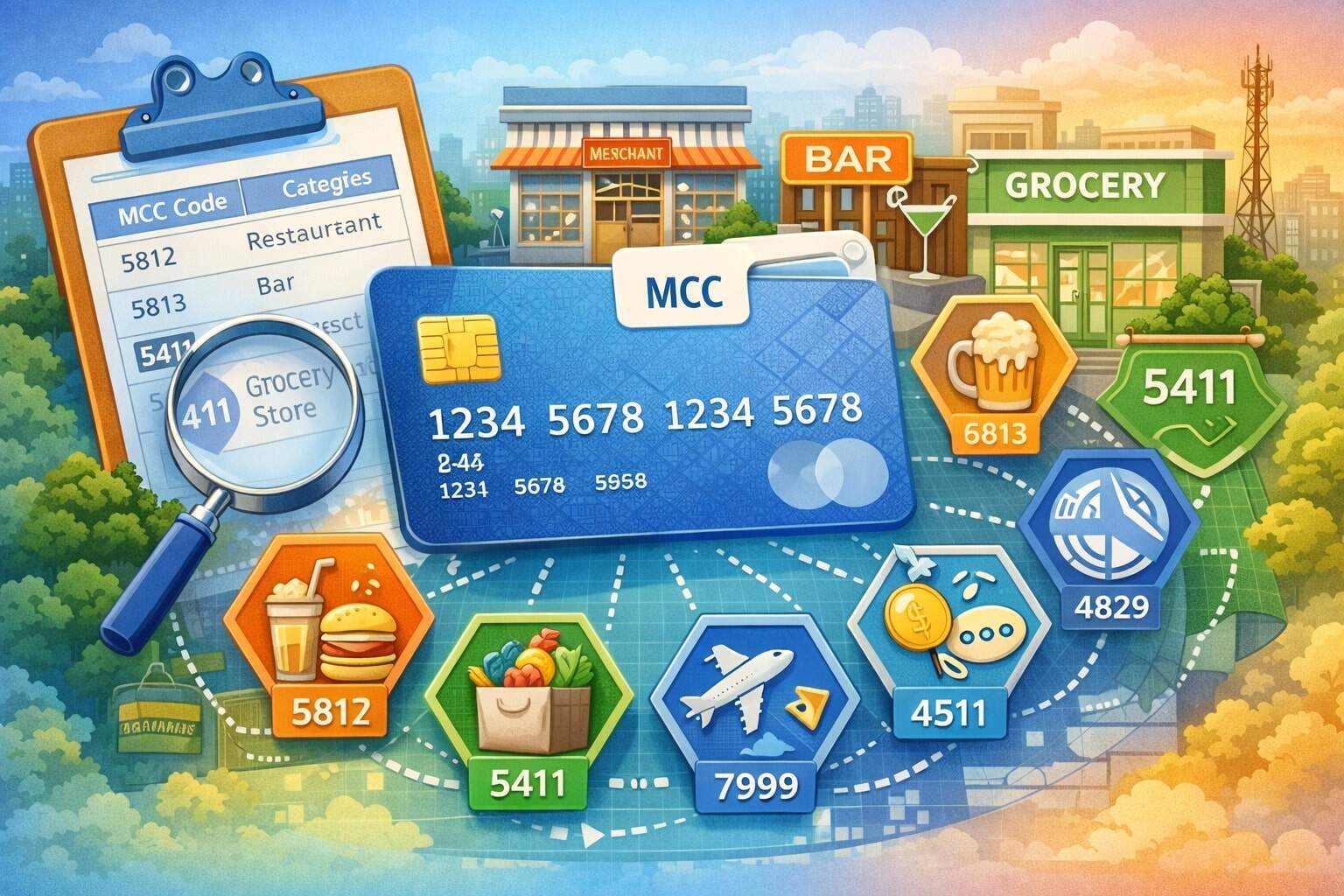
Merchant Category Codes (MCC) sit quietly behind almost every card transaction, yet they influence pricing, risk decisions, rewards, reporting, and even whether a payment is approved. Merchant Category Codes are four-digit identifiers used by card networks and payment partners to classify what a business primarily sells.
A café, a dentist, a subscription app, a contractor, and a nonprofit can all accept cards—but their MCC Codes help the ecosystem interpret the “type” of merchant on the other side of the purchase.
Because Merchant Category Codes are embedded in transaction data, they travel through authorization, settlement, and reporting. That means MCC Codes can affect interchange qualification, fraud filters, chargeback monitoring, tax documentation, and cardholder rewards logic.
The practical result is simple: when Merchant Category Codes are correct, payments tend to run smoother; when MCC Codes are wrong or inconsistent, fees, approvals, disputes, and compliance outcomes can get messy fast.
This guide explains Merchant Category Codes in a detailed, merchant-friendly way—how Merchant Category Codes are assigned, where MCC Codes show up operationally, why Merchant Category Codes matter for underwriting and compliance, how to validate MCC Codes, and what’s likely next for Merchant Category Codes as payment data becomes richer and more real-time.
What Merchant Category Codes Are and How They’re Assigned
Merchant Category Codes are standardized classification labels used to group merchants by primary business activity. While many people think of MCC Codes as “industry codes,” they’re better understood as payment network categories designed for transaction processing and policy enforcement.
A Merchant Category Code can influence how a transaction is labeled in downstream systems (like risk engines, reporting tools, and issuer rewards rules), which is why Merchant Category Codes matter far beyond “what you do for a living.”
Merchant Category Codes are typically assigned when a merchant account is set up. In most cases, the acquiring side of the ecosystem chooses the MCC Codes based on underwriting information: your website, product list, invoices, marketing copy, refund policy, fulfillment model, and historical processing patterns (if any).
For some verticals—like major travel segments—there may be dedicated Merchant Category Codes used across the ecosystem, which helps issuers and networks apply consistent rules.
A crucial nuance: MCC Codes are not a judgment of quality or legitimacy. Merchant Category Codes are a classification mechanism.
Two merchants can sell legal products and still receive very different scrutiny if one Merchant Category Code is considered higher risk (for example, due to higher dispute rates historically). That’s why Merchant Category Codes matter in underwriting and ongoing monitoring, not just in bookkeeping.
Finally, Merchant Category Codes can also intersect with what your customers see on statements. Payment networks expect merchant data—including the MCC Codes—to be consistent across the transaction lifecycle and on receipts.
Inconsistent Merchant Category Codes or confusing merchant data can trigger correction requests or downstream confusion during disputes.
Who assigns a Merchant Category Code and when it can change
Merchant Category Codes are usually assigned by the acquirer (or the payment facilitator acting under an acquiring sponsor) at the time your account is boarded.
In practice, that means your processor may collect your business details, but the final Merchant Category Codes choice is tied to the acquiring sponsorship and network rules. The MCC Codes decision should be evidence-based: what you sell, how you sell it, how you deliver it, and what the “primary” business model is.
Merchant Category Codes can change later, and that surprises many merchants. A Merchant Category Code change may happen when (1) you expand into a new line that becomes your primary revenue driver, (2) a risk review finds that your real activity doesn’t match your boarded profile, (3) network monitoring flags patterns inconsistent with your MCC Codes, or (4) your partner migrates you to a different platform or acquiring relationship and re-boards you.
These changes matter because Merchant Category Codes affect risk thresholds, reserve decisions, approval behavior, and sometimes the kinds of transactions you’re allowed to submit under the rules of the ecosystem.
There’s also a practical operational trigger: inaccurate or confusing merchant information, including MCC Codes, can be treated as non-compliant data that needs correction.
Payment networks emphasize consistency across the transaction lifecycle; if Merchant Category Codes are mismatched to descriptors or business identity data, it can create operational friction.
If you operate multiple lines (say, retail + training + subscriptions), you may need separate merchant accounts, separate Merchant Category Codes, or a boarding structure that reflects the primary activity.
The “best” Merchant Category Codes outcome isn’t always “lowest fees”—it’s the MCC Codes configuration that is accurate, sustainable, and least likely to trigger monitoring issues.
Merchant Category Codes vs. NAICS/SIC and why mismatch happens
Merchants often assume Merchant Category Codes mirror government or statistical classifications like NAICS or SIC. They don’t. NAICS/SIC categories exist for economic measurement and regulation, while MCC Codes exist for payments routing, pricing, reporting, and network rule enforcement.
That difference matters because a business that looks like one “industry” in a statistical code can behave like another “risk profile” in payments.
Mismatch happens for a few common reasons. First, Merchant Category Codes are optimized around merchant behavior that affects transaction risk: refund patterns, dispute rates, delivery timelines, subscription continuity, and high-ticket volatility.
Second, some businesses are “hybrids” that don’t fit cleanly. A wellness clinic might sell services, supplements, memberships, and digital coaching—each of which may map to different Merchant Category Codes concepts.
Third, e-commerce and “online first” models can blur lines: the same product category may behave differently online vs. in-store, which is why MCC Codes are not simply a product taxonomy.
The consequences of mismatch are real. If your Merchant Category Codes suggest one thing but your site, invoices, or descriptors suggest another, you may see higher declines, unexpected reserve requirements, or compliance reviews.
Merchant Category Codes also feed issuer-side logic; a mismatch can confuse rewards categorization and increase chargeback friction if cardholders don’t recognize the purchase category.
The practical takeaway: treat MCC Codes as payment metadata, not as a pure “industry label.” When you approach Merchant Category Codes that way, you’ll naturally focus on accuracy, clarity, and consistency—exactly what the ecosystem rewards.
How Merchant Category Codes Affect Payments
Merchant Category Codes matter because they participate in multiple decision layers of the card ecosystem. They can influence pricing, acceptance patterns, and how transactions are categorized in reports.
Even if you never look at your MCC Codes directly, your customers’ banks and your acquiring partners often do—automatically.
At a high level, Merchant Category Codes flow through authorization messages and settlement records. Issuers use MCC Codes for internal analytics, rewards logic, and sometimes risk policy.
Acquirers use Merchant Category Codes for underwriting rules, pricing models, and compliance monitoring. Networks use MCC Codes to apply certain program rules and to help standardize merchant data.
Merchant Category Codes also affect your operational “edges”: how quickly disputes are evaluated, whether certain transactions are considered cash-like, and whether a transaction is eligible for specialized processing treatment (for example, in travel or recurring billing contexts).
This is why Merchant Category Codes belong in your core payments hygiene checklist, right alongside descriptors, refund policy, and chargeback prevention.
Merchant Category Codes, interchange, and pricing models
Merchant Category Codes can affect how your transactions are priced—directly or indirectly—depending on your pricing model and payment mix.
In many merchant pricing structures, the underlying interchange and network assessments are passed through (explicitly or implicitly). MCC Codes can influence which interchange programs or categories a transaction falls into, and they can influence the risk expectations built into pricing decisions.
It’s important not to oversimplify this. Merchant Category Codes do not automatically guarantee “low fees” or “high fees.” Interchange is driven by many variables: card type (debit/credit, consumer/commercial), method (chip, contactless, e-commerce), authentication signals, data quality, and authorization behavior.
Merchant Category Codes are one input that may affect how a transaction is interpreted or which rule set is applied for certain programs. That’s why a merchant with the “same” MCC Codes can still see different effective rates based on channel, ticket size, and card mix.
Where Merchant Category Codes show their power most clearly is in underwriting and pricing strategy. If a MCC Codes is historically associated with higher dispute ratios or refund volatility, pricing may incorporate higher risk margins or require stronger controls.
This is consistent with the ecosystem’s broader focus on risk reduction and program compliance, especially for categories that networks treat as higher-integrity risk.
If you’re optimizing costs, the best approach is not “hunt for cheaper MCC Codes.” Instead, align your Merchant Category Codes accurately, improve data quality, reduce disputes, and structure your billing model in a way that fits network expectations.
Over time, strong performance plus accurate Merchant Category Codes tends to produce better stability than category shopping.
Authorization, routing, and data quality expectations
Merchant Category Codes also influence how transactions behave at authorization and in downstream processing. Issuers can apply different risk rules based on MCC Codes because categories can correlate with fraud patterns.
For example, a card issuer may have stricter velocity checks for certain Merchant Category Codes or may treat certain categories as more likely to be card-not-present fraud targets.
On the network side, Merchant Category Codes are part of merchant data integrity. Networks emphasize that merchant data (including MCC Codes) should remain consistent throughout the transaction lifecycle and on receipts.
That matters because disputes, customer service, and reconciliation often depend on these fields matching what the cardholder recognizes. If Merchant Category Codes and descriptors contradict your actual business, customer confusion rises—and customer confusion is one of the most common roots of “friendly fraud.”
Routing can be impacted in more subtle ways too. Some MCC Codes are associated with specialized processing programs or additional data requirements.
Recurring billing, travel-related activity, and certain regulated categories can carry stricter rules about descriptors, cancellation policies, or customer support. Even when the network doesn’t block transactions outright, Merchant Category Codes may influence which monitoring thresholds your account is measured against.
If you want a simple rule: treat MCC Codes as part of your “payments identity.” Keep Merchant Category Codes accurate, keep descriptors clear, and ensure the products and policies on your website match your boarded profile. It’s one of the highest-leverage ways to reduce avoidable processing problems.
Merchant Category Codes in Risk, Fraud, and Compliance

Merchant Category Codes matter deeply in risk management. Risk teams use Merchant Category Codes to predict dispute rates, regulatory exposure, fraud patterns, and reputational risk. Networks and acquirers also use MCC Codes to decide which merchants require enhanced monitoring, additional controls, or specialized underwriting.
Think of Merchant Category Codes as an early-warning label. It doesn’t tell the whole story, but it strongly influences the first layer of decisions: what documentation is required, what transaction limits are set, whether rolling reserves are used, and how aggressively chargeback and fraud metrics are monitored.
That’s why MCC Codes often show up in the same conversations as “high-risk processing,” “compliance programs,” and “brand standards.”
This is also where merchants can get frustrated. Two businesses may look similar to a consumer, but if one is boarded under a Merchant Category Codes with higher historical dispute ratios, the acquiring ecosystem may require more safeguards.
The practical win is to understand the logic, then design your business processes to perform well under that logic.
High-risk and high-integrity MCC Codes and underwriting outcomes
Some MCC Codes are widely treated as higher risk because of elevated chargeback incidence, higher fraud targeting, fulfillment complexity, subscription continuity issues, regulatory sensitivity, or reputational concerns.
Industry commentary often groups these as “high-risk Merchant Category Codes,” but the more useful framing is: certain MCC Codes require more evidence that you can operate cleanly.
In underwriting, Merchant Category Codes can affect the checklist. You may see stronger KYC verification, beneficial ownership checks, proof of inventory or supplier relationships, stricter refund and cancellation policy requirements, and extra attention to marketing claims.
For online merchants, the underwriting lens may focus on delivery timelines, customer support responsiveness, and how clearly recurring billing terms are presented.
Networks and processors also consider “program penalty” exposure. Card schemes run compliance and risk programs that can penalize acquirers when merchants exceed certain thresholds.
Documentation discussing scheme compliance programs notes that higher-integrity risk Merchant Category Codes can raise potential exposure and therefore motivate tighter controls.
If you’re in a MCC Codes that tends to attract scrutiny, you can still build stable acceptance by operating in a “low dispute posture”: crystal-clear descriptors, fast refunds, proactive support, transparent billing terms, and strong fraud screening.
In other words, you can’t always choose the Merchant Category Codes, but you can choose performance—and performance is the long-term lever.
Chargebacks, monitoring programs, and brand standards
Merchant Category Codes can affect how your dispute performance is interpreted and how quickly remediation escalates. When dispute ratios rise, acquiring partners and networks may apply structured remediation, including monitoring programs and compliance actions.
Even if you never interact directly with network programs, your acquirer does—and your Merchant Category Codes influences which programs apply and how your metrics are benchmarked.
Merchant-facing network guidance emphasizes that rules and compliance programs exist to promote reliable and secure commerce, and that merchants, processors, and partners are expected to follow standards.
Merchant Category Codes is one of the “tags” that helps these programs scale across millions of businesses.
This also intersects with data security and operational discipline. While MCC Codes is not a security control, it participates in the risk posture that determines how strict partners may be about audits, controls, and third-party oversight.
At the same time, the broader payment ecosystem has moved toward tighter baseline security expectations through updated security standards.
For example, PCI DSS 4.0 introduced enhanced requirements and timelines that payment stakeholders must meet, reinforcing that “good operational hygiene” is not optional.
The merchant takeaway is practical: Merchant Category Codes plus performance metrics shape how the ecosystem treats you. If you combine accurate MCC Codes with excellent customer experience and strong controls, you reduce the likelihood of being pulled into expensive remediation cycles.
Merchant Category Codes and the Customer Experience

Merchant Category Codes don’t just shape back-office decisions; they also shape what customers experience. That includes rewards classification, spending insights in banking apps, purchase restrictions, and even how a customer describes a transaction when filing a dispute.
Because Merchant Category Codes sit in the transaction record, they become a “story label” about the purchase—often more influential than you’d expect.
For merchants, this is a branding issue as much as a payments issue. Customers may see a category name in their banking app and decide whether the transaction looks legitimate.
Customers may also receive alerts—“You spent $X on entertainment”—that are based on Merchant Category Codes, not on your marketing description. When MCC Codes and your brand identity drift apart, confusion rises.
A modern customer experience also includes controls. Many banking apps let customers block categories (for budgeting or safety). Those category blocks are usually tied to Merchant Category Codes. So MCC Codes can indirectly affect your approval rate if customers’ controls treat your category differently than you expect.
Rewards, cash-back categories, and issuer logic
Issuers commonly use Merchant Category Codes to determine rewards eligibility. If a card advertises higher cash back on “restaurants,” “gas,” “travel,” or “online shopping,” the issuer often translates those marketing categories into MCC Codes logic.
That’s why two merchants selling similar products can produce different rewards outcomes: they may not share the same Merchant Category Codes.
From a merchant perspective, this can be a double-edged sword. If your Merchant Category Codes aligns with a popular rewards category, customers may prefer using certain cards with you, improving conversion and reducing cart abandonment.
If your Merchant Category Codes is unexpectedly outside the rewards bucket, customers may feel disappointed—especially when they expected a bonus category.
Merchant Category Codes also power consumer-facing analytics. Banking apps often auto-categorize spending (food, transport, subscriptions) based on MCC Codes.
This affects how customers budget and may influence whether they perceive your offer as “worth it.” For subscription businesses, Merchant Category Codes can become a churn driver when customers review “subscription” categories and cancel services they don’t recognize.
You can’t control issuer rewards rules, but you can reduce confusion. Make sure your descriptor matches your brand, your customer support info is reachable, and your Merchant Category Codes accurately reflect what customers think they’re buying.
MCC Codes accuracy won’t guarantee rewards classification, but it will minimize the risk of customers mislabeling your charge as suspicious.
Restrictions, cash-like categories, and unexpected declines
Merchant Category Codes can also influence declines due to issuer restrictions or category rules. Some issuers apply extra scrutiny or hard blocks for categories treated as “cash-like,” “quasi-cash,” or otherwise sensitive.
These rules vary by issuer, card product, and customer settings, but MCC Codes is usually the switch that turns them on.
This matters for merchants whose products can be interpreted as value transfer, stored value, or money movement. Even when the business is legitimate, a MCC Codes that resembles money transfer or cash-equivalent activity may cause higher declines on certain cards.
Merchant Category Codes can also influence how wallets and fraud engines interpret a transaction, especially when other signals (like new device, unusual location, or high ticket size) are present.
Another source of friction is customer confusion. If customers don’t recognize the category label, they may dispute the charge. This loops back to merchant data integrity: networks expect merchant data—including MCC Codes—to remain consistent and non-confusing through the transaction lifecycle.
Clear, consistent Merchant Category Codes paired with accurate descriptors is one of the simplest ways to reduce avoidable “I don’t recognize this” disputes.
If you’re seeing category-related declines, don’t guess. Review authorization, decline reason codes with your processor, validate your MCC Codes, and ensure your product model matches your boarded category. Merchant Category Codes issues are fixable—but they require accurate diagnosis.
Merchant Category Codes and Reporting
Merchant Category Codes appear in more places than most merchants realize. They show up in processor reports, risk dashboards, issuer analytics, and sometimes in financial reporting and compliance contexts.
Because Merchant Category Codes help standardize merchant classification, they are useful for aggregation: “How much volume moved through category X?” “Which categories had the highest dispute ratio?” “Which categories are growing fastest?”
For merchants, the reporting value of MCC Codes is twofold. First, it affects how partners evaluate you. Second, it can improve your own internal analytics when you reconcile sales across channels, locations, and product lines. Merchant Category Codes is not a substitute for product-level reporting, but it is a powerful layer of metadata.
This is also where regulations and information returns become relevant. Payment flows are increasingly used for reporting, and MCC Codes can influence how payment activity is classified and interpreted.
Even when Merchant Category Codes is not explicitly listed on a form a merchant receives, it may still influence partner decisions about compliance workflows.
Tax reporting signals and Form 1099-K threshold changes
Payment reporting rules have been a moving target in recent years, especially around Form 1099-K thresholds. Late in 2025, the tax authority issued FAQs indicating that the dollar limit reverted to a $20,000 threshold (with the transaction-count rule also referenced as 200 transactions) under a law change discussed in their release.
Many merchants and platforms had been preparing for lower thresholds based on prior phase-in plans described by industry sources, including expectations of a step-down over multiple years.
So where do Merchant Category Codes fit? MCC Codes often influence how payment facilitators, marketplaces, and processors segment their merchant base for reporting workflows, compliance checks, and risk reviews.
If a platform supports many categories, Merchant Category Codes helps them apply tailored onboarding and documentation rules. In practice, when reporting rules change, platforms frequently revisit their compliance segmentation—and MCC Codes is one of the simplest segmentation keys.
This is also the first point in this guide where it becomes necessary to be explicit about location: Form 1099-K is a domestic tax reporting concept used in the United States, and the threshold guidance referenced above comes from the IRS.
If you sell across channels or run a marketplace model, treat Merchant Category Codes as part of your “reporting readiness.” Accurate MCC Codes won’t solve reporting by itself, but it reduces misclassification risk when platforms apply policy at scale.
Accounting, reconciliation, and analytics use cases
Even outside tax reporting, Merchant Category Codes can improve day-to-day financial clarity. For multi-location businesses or multi-brand groups, MCC Codes can help separate lines of business when merchant accounts differ by concept.
For example, if you run a retail storefront and also bill recurring memberships under a separate account, different Merchant Category Codes can make reconciliation easier—if your reporting systems ingest the category reliably.
Merchant Category Codes also show up in corporate card expense management. Many expense tools auto-categorize transactions using MCC Codes, and finance teams use that categorization to set policies and flag anomalies.
If your Merchant Category Codes is wrong, it can cause false flags for customers (creating friction) or misstate category-based spend analysis.
From a merchant growth perspective, MCC Codes can support benchmarking. Acquirers and processors often compare performance metrics by Merchant Category Codes: approval rates, dispute ratios, refund rates, average ticket size, and seasonality.
If you understand how your MCC Codes peer group behaves, you can set realistic performance targets and preemptively harden the parts of your customer journey that typically create disputes in your category.
In short: Merchant Category Codes isn’t just compliance metadata—it can be business intelligence metadata, if you use it intentionally.
Getting Your Merchant Category Codes Right
Merchant Category Codes accuracy is one of the highest-impact, lowest-glamour parts of payments. It’s not as exciting as the new checkout UX, but it can improve stability, reduce risk friction, and prevent costly misclassification problems later.
The goal is not to “game” MCC Codes. The goal is to align Merchant Category Codes with reality in a way that survives scrutiny from acquirers, networks, and issuer behavior. That means your Merchant Category Codes should match what a reasonable person would say you do after reading your website, invoices, and refund policy.
If you’re unsure, assume your MCC Codes will be reviewed through a risk lens. That’s consistent with how scheme compliance programs think about exposure for higher-integrity risk categories, and why they encourage risk reduction and correct categorization.
How to verify your Merchant Category Codes and fix misclassification
Start by locating your Merchant Category Codes in processor dashboards, merchant onboarding documents, or transaction reports.
If your provider doesn’t show it, ask support specifically for the MCC Codes associated with each MID (merchant ID). Some merchants have multiple MIDs and therefore multiple Merchant Category Codes; don’t assume you have only one.
Next, validate Merchant Category Codes against your actual business profile. Review your homepage, product pages, checkout terms, return/refund policy, shipping timelines, and any advertising claims.
Ask: “If a risk analyst saw this, would they agree with this MCC Codes?” If the answer is no, your Merchant Category Codes are a liability—even if processing is currently “fine.”
If you believe your Merchant Category Codes is wrong, approach remediation like a compliance project. Gather evidence: product catalogs, invoices, supplier documentation (if relevant), licensing (if applicable), and clear policy pages.
Then request a Merchant Category Codes review through your processor or payment facilitator. Keep the request focused on accuracy. Attempting to change MCC Codes solely to lower fees can backfire and may trigger deeper underwriting review.
Also check your descriptors. Networks emphasize that merchant data (including Merchant Category Codes) must be consistent across the transaction lifecycle and on receipts. If you fix MCC Codes but leave confusing descriptors, you may still see disputes and data-quality flags.
Finally, re-check outcomes after any change. A Merchant Category Codes change can affect approval behavior, customer rewards categorization, and risk monitoring thresholds. Monitor for 30–60 days and adjust fraud tools, refund workflows, and customer communications accordingly.
Multi-line businesses, marketplaces, and payment facilitators
Multi-line businesses are the hardest MCC Codes challenge. If you sell both services and products, or both one-time and subscription billing, one Merchant Category Codes may not describe your “primary” activity in a way that satisfies risk expectations. This is where structure matters.
One common solution is segmentation: separate merchant accounts by line of business, each with its own Merchant Category Codes and descriptors. This can make reporting cleaner and risk controls more targeted.
It can also reduce customer confusion: subscription charges can carry a descriptor aligned to the subscription brand, while retail purchases carry the storefront identity.
Marketplaces and platforms add complexity because the platform often has a “master” Merchant Category Codes while sub-merchants vary widely. In these models, MCC Codes become a policy tool: platforms use MCC Codes to determine onboarding requirements, prohibited activities, monitoring thresholds, and reserves.
Documentation discussing scheme compliance programs highlights that acquirers focus on legal transactions and unique exposures tied to higher-integrity risk MCC Codes, which is especially relevant in aggregated models.
If you operate a platform model, build Merchant Category Codes governance early. Define how you classify sub-merchants, how you verify activity, how you respond to drift (when sellers change products), and how you document decisions. MCC Codes discipline at onboarding prevents operational chaos later.
The Future of Merchant Category Codes
Merchant Category Codes are likely to remain a core classification system because they are simple, compact, and deeply embedded in card rails. But the way MCC Codes are used is evolving.
Payment data is becoming richer, security standards are tightening, and fraud and compliance tooling is getting more automated. That combination pushes Merchant Category Codes into a new role: not just a category label, but one input among many in real-time decisioning.
We’re also seeing a broader industry trend toward better merchant data quality and consistency expectations. Network guidance emphasizes consistency of merchant data through the transaction lifecycle, and ecosystem-wide security standards updates reinforce the direction of travel: more structured requirements, more validation, more auditability.
In that future, MCC Codes won’t disappear—but it may become less “the” deciding factor and more “a” deciding factor alongside device signals, customer history, product-level metadata, and enriched descriptors.
Data enrichment, ISO-style messaging, and real-time decisioning
As payments move toward richer messaging and faster settlement models, classification pressure increases. Businesses want better analytics, regulators want clearer traceability, and risk teams want more precise detection.
Merchant Category Codes is a coarse category; it tells you the “type” of merchant, but not the specific item or the nature of fulfillment.
The likely next step is more enrichment layered on top of MCC Codes: better descriptors, more consistent merchant identity fields, and tokenized identifiers that reduce ambiguity.
Even within card payments, we already see issuer decisioning that relies on multiple signals rather than Merchant Category Codes alone.
In real-time environments, the emphasis shifts to: “Can we trust this transaction data?” MCC Codes will remain part of that trust chain, but it will be complemented by additional fields and stronger validation.
For merchants, the opportunity is competitive. If you maintain accurate MCC Codes, clear descriptors, and consistent policies, you create “clean data.” Clean data tends to authorize better, dispute less, and integrate better with modern analytics.
So the future prediction here is straightforward: MCC Codes will persist, but the merchants who win will treat Merchant Category Codes as one piece of a broader merchant data strategy—not as an afterthought.
AI-driven compliance and dynamic classification
Another future-facing shift is automation. Risk engines increasingly use machine learning to detect mismatches between “what you say you sell” and “what your transactions look like.” That means Merchant Category Codes drift will be detected faster.
If your MCC Codes claims you are one type of business but your settlement patterns match another, automated monitoring is likely to flag it. This mirrors the ecosystem’s existing emphasis on risk reduction and monitoring exposure for higher-integrity risk MCC Codes.
We can also expect more dynamic compliance workflows. Instead of only reviewing Merchant Category Codes at onboarding, platforms will re-check classification as product catalogs change, as marketing claims shift, and as dispute ratios evolve.
MCC Codes will still be the official category label, but the “true classification” used for internal decisioning may become more granular and more dynamic.
For merchants, this is good news if you’re disciplined—and painful if you’re not. The merchants most likely to benefit are those who keep MCC Codes accurate, maintain transparent customer terms, and proactively manage risk.
The merchants most likely to struggle are those who treat Merchant Category Codes as a set-and-forget label while their business model evolves.
FAQ
Q.1: How do I find my Merchant Category Codes (MCC) quickly?
Answer: The fastest way to find your Merchant Category Codes is to check your processor’s merchant portal or your onboarding paperwork for each merchant account (MID).
Many providers list MCC Codes under account settings, business profile, or underwriting details. If you have multiple payment products—like in-store, e-commerce, and recurring billing—you may have multiple MIDs and therefore multiple Merchant Category Codes.
If your portal doesn’t show MCC Codes, ask a direct question: “What Merchant Category Codes are assigned to each MID on my account?” Avoid general questions like “What category am I?” because support may respond with a plain-language description rather than the actual MCC Codes value.
Once you have the MCC Codes, validate it against your public-facing business. Compare your website, product pages, and billing model to what a risk analyst would infer.
Merchant Category Codes are used for transaction processing, reporting, and compliance classification, so the category should align with your real activity.
If you suspect a mismatch, don’t wait for problems to appear. MCC Codes misclassification can create downstream friction: unexpected declines, risk reviews, or customer confusion leading to disputes.
Treat Merchant Category Codes discovery as part of routine payments hygiene—like verifying your descriptor and refund policy visibility.
Q.2: Can changing Merchant Category Codes lower my processing fees?
Answer: Sometimes Merchant Category Codes changes may appear to affect pricing, but focusing on MCC Codes as a “fee hack” is risky and often counterproductive. MCC Codes are supposed to reflect what you actually sell.
If you attempt to move to a different MCC Codes primarily to reduce cost, you may trigger underwriting concerns or compliance reviews—especially if your website and transaction patterns contradict the new Merchant Category Codes.
It’s also important to understand that effective pricing depends on many variables beyond Merchant Category Codes: card type, entry mode, authentication signals, fraud performance, dispute ratios, and the specifics of your pricing agreement. MCC Codes can influence how transactions are categorized, but it’s rarely the single driver of cost.
A safer cost strategy is performance-based: reduce chargebacks, reduce refunds, improve customer support response times, strengthen fraud prevention, and keep data fields consistent. Networks emphasize consistency of merchant data across the transaction lifecycle, and accurate Merchant Category Codes is part of that data quality.
If your Merchant Category Codes is genuinely wrong, correcting it may improve stability and reduce risk margins over time. But the correct goal is “accurate MCC Codes + strong performance,” not “cheaper Merchant Category Codes.”
Q.3: Why do customers’ rewards categorize my business “wrong”?
Answer: Customers’ rewards and spending categories are usually determined by issuer rules that map Merchant Category Codes into marketing buckets. That means your customer’s bank may label you as “professional services” while the customer expected “shopping,” simply because the issuer’s rules interpret your MCC Codes that way.
This doesn’t necessarily mean your MCC Codes are incorrect. It may mean that issuer rewards programs use broad or imperfect mapping. However, mismatches can also happen if your Merchant Category Codes are inaccurate or too generic for your business model.
Your best defense is clarity. Make your descriptor recognizable, provide clear receipts, and ensure your customer support details are easy to find. Confusion about what a transaction “is” increases the chance of disputes.
Network guidance stresses that merchant data—including Merchant Category Codes—should remain consistent and non-confusing through a transaction’s lifecycle.
If many customers complain about categorization, it’s worth verifying your MCC Codes with your processor. But don’t promise customers a specific rewards outcome—issuers control that logic, and it varies by card product and bank policy.
Q.4: What are “high-risk Merchant Category Codes,” and should I worry?
Answer: “High-risk Merchant Category Codes” generally refers to categories that historically show higher fraud or chargeback rates, more complex fulfillment, more regulatory sensitivity, or greater reputational exposure.
Being in a higher-risk MCC Codes does not mean your business is bad. It means payment partners will likely require stronger controls and closer monitoring.
Industry discussions often highlight that higher-risk MCC Codes can lead to enhanced underwriting (more documentation), tighter transaction limits, rolling reserves, or longer settlement holds—especially for newer merchants without strong processing history.
From the ecosystem side, scheme compliance materials emphasize risk reduction and note that higher-integrity risk MCC Codes can raise potential exposure to program penalties and reputational damage for acquirers, which motivates stricter controls.
Should you worry? You should prepare. If you’re in a Merchant Category Codes that attracts scrutiny, build “trust signals” into your operation: clear policies, fast refunds, proactive customer communication, strong fraud screening, and consistent billing descriptors. With strong performance and accurate MCC Codes, many higher-risk merchants run stable programs for years.
Q.5: Does Merchant Category Codes affect chargebacks and dispute outcomes?
Answer: Merchant Category Codes can influence disputes indirectly. It shapes how transactions are classified in issuer systems and can affect monitoring thresholds and risk profiling. If your MCC Codes are associated with higher dispute rates, your account may be monitored more aggressively and remediation may escalate faster if disputes rise.
Merchant Category Codes also affect customer perception. When customers see a category that doesn’t match their expectation, confusion increases. Confusion is a major driver of “I don’t recognize this charge” disputes.
That’s why data consistency matters: networks expect merchant data—MCC Codes included—to be consistent across the transaction lifecycle and on receipts.
However, MCC Codes rarely determine the “winner” of a dispute by itself. Chargeback outcomes are driven by evidence: proof of authorization, delivery, service usage, refund policy disclosure, cancellation logs, and communication history.
Merchant Category Codes is better understood as a factor that influences dispute volume (how many disputes you get) more than dispute adjudication (who wins each case).
If you’re fighting chargebacks, focus first on reducing confusion (descriptor + support), tightening your policies, and improving evidence quality. Then verify your MCC Codes to ensure you’re not adding unnecessary friction through misclassification.
Q.6: Will Merchant Category Codes change as payments become more real-time?
Answer: Merchant Category Codes are likely to remain, because they’re deeply embedded in card payment data structures and network operations. But their role will evolve.
As the industry moves toward richer data and faster decisioning, MCC Codes will increasingly be supplemented by additional merchant identity fields and enriched transaction metadata.
We’re already seeing the ecosystem emphasize data quality and consistency, and broader payment security standards have tightened requirements and timelines. Those trends support a future where transaction metadata is more validated and more auditable, not less.
A practical future prediction is that automated systems will detect MCC Codes drift faster. If your Merchant Category Codes says one thing but your transaction behavior suggests another, risk engines will flag the mismatch earlier in the merchant lifecycle.
This pushes merchants toward better governance: reviewing Merchant Category Codes when launching new product lines, updating policies and descriptors when business models shift, and maintaining strong customer experience metrics.
So yes—MCC Codes may not “change” as a concept, but the tolerance for inaccurate Merchant Category Codes will likely shrink, and the operational consequences of drift may arrive sooner.
Conclusion
Merchant Category Codes (MCC) may look like a simple four-digit label, but MCC Codes influence a surprising range of outcomes: pricing inputs, approval behavior, customer rewards categorization, risk monitoring, and compliance workflows.
Merchant Category Codes also contribute to data integrity expectations across the transaction lifecycle, which matters for recognition, reconciliation, and dispute prevention.
The merchants who get the most value from Merchant Category Codes treat them like part of their payments identity. They verify MCC Codes at onboarding, re-check MCC Codes when product lines change, and pair accurate MCC Codes with clear descriptors and transparent policies.
They also understand that MCC Codes don’t replace performance—strong fraud controls, low disputes, and excellent customer support are still the real foundation of stable acceptance.
Looking ahead, MCC Codes will likely remain a core classification layer, but it will be increasingly complemented by richer transaction metadata and more automated monitoring. That makes Merchant Category Codes accuracy even more important, not less.