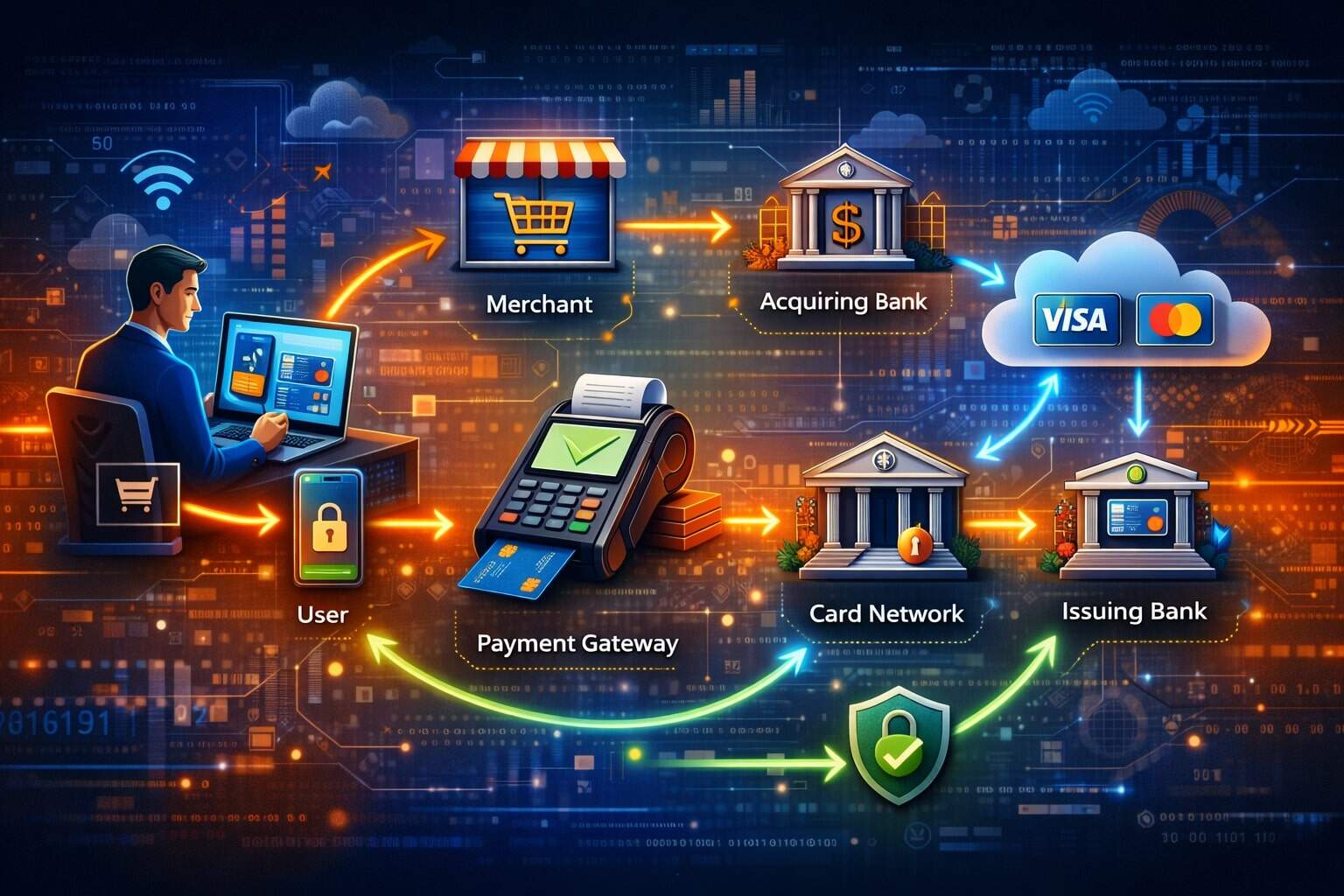
Online payment processing is the behind-the-scenes system that moves money from a customer’s payment method to your business bank account when someone buys on a website, mobile app, invoice link, or subscription checkout.
At first glance it looks simple: a customer enters details, clicks “Pay,” and gets a confirmation. In reality, online payment processing is a coordinated sequence of identity checks, risk decisions, network messaging, and settlement steps that must happen in seconds—while also meeting strict security and compliance requirements.
The main goal of online payment processing is to approve legitimate payments quickly and safely, while blocking fraud and minimizing disputes.
That means every transaction has to answer several questions at once: Is the payment instrument valid? Is the customer who they claim to be? Does the merchant have permission to accept this payment type? Is there enough balance or available credit? Does the transaction meet network rules and security standards? And finally, how will funds be settled and reconciled?
Online payment processing also has to adapt to how people pay today: cards, bank transfers, wallets, “buy now, pay later,” real-time rails, and stored credentials for subscriptions. It must also handle edge cases—partial approvals, retries, reversals, timeouts, refunds, chargebacks, and compliance events—without breaking the customer experience.
If you understand how online payment processing works, you can reduce declines, lower fees, improve authorization rates, strengthen security, and build a smoother checkout that converts better.
This guide explains the complete flow of online payment processing, the key players, the technology components, the costs, the security standards shaping the market, and what’s next.
The Core Pieces of Online Payment Processing
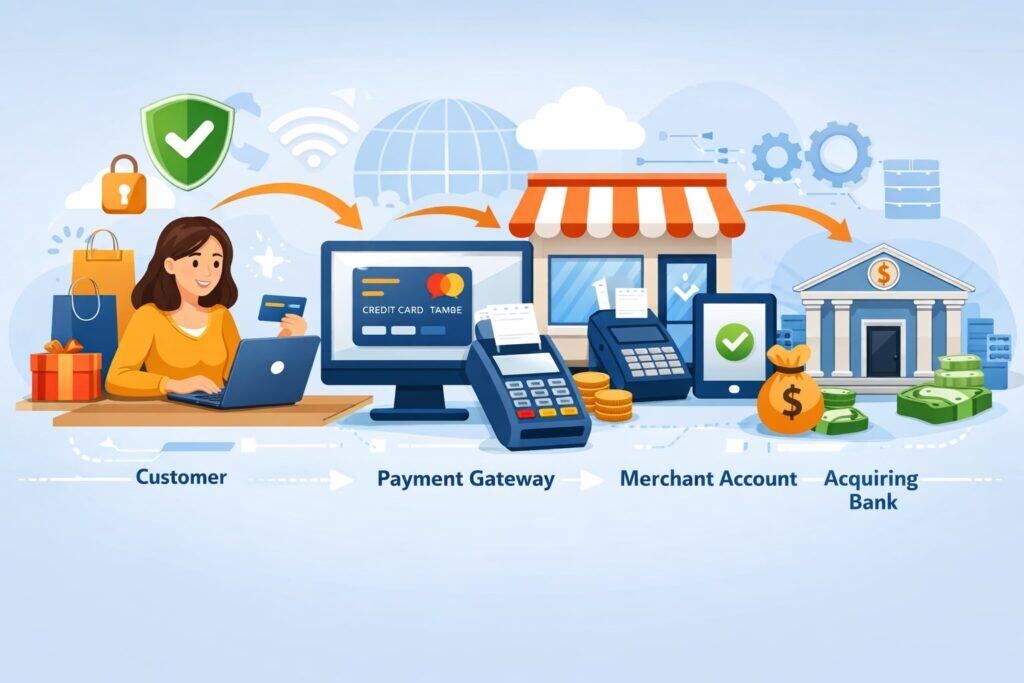
Online payment processing is usually described as a “payment stack,” because several layers work together. At the surface is your checkout or payment page—the part the customer sees. Under that is your payment gateway or payment API, which securely collects the payment details and prepares the transaction.
Then comes your payment processor, which connects to the card networks and banking rails, routes the authorization request, and returns an approval or decline.
Behind the processor is the acquiring side (often called the merchant acquirer), which sponsors your business and ensures you meet network rules. On the other end is the issuing bank (the customer’s bank), which decides whether to approve.
Even though these roles can be provided by one company in an “all-in-one” model, they are still separate functions. That separation matters because it affects pricing, reporting, risk controls, and how quickly you can change providers or add new payment methods. It also impacts how disputes and refunds are handled and how funds are deposited.
Modern online payment processing also includes additional services that used to be optional but are increasingly standard: tokenization, device fingerprinting, fraud scoring, 3-D Secure flows for certain transactions, and automated reconciliation. EMV payment tokenization is widely used to replace card numbers with tokens to improve security in digital transactions.
When a customer pays online, the system must protect cardholder data, reduce fraud, and follow security requirements that have become more demanding over time.
PCI DSS v4.0 introduced staged deadlines, with many “future-dated” requirements becoming effective after March 31, 2025, raising the bar for merchants and service providers handling card payments.
The Key Players in Online Payment Processing
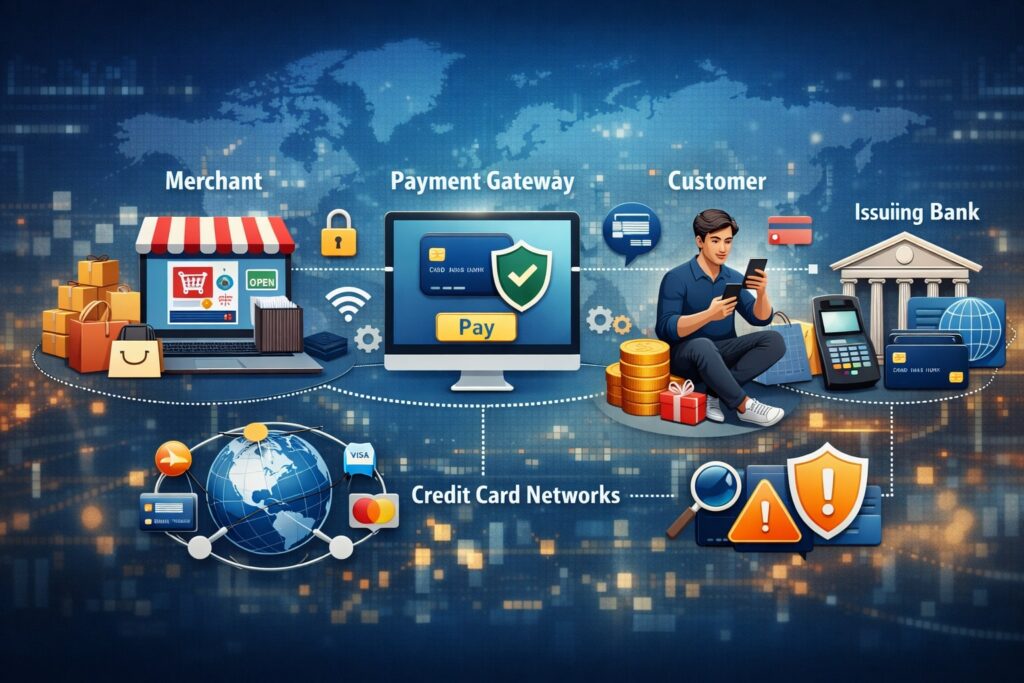
Online payment processing involves multiple parties, each responsible for a different part of the transaction lifecycle. Understanding these roles helps you troubleshoot declines, negotiate pricing, and design a more resilient checkout.
- Merchant (you): The merchant is the business accepting the payment. You decide the checkout experience, what payment methods to offer, how refunds are issued, and how order fulfillment works. Your business type, dispute rate, and average ticket influence risk decisions in online payment processing.
- Customer: The customer provides a payment credential—like a card, bank account, wallet, or installment approval—and expects a fast confirmation. Their issuing bank or wallet provider decides whether funds are available.
- Payment gateway: The gateway is the secure “front door” for online payment processing. It captures payment data, encrypts it, applies validation rules, and routes it to the processor. In API-first setups, the “gateway” may be part of the processor platform.
- Payment processor: The processor is the system that transmits transaction messages between your checkout/gateway and the networks/banks. It formats requests, manages retries, supports refunds, and provides reporting. Many processors also provide fraud tools, stored credentials support, and routing logic.
- Acquirer (merchant acquiring bank): The acquirer sponsors the merchant into the ecosystem and is ultimately responsible for merchant compliance with network rules. The acquirer settles funds to you and can enforce reserves, rolling holds, or enhanced monitoring if risk changes.
- Card networks and banking rails: These networks (for card payments) and rails (for bank transfers) carry transaction data between acquirer and issuer. For bank-based online payment processing, the “rail” could be ACH, same-day ACH, or real-time payment networks, each with its own timing and rules.
- Issuer (customer’s bank): The issuer approves or declines. It checks balance/credit, fraud signals, and authentication results. Issuer decisions are a major driver of your authorization rate, which is why optimizing online payment processing often focuses on better data quality, smarter retries, and improved authentication.
Because multiple systems are involved, online payment processing is not just “technology.” It’s an operating model—risk, compliance, data, and customer experience must work together. When one link is weak (poor data, weak fraud controls, outdated security posture), you see more declines, more chargebacks, or higher processing costs.
Step-by-Step: What Happens When a Customer Clicks “Pay”
Online payment processing can be mapped into five phases: data capture, authorization, clearing, settlement, and post-transaction operations. Most businesses focus only on the approval screen, but the later phases determine when money arrives, how fees are assessed, and how disputes are handled.
Payment Data Capture and Encryption
The process begins when the customer enters payment information—card details, wallet selection, bank transfer confirmation, or stored credential choice. Your checkout should validate fields, detect obvious errors, and reduce friction.
In online payment processing, small input improvements (autocomplete, address validation, clear error messaging) can meaningfully improve approvals.
The gateway or payment API then encrypts data in transit and applies tokenization where possible. Tokenization replaces sensitive data with a token that is useless if stolen, reducing your exposure.
Tokenization may happen at different points, including within merchant environments or via network-based token services, but the purpose is the same: reduce the value of intercepted data and support safer digital commerce.
At this point, fraud signals are also collected: device identifiers, IP geolocation, velocity checks, email patterns, shipping vs. billing comparison, and customer history. Strong online payment processing stacks decide risk early—before sending an authorization that might trigger an issuer decline or increase your fraud exposure.
Authorization Request and Issuer Decisioning
Next, the gateway forwards an authorization request to the processor. The processor routes it to the acquiring side, then through the relevant network/rail to the issuer. The issuer checks:
- Whether the credential is valid (card active, account open)
- Whether funds are available (credit limit or account balance)
- Whether the transaction looks risky (fraud models, unusual merchant, unusual amount)
- Whether authentication is required (certain transactions may require step-up verification)
The issuer returns an approval or decline code. If approved, an authorization hold is placed. Importantly, approval does not mean money has moved yet—it means the issuer has reserved funds/credit for later capture.
In online payment processing, “soft declines” may allow a retry with additional authentication or corrected data, while “hard declines” typically require a different payment method. Your processor and gateway logic can have a major effect on whether these retries help or hurt conversion.
Capture, Clearing, and Settlement
After authorization, the merchant either captures immediately (common in ecommerce) or later (common in delayed fulfillment, preorders, or certain services). Capture finalizes the amount and starts clearing.
Clearing is the process where transaction details are exchanged so funds can be transferred. Settlement is the actual movement of funds to the merchant, typically into your merchant account and then to your bank account as a payout.
Timing depends on the payment method. Card settlement is often next business day or within a couple of days depending on your arrangement, while bank rails can be faster (same-day or real-time) or slower (standard ACH).
Real-time payments are increasingly expanding into higher-value use cases. For example, one major real-time payments network raised its transaction limit to $10 million effective February 9, 2025, enabling more high-value and B2B transactions through instant rails.
Reconciliation, Refunds, and Disputes
Online payment processing doesn’t end at settlement. You still need to reconcile transactions to orders, confirm payouts match your ledger, handle refunds, and respond to disputes. Good processing systems support:
- Detailed transaction metadata (order ID, customer ID, invoice number)
- Webhooks for payment status changes
- Automated payout reconciliation
- Refund workflows and partial refunds
- Chargeback evidence management
This is where many businesses lose time and money. A clean reconciliation process reduces accounting overhead and helps you identify fraud patterns earlier. It also helps you understand true payment costs per product line, channel, or campaign—critical for profitability.
Payment Methods and Rails Used in Online Payment Processing
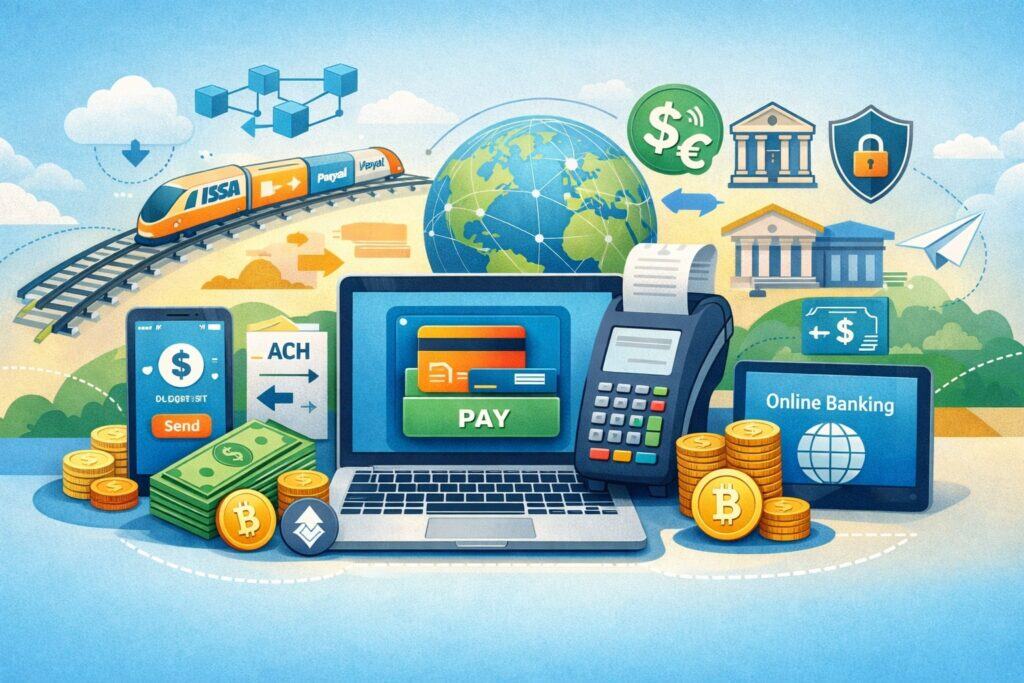
Online payment processing is not one “network.” It’s multiple rails, each with different economics and risk. Offering the right mix can lift conversion and reduce costs.
Card Payments
Cards remain a primary method for online payment processing because they’re widely accepted and have established consumer protections. Card payments run through card networks and are typically authorization-first, followed by capture and settlement. Cards also support recurring billing, stored credentials, and advanced fraud tooling.
However, cards have higher fees than many bank-based methods, and disputes (chargebacks) are more common. That’s why strong fraud prevention and good descriptor/receipt practices matter.
Digital Wallets and Tokenized Checkout
Digital wallets can reduce friction because customers don’t have to type card numbers. Wallet payments often use tokenization, meaning the merchant may never see the actual card number. Tokenization improves security by replacing valuable account data with a token, lowering the payoff for attackers and supporting safer ecommerce flows.
Checkout standards like Click to Pay are also designed to make online payment processing feel more like a one-click experience, using modern authentication and tokenization approaches. Some large payment stakeholders have emphasized tokenization and Click to Pay as key to reducing manual card entry over time.
Bank Transfers and ACH Options
Bank-based online payment processing typically uses ACH for account-to-account transfers, especially for invoices, payroll-like payments, subscriptions, and B2B. ACH can be lower cost than cards, but timing varies (standard vs. same-day).
Industry rule proposals can also change capabilities over time—such as proposals to increase same-day transfer limits, which would expand the types of payments that can move quickly via bank rails.
If you sell higher-ticket items, bank rails can meaningfully reduce fee burden, but you must manage return risk and authorization differences compared to cards.
Real-Time Payments
Real-time rails are gaining traction because they can provide immediate confirmation and faster availability of funds—important for marketplaces, gig payouts, insurance disbursements, and time-sensitive B2B.
The transaction limit increases on real-time networks signal a push into higher-value and business use cases, not just small consumer transfers.
For merchants, real-time online payment processing can reduce settlement delays, but adoption depends on bank participation, use case fit, and integration complexity. It’s increasingly valuable to design your payment stack so you can add real-time rails when your customers or payout workflows benefit from them.
Pricing and Fees in Online Payment Processing
Online payment processing fees can feel confusing because costs come from multiple layers: network fees, issuer costs, processor margins, risk costs, and sometimes gateway or platform fees. The right way to think about pricing is: you’re paying for access to rails, risk management, and operational services.
Common pricing models include:
- Interchange-plus: You pay actual interchange and assessments plus a transparent markup. This can be cost-effective at scale and is often preferred for businesses that want clear cost breakdowns.
- Flat-rate (blended): One rate for many card types. It’s simple and predictable, but may cost more for certain mixes of cards and ticket sizes.
- Tiered pricing: Transactions are bucketed into tiers. This is often the least transparent and can hide costs inside vague categories.
In addition to the base rate, online payment processing can include:
- Authorization fees per transaction attempt
- Batch or settlement fees
- Chargeback/dispute fees
- Refund fees (sometimes non-refundable processing costs)
- Monthly minimums and statement fees
- Cross-border or card-not-present surcharges (varies by network rules and setup)
What drives your effective rate in online payment processing is your mix: average order value, card types used, how many transactions are keyed vs tokenized, approval rates, refunds, and dispute levels. A cheap headline rate can become expensive if your authorization rate is low (more attempts = more fees) or your chargebacks are high.
Optimizing cost isn’t just negotiating. It’s also improving data quality sent in the authorization, using tokenization, managing fraud intelligently, and offering lower-cost rails (like bank transfers) for customers who prefer them.
Over time, shifts toward tokenized and streamlined checkout experiences can change the economics by improving approvals and reducing fraud-driven losses.
Security and Compliance Requirements That Shape Online Payment Processing
Security is not optional in online payment processing—one breach can create massive financial and reputational damage. The baseline security framework for card payments is PCI DSS, and the newest version has raised expectations for how organizations protect payment data.
PCI DSS v4.0 introduced staged implementation where some requirements were effective for assessments after March 31, 2024, while others were treated as best practices until March 31, 2025—after which they became effective requirements that must be considered in assessments.
This means many organizations faced a clear “now mandatory” line in 2025, pushing upgrades in authentication, vulnerability management, logging, and other controls.
In practical terms, secure online payment processing usually includes:
- Minimizing payment data exposure by using hosted payment fields or redirect checkout where appropriate
- Tokenization so your systems store tokens instead of raw card numbers
- Strong access controls (least privilege, MFA, regular access reviews)
- Secure development practices (patching, code scanning, dependency management)
- Monitoring and incident response capabilities
Tokenization is one of the most impactful security strategies because it reduces the value of stolen data. EMV payment tokenization is explicitly designed to replace valuable card data with tokens, increasing the security of mobile and ecommerce transactions while maintaining compatibility with existing acceptance infrastructure.
For merchants operating in the U.S., compliance also intersects with card network rules, consumer protection expectations, and data privacy obligations depending on where customers live and how data is stored.
You don’t need to become a compliance expert, but you do need a provider and architecture that reduces scope and keeps audits manageable.
The future direction is clear: stronger authentication, more tokenization, and more automation in security controls. Online payment processing stacks that treat security as a product feature—rather than a checklist—tend to see fewer incidents and higher long-term resilience.
Fraud, Chargebacks, and Risk Controls in Online Payment Processing
Fraud is one of the biggest hidden costs in online payment processing. It’s not just stolen cards—it includes account takeovers, friendly fraud, refund abuse, triangulation fraud, and subscription scams.
If you manage fraud poorly, you pay twice: you lose goods/services and you lose processing health (more chargebacks and higher risk reviews).
Effective fraud management starts with understanding the difference between:
- Fraud declines (false positives): You block real customers, hurting revenue and lifetime value.
- Fraud approvals (false negatives): You approve risky payments that later become chargebacks or losses.
A modern online payment processing approach uses layered defenses:
- Frictionless checks: velocity limits, device intelligence, IP risk, email/phone validation, BIN insights, behavioral signals.
- Step-up verification: OTP, wallet authentication, or 3-D Secure flows when risk is high.
- Post-transaction monitoring: refund abuse detection, dispute pattern analysis, fulfillment risk rules.
Chargebacks are a parallel system where the customer disputes a transaction through their bank. Common reasons include “fraud,” “item not received,” and “not as described.”
Your best defense is prevention: clear product pages, fast shipping updates, accurate descriptors, responsive support, and easy refunds. In many cases, the customer files a dispute because they can’t get a timely resolution.
Online payment processing providers often supply chargeback tools, but you still need an internal playbook: evidence templates, timelines, and a triage system for which disputes to fight vs accept. Winning every chargeback isn’t the goal—profitability is. Some disputes cost more to fight than to refund.
Looking ahead, risk systems are becoming more automated and more connected to tokenized identities, passkeys, and network signals. Checkout initiatives combining tokenization with biometric-style authentication are positioned to reduce manual entry and potentially reduce certain fraud vectors over time.
How to Choose and Optimize an Online Payment Processing Setup
Choosing online payment processing is a business decision as much as a technical one. The best provider for you depends on your sales model, ticket size, risk profile, support needs, and how much control you want over routing and data.
Start by evaluating these factors:
- Payment method fit: Do you need cards only, or also bank transfers, wallets, recurring billing, invoicing, and real-time payouts? Your online payment processing stack should match how customers want to pay and how you want to get paid.
- Integration model: A hosted checkout is faster and reduces compliance scope. A direct API integration offers more control and better UX but requires more engineering and security maturity.
- Authorization performance: Ask about optimization features: smart retries, network tokens, account updater, and enriched authorization data. Better approvals can outweigh small rate differences.
- Risk and dispute support: If your business has elevated fraud exposure, choose a provider with strong fraud tooling, clear dispute workflows, and good reporting.
- Transparency: Ensure you can see fees clearly and reconcile payouts to transactions. Online payment processing becomes painful when reporting is weak.
- Scalability and redundancy: As you grow, you may want multiple acquiring options, backup routing, or region-specific optimizations. Even if you start with one provider, design your systems so switching isn’t a rebuild.
Optimization is ongoing. Review monthly:
- Approval rate by card type, issuer, and channel
- Refund and dispute ratios
- Fraud losses vs false positive losses
- Effective processing rate and fee drivers
- Checkout drop-off by step
Also keep an eye on how rails are evolving. Real-time payment networks expanding transaction limits enable new online payment processing use cases, especially for high-value B2B and time-sensitive transfers.
And proposed rule changes—like increasing same-day transfer limits—can shift when bank rails become viable alternatives to cards for larger payments.
The Future of Online Payment Processing
The future of online payment processing is moving toward faster settlement, less manual data entry, stronger authentication, and more tokenization. Several trends are converging:
- Tokenization everywhere: Tokenization reduces risk and enables safer stored credentials. EMV tokenization frameworks support secure digital commerce while keeping compatibility with existing systems. Expect more merchants to rely on network tokens rather than storing raw credentials.
- Passwordless and biometric-style authentication: Checkout experiences that combine tokenization with passkeys/biometric verification are positioned to reduce friction and fraud. Major networks and payment stakeholders have publicly emphasized moving away from manual card entry as part of a one-click-style future.
- Real-time rails for bigger payments: Raising real-time payment limits to $10 million signals growth in high-value payments and deeper penetration into corporate use cases, not just consumer transfers. This can reshape how marketplaces, contractors, and supply chains move money.
- Bank rails speeding up: Proposals to increase same-day transfer limits suggest that traditional bank rails continue evolving to support larger, faster payments. As these limits rise, merchants may route more payments away from cards when appropriate, lowering costs.
- Compliance tightening: Security standards like PCI DSS v4.0 have already increased requirements, with future-dated controls becoming effective after March 31, 2025. This trend continues: more logging, more automation, and more expectations around secure software and access management.
- AI-driven risk and ops automation: Fraud systems will increasingly use adaptive models and network-level insights. Reconciliation, exception handling, and dispute workflows will become more automated, reducing manual work and speeding up cash flow visibility.
The biggest prediction: online payment processing will feel less like “enter card details” and more like “confirm and pay.” Businesses that modernize their stack—tokenization, better authentication, multi-rail routing, and strong security hygiene—will see better conversion, lower fraud, and more resilience as payment behavior keeps changing.
FAQs
Q.1: What’s the difference between a payment gateway and a payment processor?
Answer: A payment gateway is the secure layer that collects payment details from your checkout and passes them to the processing system in a compliant way. It focuses on data capture, encryption, tokenization, and routing the request.
A payment processor is the system that actually transmits the authorization and settlement messages between your business and the networks/banks that approve the payment. In other words, the gateway is often the “front end” of online payment processing, while the processor is the “engine” that connects into the financial ecosystem.
Many modern platforms bundle gateway and processor services into one product, which can simplify integration and support. But the functions still exist, and it matters when you’re diagnosing issues.
For example, if customers see errors before the bank is ever contacted, that may be a gateway or checkout problem. If they see bank declines, it’s usually an issuer decision influenced by authorization data, fraud signals, or authentication.
When choosing online payment processing, look at both layers: gateway features that improve checkout and security, and processor capabilities that improve authorization rates, reporting, and settlement speed.
Q.2: How long does settlement take in online payment processing?
Answer: Settlement timing depends on the payment method and the agreements in your merchant account. Card payments often authorize instantly but settle later—commonly within one or more business days.
Bank transfers can range from standard multi-day timing to same-day options. Real-time payment rails can provide near-instant movement and confirmation, which changes how quickly funds become available and how fast you can fulfill services or pay out partners.
Recent changes in real-time networks show a push toward broader, higher-value usage—for example, a major real-time rail increased per-transaction limits to $10 million in early 2025, which supports larger-value settlements in more business scenarios.
Even when the rail settles quickly, your provider may still apply payout schedules, rolling reserves, or risk holds based on your business profile. That’s why it’s important to separate “network settlement” from “merchant payout.” A good online payment processing provider will clearly document both.
Q.3: Why do online card payments get declined even when the customer has funds?
Answer: Declines happen for many reasons beyond available funds. Issuers use fraud models and policy rules that can reject transactions that look unusual—new merchant, unfamiliar device, mismatched address, high-risk product category, or rapid repeat attempts.
In online payment processing, data quality matters: incomplete billing address data, missing customer signals, or inconsistent metadata can reduce trust and lead to issuer declines.
Some declines are “soft” and can be resolved with step-up verification or a retry after correcting details. Others are “hard” and require the customer to use a different payment method or contact their bank.
Optimizing online payment processing involves reducing avoidable declines by improving checkout input validation, using tokenization and stored credentials correctly, and applying authentication flows intelligently so legitimate buyers aren’t blocked.
It also helps to monitor declines by reason code and issuer patterns. If a particular issuing bank declines a lot, you may need better authorization data, improved fraud signaling, or alternative payment methods like bank transfer options.
Q.4: Do I need PCI compliance if I use a hosted checkout?
Answer: Even with a hosted checkout, you typically still have some PCI responsibilities, but your scope is much smaller. If payment data is collected on a provider-hosted page or via embedded hosted fields, you reduce the chance that your servers handle raw card data.
That makes PCI compliance easier and lowers risk. However, you still must maintain secure systems, manage access controls, and ensure your website doesn’t get compromised in a way that captures customer data before it reaches the hosted component.
PCI DSS v4.0 has increased expectations over time, and many future-dated requirements became effective after March 31, 2025, affecting how organizations approach security controls and assessments.
Even if your provider handles the heavy lifting, you should still treat online payment processing security as part of your operational baseline: patching, monitoring, secure admin access, and vendor management.
The simplest strategy is to minimize card-data exposure via tokenization and hosted components, and then keep your environment clean and well-managed.
Q.5: What is tokenization in online payment processing, and why does it matter?
Answer: Tokenization is the practice of replacing sensitive payment credentials—like a card number—with a non-sensitive token. The token can be stored and reused (for subscriptions or saved cards) without exposing the real account number to your systems. If attackers steal a token, it’s typically useless outside the intended context.
Tokenization matters because it reduces the “blast radius” of a breach and can improve approval performance in some setups, especially when combined with network token programs and account updater tools.
EMV payment tokenization is designed to replace valuable card data with tokens to increase security for ecommerce and mobile transactions, while maintaining compatibility with existing payment infrastructure.
From a business standpoint, tokenization can also reduce compliance scope and simplify how you handle stored credentials. It supports better customer experiences (saved payment methods) without forcing you to store raw card details. In modern online payment processing, tokenization is increasingly foundational, not optional.
Q.6: How can I reduce chargebacks in online payment processing?
Answer: Reducing chargebacks starts before a dispute happens. Many chargebacks come from confusion: customers don’t recognize the billing descriptor, expected different shipping timing, or couldn’t get support quickly.
To prevent those, improve your checkout confirmation page, email receipt, shipping updates, return policy clarity, and customer support response time.
Next, reduce actual fraud through layered screening: device intelligence, velocity controls, address verification where relevant, and step-up authentication for risky transactions. Don’t over-block, though—false positives can cost more than fraud when you lose legitimate customers.
Operationally, build a chargeback playbook:
- Categorize disputes by reason (fraud vs service vs fulfillment)
- Decide when to refund instead of fight (profit-based decisions)
- Standardize evidence (proof of delivery, logs, customer communication, policy acceptance)
- Track dispute ratios and identify product lines or channels causing issues
Strong online payment processing reporting is essential here. If you can tie disputes back to acquisition source, device type, or shipping carrier, you can fix root causes instead of treating chargebacks as random events.
Conclusion
Online payment processing is the system that turns “Pay Now” into a real movement of money—securely, quickly, and at scale. It includes more than just approving a card: it’s a full lifecycle of data capture, authorization, clearing, settlement, and post-transaction operations like reconciliation, refunds, and disputes.
The better your online payment processing setup, the more you can improve conversion, lower fraud, reduce chargebacks, and control costs.
The direction of the industry is clear: more tokenization, stronger authentication, and faster rails. EMV tokenization frameworks continue to expand security for digital transactions, while real-time networks are pushing into higher-value territory through larger transaction limits.
At the same time, security expectations are tightening through standards like PCI DSS v4.0, with important requirements becoming effective after March 31, 2025.