
By Thomas Brandt August 10, 2026
When a business starts accepting customer payments, two financial terms often create confusion: merchant account and business bank account. They are closely connected in many payment setups, but they perform fundamentally different jobs.
The simplest way to understand merchant account vs business bank account is this: a business bank account is where a company manages its operating money, while a merchant account is part of the infrastructure used to accept and settle eligible electronic payments, especially debit and credit card transactions.
A business checking account may receive sales deposits, pay suppliers, fund payroll, send ACH transfers, and cover operating expenses. A merchant account, by contrast, participates in the card-processing workflow between the customer, payment processor, acquiring bank, card network, and issuing bank.
Businesses that accept cards commonly use both functions. However, they may not always see a separately labeled merchant account because many modern payment platforms use payment-facilitator or aggregated processing models.
Understanding where each account fits can make it easier to compare payment providers, predict cash flow, reconcile deposits, understand fees, and choose financial tools that match the way your business gets paid.
What Is a Merchant Account?
A merchant account is a specialized payment processing account that enables a business to accept eligible electronic payments, particularly debit and credit card transactions. It works within the merchant acquiring system rather than functioning like a normal checking or savings account.
When a customer pays by card, the money does not simply move directly from the customer’s checking account into the merchant’s business checking account. Multiple institutions and systems participate in authorization, clearing, settlement, risk management, and funding.
The merchant account relationship helps connect the merchant to this ecosystem.
An acquiring bank, sometimes called an acquirer, provides or sponsors merchant access to the card-payment system. Federal Reserve regulations describe an acquirer in the debit-card context as a party that contracts directly or indirectly with a merchant to provide settlement for electronic debit transactions over a payment card network.
Other organizations may handle much of the technology and day-to-day operation, including:
- a payment processor
- a payment gateway
- a POS system
- fraud-screening services
- an independent sales organization
- an ecommerce platform
- an acquiring bank
- card networks
The merchant usually interacts most frequently with the processor or merchant services provider rather than with every organization behind the transaction.
A credit card merchant account therefore should not be viewed as an ordinary repository where a business stores money indefinitely. Its purpose is closely tied to processing eligible transactions and facilitating payment settlement.
After card transactions are cleared and settled, the merchant’s proceeds generally move to the designated bank account associated with the processing relationship.
For a deeper look at the surrounding ecosystem, this guide to how credit card processing works explains authorization, clearing, settlement, processing, gateways, and acquiring relationships in greater detail.
Traditional merchant accounts and aggregated payment platforms
Historically, many businesses applying for merchant services received their own merchant identification arrangements under an acquiring relationship. Applications could involve business verification, financial review, estimated processing volume, average transaction size, and industry-specific underwriting.
That model still exists and remains common.
Modern platforms, however, may operate under a payment facilitator, or PayFac, model. Under these arrangements, individual businesses may be boarded as sub-merchants under a larger processing relationship rather than receiving what customers would recognize as a completely separate traditional merchant account.
This explains why two businesses can both accept Visa or Mastercard payments while experiencing very different onboarding processes.
One business may complete a detailed merchant application and receive specific processing credentials. Another may create an account through an integrated payment platform and begin onboarding through a streamlined workflow.
The underlying card ecosystem still requires acquiring, authorization, processing, settlement, and risk functions. What changes is how those functions are packaged and presented to the merchant.
How Merchant Accounts Work From Payment to Settlement
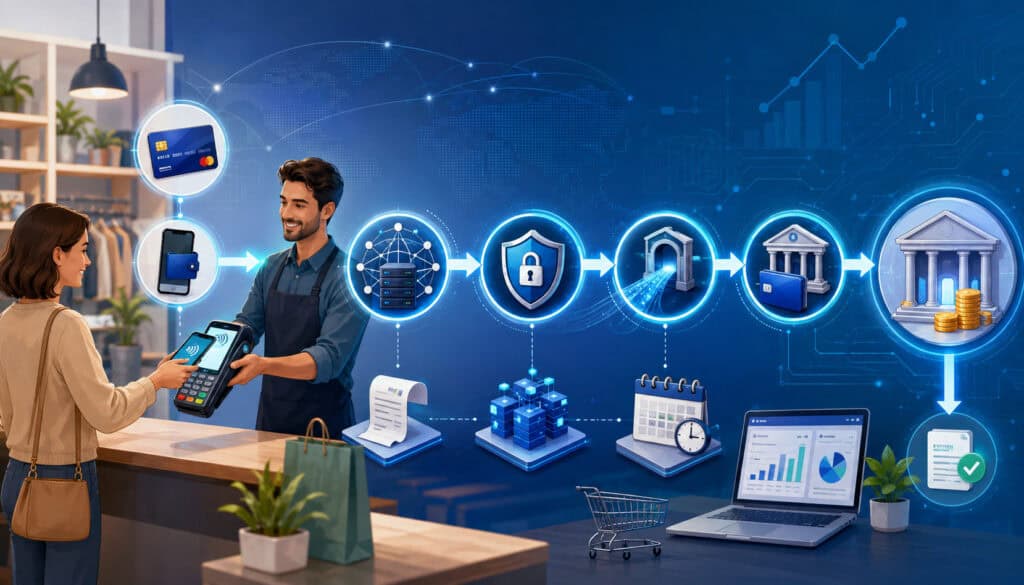
Understanding how merchant accounts work becomes easier when you follow one transaction from checkout through funding.
Suppose a customer buys a $100 product with a credit card. The merchant may see an approval within seconds, but that approval is only the beginning of the financial process.
Federal Reserve material distinguishes the authorization, clearing, and settlement functions involved in card transactions, and describes card payments as moving between issuing and acquiring institutions through card-network intermediaries.
Here is the typical sequence.
1. The customer initiates the payment
A customer presents payment credentials.
At a physical store, the customer might tap a contactless card, insert an EMV chip card, or use a mobile wallet. For ecommerce, the customer might enter payment details into an online checkout or use stored credentials.
The POS terminal, website, application, or payment gateway securely captures the information needed to create a transaction request.
2. An authorization request is sent
The transaction information is transmitted to the merchant’s payment processor and routed through the appropriate card network.
The network directs the request to the bank or financial institution that issued the customer’s card. This institution is known as the issuing bank or issuer.
The issuer evaluates the transaction using factors that can include available credit or funds, account status, fraud controls, authentication information, and its own risk rules.
3. The issuer approves or declines the transaction
The issuing bank sends a response back through the card network and processing infrastructure.
An approval means the issuer has authorized the transaction. It does not necessarily mean the merchant already has the final money in its business checking account.
A decline means the transaction was not authorized.
4. The merchant captures the transaction
Authorization and capture are related but separate concepts.
Capture indicates that the merchant is proceeding with the authorized sale and preparing it for clearing and settlement. In many retail environments, transactions are captured automatically or included in a batch.
Some businesses intentionally authorize an amount first and capture it later. Hotels, rental operations, restaurants, and certain ecommerce businesses are common examples where authorization and final capture amounts may differ.
5. Transactions enter clearing
Captured transactions are submitted for clearing, often through a batch process.
During clearing, transaction information moves through the processing and card-network infrastructure so obligations between the relevant parties can be calculated and recorded.
Businesses interested in the operational side of this stage can review how batch processing works for merchants.
6. Settlement takes place
Settlement involves the financial movement associated with the transaction among participating institutions.
Interchange, network fees, processor charges, refunds, adjustments, reserves, or other contractual items can affect what the merchant ultimately receives.
The exact mechanics differ by processor, payment type, pricing arrangement, card network, and acquiring setup.
7. Merchant proceeds reach the settlement account
After processing and applicable adjustments, the processor or acquiring relationship funds the merchant’s designated settlement account, which is commonly a business bank account.
That funding deposit may combine many customer transactions rather than appearing as one bank deposit for each individual card sale.
Settlement schedules vary. Weekends, banking holidays, batch deadlines, account risk, reserves, processor policies, funding programs, transaction types, and account reviews can all influence when funds become available.
What Is a Business Bank Account?
A business bank account is a deposit or transaction account used to receive, hold, spend, and manage company money. Business checking accounts are the most common example, although businesses may also use savings accounts, money market deposit accounts, certificates of deposit, or other banking products depending on their needs.
The FDIC describes banks generally as institutions that accept deposits and provide other financial services, while checking accounts allow money to be transferred through checks, debit cards, withdrawals, and similar transactions.
Unlike a merchant account, a business bank account is designed for broad financial management.
A business might use its account to:
- receive payment-processing settlements
- deposit checks or cash
- receive ACH payments
- pay vendors
- make tax payments
- run payroll
- pay rent and utilities
- send domestic or international wires
- make debit-card purchases
- withdraw cash
- maintain operating reserves
- transfer money between checking and savings
- connect accounting or bookkeeping software
This broad functionality is the biggest distinction in the business bank account vs merchant account comparison.
Merchant accounts exist primarily to facilitate payment acceptance and settlement. Business deposit accounts support the company’s overall financial operations.
Maintaining separate business and personal records can also make accounting and recordkeeping easier. The FDIC has highlighted guidance recommending separation of business checking from personal accounts for recordkeeping purposes.
Whether a particular business is legally required to maintain a dedicated business banking account depends on its structure, agreements, jurisdiction, and circumstances. Business owners should verify requirements applicable to their entity rather than assuming one rule applies universally.
Business checking, savings, and related banking tools
A business checking account normally acts as the central operating account.
Incoming payments arrive there, while outgoing expenses such as payroll, supplier invoices, software subscriptions, insurance premiums, and rent leave the account.
Business savings accounts may be used for reserves, taxes, future purchases, or other planned funds. The available products, withdrawal rules, interest features, balance requirements, and fees depend on the financial institution.
Many business banking platforms also provide:
- multiple employee debit cards
- administrator and user permissions
- ACH origination
- check services
- wire transfers
- mobile deposits
- bill payment
- transaction alerts
- accounting integrations
- fraud controls
- account statements
- cash-management services
A merchant services account generally does not provide this complete set of banking functions.
How Business Bank Accounts Work
Understanding how business bank accounts work is more familiar than understanding merchant acquiring because the account behaves much like other deposit accounts, but with services and controls designed around business activity.
Money can enter the account through several sources.
A company might deposit cash, receive customer checks, accept an ACH credit, receive a wire transfer, transfer funds from another company account, or receive a processor’s card-payment settlement.
Once deposits are credited and available according to the institution’s policies, the business can use the funds for ordinary operations.
Outgoing transactions might include:
- debit-card purchases
- electronic bill payments
- ACH payments
- payroll
- checks
- wire transfers
- ATM withdrawals
- transfers to another account
- automatic recurring payments
Banks may impose limits or fees on certain transactions. These can vary considerably between accounts, so businesses should evaluate actual deposit agreements and fee schedules rather than assuming all business banking accounts work identically.
A business bank account can also become an important source of accounting data. Many accounting platforms can import transactions automatically, allowing bookkeepers to classify income and expenses and perform account reconciliation.
Payment settlements add another layer to reconciliation.
For example, your POS may report $10,000 in card sales for a period, while your bank statement shows several settlement deposits with different amounts. The difference could reflect timing, refunds, fees, chargebacks, withheld reserves, tips, or other adjustments.
The processor’s settlement reports help bridge that gap.
Some businesses also accept ACH transfers directly into the bank account. ACH is a separate payment rail from card processing. A business can therefore receive bank-to-bank electronic payments without those payments necessarily passing through its credit card merchant account.
Merchant Account vs Business Bank Account: Key Differences
The difference between a merchant account and a business bank account comes down primarily to function.
A merchant account supports payment acceptance and merchant acquiring. A business bank account holds and manages the company’s operating funds.
That distinction affects everything from underwriting and fees to access, chargebacks, and everyday banking features.
| Feature | Merchant Account | Business Bank Account |
| Primary purpose | Facilitate eligible electronic/card payment processing and settlement | Hold and manage general business funds |
| Handles card transactions | Yes, as part of a merchant processing arrangement | Not by itself |
| Holds general operating funds | Generally not intended for this purpose | Yes |
| Used for operating expenses | Generally no | Yes |
| Receives payment settlements | Helps facilitate them | Common destination for merchant-processing deposits |
| Application process | May include merchant underwriting and risk evaluation | Primarily identity, entity, banking, and compliance verification |
| Typical fees | Processing, gateway, account, dispute, equipment, or other service fees may apply | Maintenance, transaction, cash deposit, wire, overdraft-related, or other banking fees may apply |
| Access to funds | Governed by settlement and processing terms | Funds can generally be used after becoming available, subject to account terms |
| Chargeback involvement | Directly involved in handling card disputes | May experience related debits or adjustments but does not itself process card disputes |
| Banking tools | Limited or processing-focused | Checking, debit cards, ACH, checks, transfers, wires, cash services, and more |
| Needed for card acceptance | Merchant acquiring functionality is generally required, though it may be bundled under a payment facilitator | A normal bank account alone does not enable card processing |
| Best use | Accepting and processing customer electronic/card payments | Managing day-to-day company finances |
One nuance deserves special attention: a merchant account may be described as an “account,” but that does not make it equivalent to a deposit account.
When comparing merchant account vs bank account, think of the merchant account primarily as part of a payment-acceptance relationship. The business bank account is where the company manages its broader financial life.
The distinction also explains why banks sometimes advertise “merchant services” alongside checking accounts. The financial institution may offer both products, but one does not automatically replace the other.
How Merchant Accounts and Business Bank Accounts Work Together
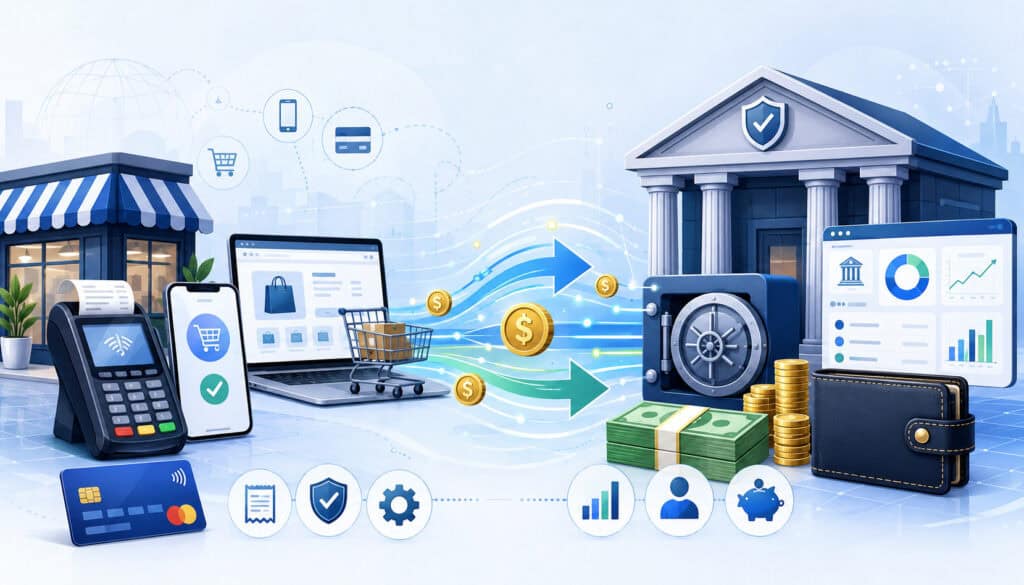
For many companies, the merchant account and business bank account form two connected stages of the payment process.
The merchant-services side handles acceptance, transaction routing, authorization, capture, clearing, settlement, disputes, and related processing activities. The business banking side receives the resulting funds and makes them available for operations according to the bank’s account terms.
Consider a simplified $100 card purchase.
- A customer pays $100 at the merchant’s checkout.
- The payment request travels through the processor and card network.
- The issuing bank approves the transaction.
- The merchant captures the authorized transaction.
- The transaction enters clearing and settlement.
- Applicable fees, credits, refunds, reserves, or adjustments may affect funding depending on the agreement.
- The merchant’s resulting settlement is deposited into its designated business bank account.
Suppose the company processes many card transactions in one day. It may not receive a separate deposit for each purchase.
Instead, the processor might fund a consolidated amount corresponding to a batch or settlement period. Depending on pricing arrangements, some fees may be deducted before funding while others may be billed separately.
That means a $100 customer transaction does not necessarily translate into an immediately identifiable $100 bank deposit.
Settlement timing also varies. Funding schedules can depend on processor policies, cut-off times, weekends, holidays, transaction risk, business history, account status, reserves, payment channel, and other considerations.
A processor may also temporarily withhold certain funds when permitted under the agreement, such as through a reserve or risk hold.
Do You Need Both Accounts?
For many established businesses accepting cards, the practical answer is yes, they need both payment-processing functionality and a suitable account for managing business funds. That does not necessarily mean every company must obtain a separately labeled traditional merchant account.
The right setup depends on how customers pay.
Cash-only business
A business that accepts only cash does not need card-processing infrastructure.
It may still benefit from or require an appropriate business bank account depending on its legal structure, banking needs, contracts, and circumstances.
If it later starts accepting cards, it will need a merchant acquiring or payment-platform relationship.
Retail store accepting cards
A retail store accepting debit and credit cards generally needs POS payment processing connected to merchant acquiring services.
The store also typically uses a business checking account for settlements, payroll, supplier payments, cash deposits, rent, and other expenses.
Ecommerce business
An ecommerce company generally needs online payment-processing infrastructure.
Depending on the setup, this may include:
- an ecommerce checkout
- payment gateway
- payment processor
- merchant account or payment-facilitator relationship
- fraud controls
- tokenization
- recurring billing tools when applicable
- settlement account
For a deeper overview, see how online payment processing works.
Freelancer or independent consultant
A freelancer paid exclusively through checks or ACH might not need card merchant services.
A consultant accepting credit cards through invoices, payment links, or a virtual terminal will need card-processing capabilities, even if those capabilities are bundled through an aggregated payment platform.
Subscription business
Recurring billing makes payment-processing design especially important.
The company may need stored-credential capabilities, tokenization, retry logic, recurring billing controls, fraud monitoring, refund tools, and careful chargeback management.
It also needs a bank account where settlements arrive and normal expenses are managed.
Business using a payment facilitator
Businesses using an all-in-one platform may never hear the phrase “merchant account” during onboarding.
The platform may combine gateway, processing, acquiring access, risk management, reporting, and merchant onboarding into a single service.
That does not eliminate the merchant-acquiring function. It changes how the relationship is structured.
Merchant Account vs Payment Processor vs Payment Gateway
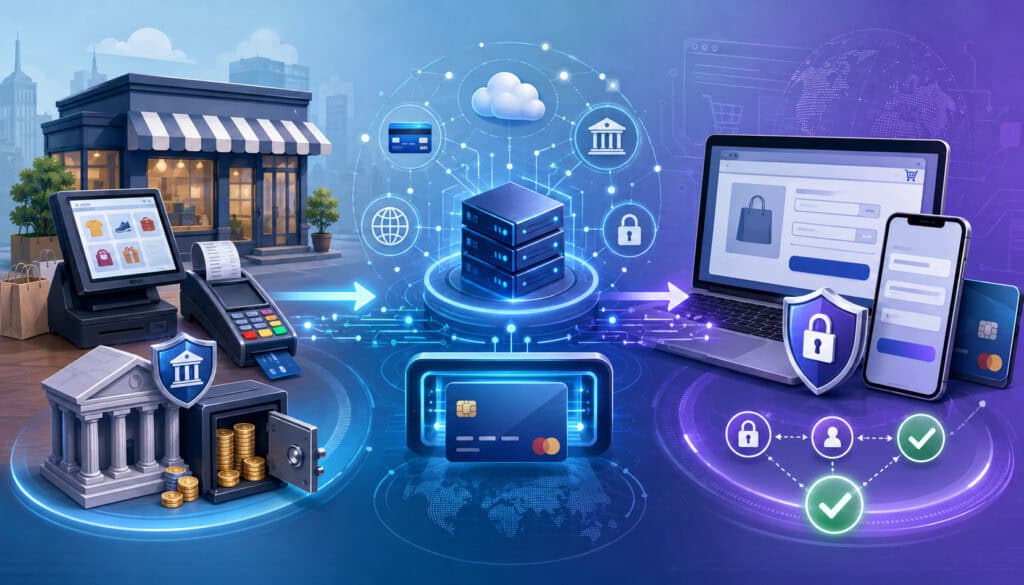
One reason the merchant account vs business bank account question becomes confusing is that several payment-industry terms are routinely discussed together.
They should not be treated as interchangeable.
Merchant account and acquiring bank
The merchant account relationship enables a business to participate in card acceptance and settlement.
The acquiring bank is the financial institution or acquiring entity involved in providing settlement access for merchant transactions.
Depending on the provider structure, the merchant may have little direct interaction with the acquiring bank even though it plays an essential role behind the scenes.
Payment processor
A payment processor handles transaction routing and numerous operational functions involved in electronic payment processing.
During authorization, the processor helps move transaction information between the merchant’s payment environment and the relevant payment networks.
Processors may also support:
- transaction reporting
- batching
- settlement processing
- fraud tools
- recurring payments
- tokenization
- terminal management
- dispute workflows
- gateway integrations
A processor is therefore a service and technology function, not simply another term for the merchant’s bank account.
For additional context, see this detailed comparison of a payment processor vs merchant account.
Payment gateway
A payment gateway is especially relevant to online and card-not-present transactions.
It securely collects or transmits payment information from a website, application, invoice, or other digital interface into the processing environment.
Modern providers frequently combine gateway and processing capabilities, but their conceptual roles remain different.
Card network
Card networks provide the communication and operating infrastructure linking participants in card transactions.
They establish rules and help route transaction messages between acquiring and issuing sides of the ecosystem.
Issuing bank
The issuing bank is the financial institution that issued the customer’s card.
During an authorization request, the issuer determines whether to approve or decline according to account status, available credit or funds, authentication information, and its risk controls.
Business bank account
Finally, the business bank account is the company’s deposit account.
It commonly receives processing settlements but does not independently perform authorization, gateway, processor, network, or acquiring functions.
A useful mental model is:
Checkout/POS → Gateway → Processor/Acquiring Infrastructure → Card Network → Issuing Bank → Clearing and Settlement → Business Bank Account
The exact technology path varies, but this sequence shows why payment processor vs bank account is not an either/or comparison. They perform completely different jobs.
Merchant Account vs Business Checking Account
A merchant account and a business checking account are not substitutes for each other.
The business checking account is designed for operating money. A business can receive deposits, pay bills, issue checks, use debit cards, initiate transfers, and manage daily cash flow.
A merchant account is centered on card payment processing.
It generally cannot replace the practical banking functions businesses rely on every day. You normally would not use a merchant account to write your landlord a check, pay an employee directly, withdraw operating cash at an ATM, or manage a broad range of vendor payments.
Likewise, a business checking account cannot normally authorize a Visa or Mastercard transaction simply because it can receive electronic deposits.
A business that wants to begin accepting credit card payments needs the relevant merchant services or payment-facilitator infrastructure in addition to its deposit account.
Some banks make this distinction less visible because they sell business checking and merchant services together. A business owner may complete the setup through one financial institution and view both products through related dashboards.
They remain functionally separate services.
This distinction also matters during troubleshooting.
If a card transaction is declined, the business usually needs to investigate the payment-processing side rather than its checking account.
If a settlement was successfully sent by the processor but has not been credited by the receiving bank, the bank account side may need attention.
Understanding which system performs which function helps a business contact the right provider when something goes wrong.
Fees, Requirements, and Approval Considerations
Merchant accounts and business bank accounts can both involve applications, documentation, and fees, but the reasons behind those requirements are different.
Merchant account underwriting focuses heavily on payment risk. Business banking onboarding focuses primarily on identity, business verification, account eligibility, regulatory compliance, and the financial institution’s account policies.
Merchant account fees
Merchant account fees vary according to provider, business model, transaction characteristics, contract structure, card mix, processing volume, risk profile, and technology requirements.
Possible charges include:
- transaction fees
- interchange-related costs
- card-network fees
- processor markup
- authorization fees
- monthly service charges
- statement fees
- gateway fees
- PCI-related fees
- chargeback or dispute fees
- batch fees
- equipment costs
- virtual terminal charges
- monthly minimums
- early termination fees
- account closure fees where permitted
- additional risk or service charges
Not every merchant pays every fee.
Pricing models also differ. Some providers offer flat-rate pricing, while others use interchange-plus, tiered, subscription, or other pricing structures.
A low advertised transaction rate therefore does not necessarily reveal the total cost of business payment processing.
This overview of merchant service pricing models provides additional context on evaluating total processing expense rather than comparing a single advertised percentage.
Business bank account fees
Business bank account fees may include entirely different categories of charges.
Possible examples include:
- monthly maintenance charges
- minimum balance requirements
- excess transaction fees
- cash deposit fees
- outgoing wire fees
- incoming wire fees
- ACH charges
- ATM fees
- check fees
- overdraft-related charges
- stop-payment fees
- additional user or service charges
Some financial institutions waive certain fees when businesses satisfy balance, transaction, or relationship requirements.
Again, terms vary substantially.
A small ecommerce company receiving only electronic deposits might prefer an account optimized for ACH and online banking. A restaurant depositing large amounts of cash may care much more about cash-deposit allowances and convenient branch access.
Merchant account requirements
Merchant account requirements vary by provider and business profile because processors and acquiring partners evaluate transaction and chargeback risk.
An application may ask for:
- legal business name
- DBA or trade name
- business address
- taxpayer identification information
- owner or controlling-person information
- settlement bank account details
- business formation documents
- products or services sold
- sales channels
- expected monthly card volume
- average transaction amount
- maximum expected transaction
- refund and cancellation policies
- processing history
- prior chargeback information
- website address
- shipping or fulfillment information
- financial documentation in some cases
Online businesses may receive additional website review.
An underwriter might evaluate whether the website accurately describes products, displays contact information, explains refunds and fulfillment, uses appropriate checkout security, and matches the business described in the application.
Industry risk also matters.
Providers may treat businesses differently based on chargeback exposure, fulfillment time, recurring billing, card-not-present activity, regulated products, unusually large tickets, future delivery, or other risk characteristics.
The exact review is provider-specific. This resource on how merchant accounts are approved offers additional detail about underwriting and documentation.
Business bank account requirements
A bank opening a business deposit account may request:
- government-issued identification
- legal business name
- physical or mailing address
- taxpayer information
- EIN where applicable
- ownership or control information
- articles of organization or incorporation
- partnership documentation
- DBA documentation where relevant
- business licenses when applicable
- operating agreements or similar documents in some situations
Requirements depend on the bank, account type, entity structure, ownership, and applicable compliance obligations.
The IRS notes that businesses may need to confirm their Employer Identification Number when opening a bank account or obtaining other business services.
The IRS also identifies opening a bank account as one common use for an EIN.
Businesses should check the chosen institution’s current documentation requirements before applying.
Pros and Cons of Merchant Accounts and Business Bank Accounts
Both accounts solve valuable problems, but neither is perfect for every purpose.
Evaluating their advantages and limitations makes the distinction easier to apply.
Merchant account benefits and limitations
A merchant account or equivalent acquiring relationship allows a business to participate in modern card acceptance.
Potential benefits include:
- accepting debit and credit cards
- supporting in-person, online, mobile, or recurring payments
- integrating with POS systems
- accessing transaction reports
- receiving card settlements
- supporting payment gateways
- using fraud-management tools
- managing refunds and disputes
- potentially obtaining pricing tailored to business volume and risk
There are also limitations.
Merchant services can involve complicated pricing, contracts, chargeback exposure, underwriting, reserves, funding holds, PCI responsibilities, and provider-specific restrictions.
Account stability can depend on the business continuing to operate within its approved risk profile and contract terms.
A major change in transaction volume, products sold, average ticket, fulfillment model, or chargeback levels may prompt additional review.
Business bank account benefits and limitations
A business bank account provides a central place for company money and transactions.
Potential advantages include:
- separation of business and personal activity
- easier bookkeeping
- organized financial records
- vendor and payroll payments
- ACH and wire capabilities
- debit-card access
- cash deposits where supported
- accounting integrations
- multiple account users or permissions
- easier reconciliation of payment-processing deposits
The account can still have limitations.
Banks may impose monthly fees, minimum balances, transaction limits, cash-deposit limits, wire charges, ACH fees, or account eligibility requirements.
Banking tools also do not replace merchant processing.
A checking account can receive a settlement deposit, but it does not automatically provide a checkout, POS terminal, card-network connection, authorization system, chargeback workflow, or payment gateway.
Online Businesses and Small Businesses
The merchant account for small business decision is often less about whether merchant acquiring exists and more about what type of processing structure makes sense.
The same principle applies online, where payment technology is typically more layered.
Merchant account vs business bank account for online businesses
An ecommerce company usually starts with a checkout where customers enter or select payment credentials.
The checkout connects to a gateway or payment API. Transaction data then reaches a processor and acquiring infrastructure before traveling through the relevant network for authorization.
Online merchants also face card-not-present risks that may require:
- address verification
- security-code checks
- tokenization
- device analysis
- velocity controls
- authentication tools
- fraud scoring
- recurring-payment controls
- chargeback monitoring
The PCI Security Standards Council states that PCI DSS applies to entities involved in payment card processing and is intended to protect payment-account data throughout the ecosystem.
Outsourcing payment processing can reduce the number of PCI DSS requirements directly applicable to a merchant’s environment, but it does not automatically eliminate all merchant responsibilities.
Businesses should confirm their specific PCI obligations with their acquiring or payment provider and appropriate compliance resources.
After successful ecommerce transactions are captured and settled, merchant proceeds normally reach the designated bank account.
Refunds and chargebacks can cause money to move in the opposite direction. The processor may debit settlement funds or the linked bank account according to the agreement.
That makes reconciliation especially important for businesses with high online sales volume.
Merchant account vs business bank account for small businesses
Small businesses should evaluate payment and banking products according to actual operations rather than choosing whichever account appears cheapest.
Consider:
- monthly processing volume
- average transaction amount
- number of monthly bank transactions
- cash versus electronic sales
- in-person versus online payments
- recurring billing
- chargeback risk
- number of locations
- POS requirements
- ecommerce integrations
- bookkeeping systems
- customer support needs
- settlement timing
- contract flexibility
- expected growth
A very small service provider accepting a few cards through invoices may value simplicity more than complicated pricing optimization.
A growing retailer processing large card volume may care more about transparent interchange treatment, terminal reliability, reporting, support, and settlement controls.
A business receiving mostly ACH payments might place greater weight on banking features than on advanced card processing.
The right setup is the combination that supports the company’s real payment mix and operating workflow.
Can One Account Replace the Other?
Several common questions can be answered by separating card acceptance from money management.
Can you accept credit cards with only a business bank account?
Generally, no. A normal business deposit account does not itself provide the infrastructure necessary for card authorization and processing.
Card acceptance requires access to merchant acquiring and processing services.
Those services may come through:
- an acquiring bank
- a merchant services provider
- a payment processor
- an integrated payment platform
- a payment facilitator
A bank may offer merchant processing alongside its business checking products, which can make the services appear unified. The card-processing service is still separate from the basic deposit-account function.
Can a merchant account replace a business bank account?
Generally, no.
A merchant account is not intended to be the company’s all-purpose operating bank account.
Businesses ordinarily need broader financial capabilities such as paying suppliers, issuing checks, running payroll, sending ACH payments, withdrawing cash, managing reserves, and using debit cards.
Merchant processing infrastructure is designed around accepting and settling payments rather than providing a complete business banking environment.
Can you have a merchant account without a business bank account?
This depends on provider policy and what is meant by “business bank account.”
Merchant processors generally need an eligible settlement destination where merchant proceeds can be deposited and from which permitted adjustments may be handled.
Some providers may have specific rules regarding the name, ownership, account type, or institution that can be used.
A sole proprietor’s banking options may also differ from those of a corporation or LLC.
Rather than assuming a personal checking account is acceptable, ask the merchant provider what types of settlement accounts are permitted and ask the bank whether the intended transaction activity complies with its deposit agreement.
How Long Does Opening Each Account Take?
Neither merchant approval nor business bank-account opening has one universal timeframe.
The process can be quick in straightforward cases, while applications needing additional verification may take longer.
Merchant account onboarding
The time required to establish a merchant processing relationship may depend on:
- provider onboarding model
- business industry
- transaction risk
- documentation completeness
- processing history
- monthly volume
- average ticket size
- business age
- website readiness
- recurring billing
- fulfillment model
- chargeback exposure
- additional underwriting requirements
A payment facilitator may automate significant parts of onboarding.
A traditionally underwritten merchant account, especially for complex or higher-risk businesses, may require more documentation or manual review.
Fast initial signup should not automatically be interpreted as unconditional long-term approval. Some providers continue risk review after processing begins and may request documentation if activity changes materially.
Business bank-account opening
Bank-account onboarding also varies.
Some institutions allow eligible businesses to complete applications online. Others require branch visits for certain entity types, ownership structures, or services.
The bank may verify:
- identity
- taxpayer information
- business registration
- ownership
- address
- authorized signers
- formation documents
Additional verification can affect the process.
Businesses should avoid planning critical payroll, settlement, or supplier activity around an assumed opening date until the account is active and the necessary services have been confirmed.
How to Choose the Right Merchant Account
Choosing a merchant services provider requires more than comparing one advertised rate.
A strong evaluation should consider the entire cost, contract, operational structure, payment technology, and risk policies.
Review these areas:
- Pricing model: Determine whether pricing is flat-rate, interchange-plus, subscription-based, tiered, or structured another way.
- Total fees: Look beyond the headline transaction percentage.
- Contract length: Check renewal, cancellation, and termination provisions.
- Settlement schedule: Understand funding cut-offs and normal deposit timing.
- Reserve policies: Ask when reserves or holds may be imposed.
- Chargebacks: Understand fees, notifications, response deadlines, and account monitoring.
- Industry support: Verify that the provider knowingly supports your products and business model.
- Payment methods: Confirm support for the card brands and payment methods your customers use.
- Gateway compatibility: Online merchants should ensure the gateway works with their website and checkout.
- POS integrations: Retailers and restaurants should verify hardware and software compatibility.
- Recurring billing: Subscription businesses need reliable tokenization and stored-credential tools.
- Reporting: Good reports make reconciliation and accounting significantly easier.
- Security: Understand encryption, tokenization, PCI responsibilities, access controls, and fraud tools.
- Customer support: Determine when support is available and who handles payment emergencies.
- Cancellation terms: Know what happens to equipment, stored payment credentials, data, and outstanding funds after termination.
The PCI Security Standards Council provides merchant-focused resources explaining responsibilities for protecting payment information and evaluating payment technologies.
How to Choose the Right Business Bank Account
Choosing business banking requires a different checklist because the priority is efficient money management rather than card authorization.
Start with the transactions your company performs most frequently.
Consider:
- monthly account fee
- minimum balance requirements
- number of included transactions
- cash-deposit allowances
- ACH capabilities
- ACH pricing
- wire-transfer fees
- branch access
- ATM network
- mobile deposit limits
- check services
- online bill payment
- mobile banking
- accounting integrations
- user permissions
- fraud controls
- alerting features
- customer support
- availability of savings or reserve accounts
A retail store that handles large amounts of physical currency may need local branches and generous cash-deposit allowances.
An ecommerce company may never enter a branch and instead prioritize ACH, wire capabilities, API or accounting integrations, and digital permissions for finance staff.
Also consider whether the institution is appropriately insured and how deposit insurance applies to the business’s accounts. The FDIC explains that eligible deposit accounts at insured banks include checking, savings, money market deposit accounts, and certificates of deposit, subject to applicable coverage rules and limits.
Businesses with significant balances should review current deposit-insurance rules and ownership categories rather than making assumptions about coverage.
Questions to Ask Before Opening Either Account
Before opening either a merchant account or business banking account, ask questions that reveal actual operational costs and restrictions.
For merchant services, ask:
- What pricing model will apply?
- What fees can appear beyond transaction pricing?
- Who is the acquiring bank?
- Is this a traditional merchant account or payment-facilitator arrangement?
- What is the normal settlement schedule?
- When can funding be delayed?
- Can reserves be established?
- How are chargebacks handled?
- What happens if processing volume suddenly increases?
- Are there monthly minimums?
- Are gateway fees separate?
- Which POS systems are compatible?
- Who owns or controls stored payment tokens?
- What PCI responsibilities apply?
- How can the agreement be canceled?
- Are there early termination or equipment obligations?
For business banking, ask:
- What monthly fees apply?
- How can they be waived?
- Is there a minimum balance?
- How many transactions are included?
- What are the cash-deposit limits?
- What do ACH transfers cost?
- What do wires cost?
- Are mobile deposit limits sufficient?
- Can bookkeepers or employees receive limited access?
- Which accounting platforms integrate with the account?
- What fraud controls are available?
- What happens when suspicious transactions occur?
- Are there withdrawal or transfer limits?
- How quickly do incoming funds generally become available?
Keep written copies of account disclosures, processing agreements, fee schedules, and policy documents.
Common Mistakes to Avoid
Confusing a merchant account with a business bank account is only one potential mistake.
The larger problems often appear when businesses fail to examine how the two systems interact.
One common mistake is focusing only on the advertised card rate. Processing costs can include multiple components, and two apparently similar offers may produce very different overall expenses.
Another is ignoring settlement schedules.
A profitable company can still face short-term cash-flow problems if it assumes today’s card sales will immediately become available operating cash.
Businesses should also pay attention to chargebacks. A chargeback is not simply a customer refund. It follows a card-network dispute process and can create fees, account monitoring, evidence requirements, and funding adjustments.
Other avoidable problems include:
- assuming merchant and banking accounts are interchangeable
- mixing complex personal and business activity without reviewing account rules
- choosing a processor that does not support the company’s industry
- submitting inaccurate processing-volume estimates
- failing to read reserve provisions
- ignoring contract renewal terms
- overlooking cancellation fees
- using incompatible gateways or POS systems
- failing to reconcile processor reports against bank deposits
- ignoring changes in processing patterns
- giving employees unnecessarily broad banking permissions
- overlooking fraud and security controls
Businesses accepting cards also need to take payment security seriously.
PCI DSS is designed to protect payment account data and applies across organizations involved in payment-card processing, including merchants, acquirers, processors, issuers, and service providers.
The most effective setup is usually one in which responsibilities are clearly understood: who handles transactions, who manages risk, where settlement goes, how fees are charged, and who the business contacts when an exception occurs.
Realistic Business Examples
The ideal combination of merchant services and business banking differs significantly by business model.
These scenarios show how the pieces fit together.
Local retail store
A neighborhood retail store accepts cash, debit cards, credit cards, and mobile wallets.
It likely needs a POS system connected to merchant processing and acquiring services. Its business checking account receives card settlements and cash deposits while also paying rent, suppliers, utilities, and payroll.
Because staff members handle physical terminals, the retailer may prioritize reliable hardware, employee permissions, inventory integration, fraud controls, and easy daily reconciliation.
The banking side may need nearby branches because cash deposits remain part of the operation.
The merchant account cannot replace those banking capabilities, and the checking account cannot independently process cards.
Online store
An online seller receives almost all customer payments through its website.
It may use a shopping cart connected to a payment gateway and processor. Depending on its provider, it might have a traditionally underwritten ecommerce merchant account or operate as a sub-merchant through a payment facilitator.
The company will likely care about fraud screening, tokenization, checkout integrations, refund management, chargeback reporting, and reliable settlement.
Its bank account primarily receives processor deposits and pays inventory suppliers, advertising platforms, shipping providers, contractors, software vendors, and taxes.
Because the company rarely handles cash, branch access may matter less than digital banking features.
Independent consultant
A consultant invoices corporate clients and receives most payments by ACH.
If clients rarely request credit-card payment, the consultant might choose a lightweight payment-processing arrangement rather than a feature-heavy POS platform.
The business bank account remains central because it receives ACH transfers and is used for ordinary operating expenses.
If the consultant later adds card payment links to invoices, merchant-processing functionality becomes necessary for those transactions.
Restaurant
A restaurant may have considerably more complicated payment requirements.
Its POS system may handle cards, contactless payments, tips, refunds, employee permissions, table management, online orders, and gift cards.
Card authorizations and final captured amounts can differ when tips are added.
The restaurant’s processor then settles payment proceeds to the business bank account.
The bank account may also receive cash deposits and pay food suppliers, payroll, rent, utilities, and other expenses.
For the owner, dependable POS functionality, processing support, settlement reporting, and cash-management banking services can all be critical.
Subscription-based company
A subscription company bills customers automatically at recurring intervals.
Its payment setup may require stored payment tokens, recurring billing tools, account updater services, retry logic, cancellation controls, fraud monitoring, and careful dispute management.
Because recurring card payments can create distinctive chargeback and retention issues, the company should understand both its processor’s policies and the contractual terms governing reserves or holds.
Settlement ultimately reaches the business bank account, which supports payroll and operating expenses.
This company needs both strong payment-processing infrastructure and reliable business banking, but the two products solve different parts of the workflow.
Merchant Account vs Business Bank Account: Which Should You Choose?
For most businesses, this is not truly a choice between two competing accounts.
The better question is: Which financial functions does my business need?
If you need to hold company money, pay bills, send ACH transfers, run payroll, deposit checks, use debit cards, or manage operating cash, you need appropriate banking functionality.
If you need to accept debit and credit cards, you need merchant acquiring and payment-processing functionality.
Some businesses therefore need both immediately.
Others may begin with banking and add card acceptance later.
A simple decision framework is:
- Only receiving cash, checks, wires, or ACH? Focus first on the right business banking setup.
- Accepting cards in person? Add merchant processing and compatible POS capabilities.
- Accepting cards online? Add online processing, gateway or payment API capabilities, security, and fraud controls.
- Charging recurring subscriptions? Confirm recurring billing, tokenization, dispute tools, and stored-credential support.
- Using an all-in-one payment platform? Determine whether you are operating through a payment facilitator rather than assuming you have a traditional standalone merchant account.
- Processing substantial volume? Examine pricing transparency, settlement schedules, underwriting terms, support, and reconciliation carefully.
The correct combination should match the business model rather than the terminology used in a provider’s marketing.
Frequently Asked Questions
Is a merchant account the same as a bank account?
No. A merchant account is part of the infrastructure used to accept and settle eligible electronic payments, particularly cards. A business bank account is a deposit account used to hold and manage company money. Merchant proceeds may ultimately be deposited into the business bank account, which is why the two are closely connected.
What is the main difference between a merchant account and a business bank account?
The main difference is purpose. A merchant account facilitates payment processing, authorization, acquiring, settlement, and related card-payment activities. A business bank account stores company funds and supports ordinary financial operations such as paying suppliers, receiving ACH transfers, sending wires, using debit cards, and managing payroll.
Do I need a merchant account if I already have a business bank account?
If you want to accept card payments, you generally need merchant-acquiring functionality in addition to the bank account. It may be provided through a traditional merchant account or bundled into a payment-facilitator platform. A normal checking account by itself does not process card transactions.
Do I need a business bank account to accept credit cards?
Processors generally require an eligible account for settlement, but requirements regarding the exact type and ownership of that account vary.
Many established businesses use business checking accounts because they provide an appropriate destination for settlements and support broader business financial activity. Confirm the processor’s settlement-account rules and your bank’s account terms.
Can money stay in a merchant account?
A traditional merchant account is generally not intended to operate like a normal deposit account where the business stores operating funds indefinitely. It participates in processing and settlement.
Funds are typically routed through the processing system and then funded to the merchant’s designated settlement account, subject to applicable fees, reserves, holds, adjustments, and provider terms.
Where does merchant account money go?
Merchant proceeds are generally deposited into the settlement bank account designated in the merchant agreement. For many businesses, that is a business checking account. Deposit amounts may reflect multiple transactions and can be affected by fees, refunds, chargebacks, reserves, timing differences, and other adjustments.
Can a merchant account receive ACH payments?
Merchant-service providers may offer ACH processing, but ACH and card payments use different payment rails. Whether ACH payments appear inside the same platform depends on the provider. A business can also receive certain ACH transfers directly through its bank account without using its card merchant account.
Can I use a personal bank account with a merchant account?
That depends on the merchant provider’s policies, the bank’s deposit agreement, the business structure, and other circumstances. Some arrangements may require an account matching the business or owner information.
Businesses should verify both the processor’s settlement requirements and the bank’s rules rather than assuming a personal account is appropriate.
Is PayPal or another payment platform considered a merchant account?
The answer depends on the platform and product. Many modern payment companies operate through payment-facilitator or aggregated structures rather than giving each small seller a traditional standalone merchant account. The merchant still receives payment-processing functionality, but the acquiring relationship may be structured differently.
Is a payment processor the same as a merchant account?
No. The payment processor handles transaction routing and operational processing functions. The merchant account is part of the merchant’s acquiring and settlement relationship. Providers frequently bundle processing, acquiring access, gateways, reporting, and other services, which can make the distinctions less visible.
What is a settlement account?
A settlement account is the bank account designated to receive proceeds from payment processing. For many merchants, it is their primary business checking account. Merchant settlement deposits may represent batches of transactions rather than individual customer purchases.
Does every small business need a merchant account?
No. A business that does not accept card payments may not need card merchant services. Businesses accepting cards need access to merchant acquiring, but that access may come through a traditional merchant account or a payment facilitator rather than a separately labeled account.
Are merchant accounts difficult to get?
Approval depends on the provider and risk profile. Straightforward businesses with complete documentation may experience relatively simple onboarding, while businesses with higher chargeback exposure, unusual sales models, large ticket sizes, future delivery, recurring billing, or certain industries may undergo more extensive underwriting.
Conclusion
The merchant account vs business bank account distinction becomes straightforward once each product is viewed according to its purpose.
A merchant account, or comparable acquiring relationship offered through a modern payment platform, enables payment processing for businesses. It connects the merchant to the systems responsible for card authorization, capture, clearing, settlement, disputes, and merchant funding.
A business bank account performs a different role. It receives and holds company funds and supports the day-to-day financial work of running a business, including ACH transfers, supplier payments, payroll, checks, wires, debit-card purchases, and accounting reconciliation.
For businesses accepting cards, these functions frequently work together. The merchant-processing system handles the customer transaction, while the resulting settlement ultimately reaches the designated bank account.
Not every business needs a traditional standalone merchant account, particularly when payment-facilitator platforms bundle acquiring and processing services. Likewise, banking requirements, processing fees, settlement schedules, reserves, underwriting standards, and account features differ among providers and business circumstances.
The best setup depends on how customers pay, how the company manages money, its transaction volume, industry, risk profile, technology needs, and growth plans.
Understanding the merchant account and business bank account as complementary financial tools makes it easier to evaluate both. Instead of asking which one is better, determine which functions your business needs, how money will move from customer payment to usable company funds, and whether the providers involved offer transparent terms that support that workflow.