
Merchant account approval is one of the most important steps a business takes before accepting card payments through a traditional merchant account. For many owners, the process can feel confusing at first because it involves forms, documents, verification steps, underwriting review, risk checks, and account setup.
The good news is that the process becomes much easier to understand when you know what reviewers are looking for. A merchant account is not approved only because a business wants to accept payments.
It is approved after the merchant account provider, payment processor, acquiring bank, and underwriting team confirm that the business is legitimate, the owner is authorized, the products or services are clear, and the expected payment activity is reasonable.
This guide explains how merchant account approval works from start to finish. You will learn what information is reviewed, what merchant account documents may be requested, why some applications take longer, how website review works for ecommerce merchants, what high-risk merchant account approval may involve, and how to prepare for a smoother underwriting review.
What Is Merchant Account Approval?
Merchant account approval is the review process used to decide whether a business can open a merchant account and accept card payments. A merchant account allows a business to process credit card processing transactions, debit card payments, and other card payments through the card payment system.
Before an account is opened, the business must usually complete a merchant account application or merchant services application. This application gives the processor and acquiring bank important details about the business, its owners, its sales channels, and its expected transaction activity.
Approval is not just a formality. When a business accepts card payments, there is financial risk involved. Customers may dispute transactions, request refunds, claim fraud, or complain about products and services. The payment processor and acquiring bank may be responsible for certain losses if the merchant cannot cover chargebacks, refunds, or other obligations.
Merchant account underwriting helps reduce that risk. Underwriters review business verification, owner verification, processing volume, average ticket size, website content, refund policy, privacy policy, terms and conditions, business bank account details, and other merchant account requirements.
For a retail shop, approval may focus on business documents, bank account verification, processing estimates, and physical location details. For an ecommerce merchant account, reviewers may also examine the website, checkout flow, policies, shipping details, customer support information, and payment gateway setup.
Why Merchant Account Approval Matters
Merchant account approval matters because it affects more than the ability to accept payments. It can influence account stability, settlement timing, processing limits, risk review frequency, reserve requirements, and long-term payment operations.
A complete and accurate payment processing application helps underwriters understand the business before transactions begin. When the application matches the website, documents, ownership records, business bank account, and expected sales activity, the review is usually easier to complete.
Approval also protects the payment ecosystem. Fraud prevention, chargeback control, PCI compliance awareness, and accurate business verification all help reduce payment risk. If a business is unclear about what it sells, how it delivers products, or how customers can request refunds, underwriting teams may need more information before approving the account.
For business owners, approval matters because payment interruptions can be expensive. If important details are missing or inaccurate during onboarding, the account may later face a funding hold, processing limit, reserve, or additional risk review. A strong application reduces surprises after the account goes live.
Merchant account approval also creates a baseline for future monitoring. The processor compares actual activity against what was approved. If a business applies as a small local service provider but later begins processing large ecommerce subscription transactions, that change may trigger review.
Businesses that understand merchant onboarding can plan ahead. They can prepare documents early, align website policies, set realistic sales estimates, and avoid unnecessary delays.
For a broader overview of how merchant services fit into payment operations, this guide on merchant services for businesses may be useful.
How the Merchant Account Approval Process Works
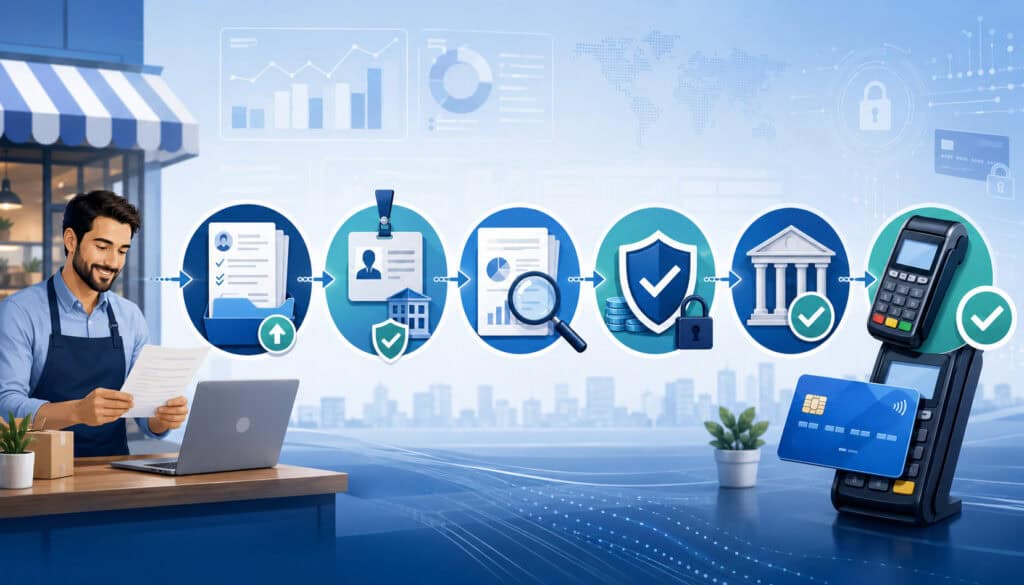
The merchant account approval process usually begins when a business submits an application. The form asks for legal business information, ownership details, tax identification information, bank account details, sales channels, estimated processing volume, average ticket size, and business activity.
After submission, the provider or processor performs merchant account verification. This may include checking the legal business name, DBA name, business address, phone number, website, EIN, ownership information, and business bank account. The goal is to confirm that the business exists, the applicant is authorized, and the activity matches the application.
Next, the underwriting review begins. Underwriters evaluate risk. They may review merchant account documents such as a business license, articles of organization, articles of incorporation, EIN confirmation, voided check, bank letter, utility bill, lease agreement, financial statements, processing statements, supplier invoices, or fulfillment records.
Online businesses often receive a website review. Reviewers check whether the website clearly explains products or services, pricing, contact details, refund policy, privacy policy, terms and conditions, shipping policy, subscription terms, and customer support. For online sellers, the website is often treated as evidence of how the business presents itself to customers.
Once underwriting is complete, the application may be approved, approved with conditions, delayed for more information, or declined. If approved, the account is boarded, pricing and limits are configured, a payment gateway may be connected, and settlement settings are established.
After approval, initial transaction monitoring may continue. Early processing activity is often watched closely to confirm that actual sales match the approved profile.
Who Reviews a Merchant Account Application?

Several parties may be involved in reviewing a merchant account application. The exact structure depends on the provider, processor, acquiring bank, payment gateway, business type, and sales model. Even when one company appears to handle everything, multiple risk and operations functions may be working behind the scenes.
The merchant account provider typically collects the application, communicates with the business, gathers documents, explains next steps, and helps prepare the file for review. The payment processor handles transaction processing systems, boarding, reporting, settlement, risk tools, and ongoing payment operations.
The acquiring bank is the financial institution connected to the merchant account. It plays a key role because it supports the merchant’s access to card network processing. The acquiring side of the relationship has risk exposure if the merchant generates chargebacks, refunds, fraud losses, or unpaid obligations.
Underwriting teams review the details. They look at legitimacy, ownership, business model, processing risk, refund exposure, chargeback history, industry type, and compliance concerns. Risk departments may also monitor the account after approval.
A payment gateway may be involved when the business accepts online payments. The gateway connects the checkout or software platform to the processor and helps transmit payment data securely.
The Role of the Business Owner
The business owner or authorized signer has one of the most important roles in merchant account approval. This person is responsible for submitting accurate information, providing required merchant account documents, explaining the business model, and responding to underwriting questions.
The owner may need to provide legal business name, DBA name, EIN, business address, ownership percentage, phone number, email address, business bank account details, website, expected monthly volume, average ticket size, highest expected ticket, refund practices, and fulfillment details.
Accuracy matters. If the business name on the application does not match formation documents, bank account records, or website information, the application may be delayed. If the website says one thing and the application says another, underwriters may ask for clarification.
The owner should also be prepared to explain how customers buy, how products are delivered, how refunds are handled, and whether transactions are card-present, card-not-present, recurring, subscription-based, invoiced, or ecommerce.
The Role of Underwriting Teams
Underwriting teams evaluate whether the merchant can be approved safely under the processor’s rules, acquiring bank requirements, card network expectations, and risk policies. Their job is not only to approve or decline applications. Their job is to understand risk and decide what conditions, if any, are needed.
Underwriters may review business verification, owner verification, website consistency, chargeback exposure, refund patterns, processing history, financial stability, business category, product restrictions, billing practices, and customer complaint risk.
They may request additional information when something is unclear. For example, a business selling high-ticket products may be asked for supplier invoices or proof of fulfillment. A subscription business may be asked for cancellation terms. A business with prior processing may be asked for merchant statements.
Underwriting is also practical. Reviewers want to know whether the business can deliver what it sells, communicate clearly with customers, manage disputes, and cover refunds or chargebacks if needed.
Basic Information Needed for Merchant Account Approval
Most merchant account approval requirements begin with basic business information. This information helps reviewers confirm that the business is real, properly identified, and connected to an authorized owner or signer.
A typical merchant services application may ask for the legal business name, DBA name, business address, phone number, website, business type, entity structure, EIN, ownership details, business start details, contact information, and business bank account information.
The legal business name should match formation records and tax identification records. The DBA name should match how the business presents itself to customers. If the customer-facing name is different from the legal name, the application should make that clear.
The business address also matters. Some businesses operate from a storefront, office, warehouse, home office, shared workspace, or virtual location. Underwriters may need to understand where operations happen and whether the address is consistent with public records, documents, invoices, or utility bills.
Applications also ask about sales channels. A business may accept payments in person, online, by invoice, by phone, through a mobile device, through recurring billing, or through a payment gateway. These channels carry different risk levels.
Processing estimates are another important part of the application. Underwriters review expected monthly processing volume, average ticket size, highest ticket size, and card-present versus card-not-present activity. These numbers help establish initial account limits and risk expectations.
Documents Commonly Required for Merchant Account Approval
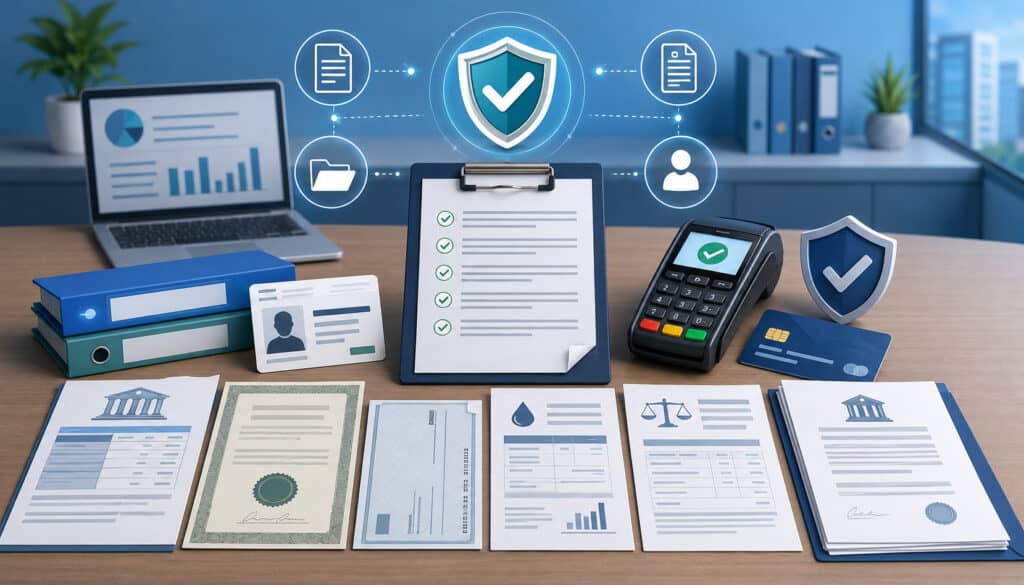
Merchant account documents vary based on the business type, ownership structure, industry, sales channel, risk level, and processing history. Some businesses may need only basic documents, while others may need a more detailed file.
Common documents include a business license, articles of organization, articles of incorporation, EIN confirmation, bank letter, voided check, utility bill, lease agreement, government-issued identification for owners, financial statements, processing statements, supplier invoices, website policies, proof of inventory, proof of fulfillment, or professional licenses.
A business bank account document is often requested to verify settlement details. This may be a voided check or bank letter showing the business name, routing number, and account number. The name on the bank account should match the legal business name or acceptable DBA structure.
Existing businesses may be asked for processing history. Merchant statements can show monthly volume, average ticket size, chargebacks, refunds, card mix, transaction patterns, and account performance. These statements help underwriters compare the new application to actual historical activity.
Online sellers may need website documentation or policy updates. Underwriters may ask for a visible refund policy, privacy policy, terms and conditions, fulfillment details, subscription terms, or customer support contact information.
Higher-risk businesses may need extra support documents. These may include supplier invoices, licenses, bank statements, financial statements, product documentation, chargeback mitigation plans, or compliance records.
Merchant Account Approval Requirements Table
The exact merchant account approval requirements depend on the business, but many applications include a similar set of review items. The table below summarizes common requirements and how to prepare for them.
| Requirement | What It Verifies | When It May Be Requested | Preparation Tip |
| Legal business name | Confirms the registered business identity | Most applications | Match the name to formation and tax records |
| DBA name | Confirms the customer-facing business name | When the public name differs from the legal name | Keep website, signage, receipts, and application consistent |
| EIN | Verifies tax identification details | Most business accounts | Use the exact number assigned to the entity |
| Business license | Supports business legitimacy | Regulated, local, or licensed activities | Provide current and readable copies |
| Owner identification | Supports owner verification | Most applications | Ensure details match application information |
| Business bank account | Confirms settlement destination | Most applications | Use a bank letter or voided check with matching name |
| Website policies | Shows customer-facing terms | Ecommerce and online businesses | Publish refund, privacy, terms, and fulfillment pages |
| Processing history | Shows prior payment performance | Existing merchants | Prepare recent merchant statements if available |
| Financial statements | Supports financial stability review | Higher-risk or higher-volume accounts | Keep current statements organized |
| Chargeback history | Helps assess dispute risk | Existing or higher-risk merchants | Know dispute ratios and prevention steps |
| Fulfillment proof | Shows ability to deliver products or services | Delayed delivery, high-ticket, or online sales | Keep invoices, tracking, and delivery records |
| PCI compliance awareness | Supports payment data security expectations | Businesses handling card data | Review requirements through the PCI Security Standards Council |
This table is not a guarantee that every item will be requested. It is a preparation tool. A low-risk retail business may need fewer documents, while a higher-risk merchant account approval may require more evidence before payment processor approval is granted.
Business Verification During Merchant Account Approval
Business verification is the process of confirming that the business exists, operates as described, and matches the information submitted on the merchant account application. This step is central to merchant account approval because payment processors and acquiring banks need to know who they are onboarding.
Underwriters may verify the legal business name, DBA name, business address, phone number, website, business bank account, EIN, and public registration details. They may compare these details with documents, public records, bank records, website content, invoices, licenses, or other evidence.
Consistency is one of the biggest factors. If the legal name on the application differs from the bank account, or the website shows a different business model than the application, the review may pause until the discrepancy is explained.
Business verification also looks at activity. A company applying as a restaurant should not have a website that primarily sells unrelated high-risk products. A service provider should describe services clearly. An ecommerce store should show product details, pricing, policies, contact information, and checkout expectations.
Phone number and address verification can also matter. Underwriters may want to see that customers have a way to contact the business and that the address supports the stated operation. A home-based business is not automatically a problem, but it should be disclosed accurately.
For businesses researching classification, this guide to merchant category codes explains how business activity can influence payment setup and risk review.
Owner Identity and Personal Verification
Owner verification helps confirm that the person applying for the account is authorized to do so. It also helps reduce fraud, identity misuse, and unauthorized account opening. This part of merchant account approval is common because card payments involve financial responsibility.
The application may ask for owner name, ownership percentage, title, address, date of birth, contact details, and identifying information. In some cases, the authorized signer may be reviewed even if they are not the only owner.
Underwriters may verify identity, address, ownership records, and authorization. They may also review whether the owner or signer has authority to bind the business to merchant account terms. For larger or more complex entities, ownership information may need to show who controls the business.
This review should be understood as a standard risk and verification step. It does not mean the business has done anything wrong. Payment accounts can be misused if opened under false identities, stolen business information, or unauthorized signers.
Privacy matters. Businesses should submit sensitive information only through secure channels provided during the application process. Owners should avoid sending sensitive identity documents through unsecured methods unless specifically instructed through an approved process.
Business Bank Account Review
A valid business bank account is important because approved card payments must be settled somewhere. Settlement is the process of depositing processed funds into the merchant’s account after transactions are authorized, captured, and cleared.
During merchant account approval, bank verification helps confirm that deposits will go to the correct business. Underwriters may request a voided check, bank letter, or other bank document that shows the account name, routing number, and account number.
The account name should generally match the legal business name or an accepted DBA. If the application lists one name but the bank account shows another, approval may be delayed. Mismatched bank information can create funding errors, settlement delays, or fraud concerns.
Bank account review is also used to confirm that the merchant can receive deposits and handle debits related to fees, chargebacks, refunds, or adjustments. Merchant services accounts often require both credit and debit access for normal payment operations.
New businesses should open a dedicated business bank account before applying. Using a personal account can create avoidable problems, especially when the business is registered as a separate entity.
Bank letters should be current, clear, and issued by the financial institution. Voided checks should not be altered or handwritten in a way that creates doubt. If the bank account was recently opened, be ready to explain that the business is new.
Website Review for Online Businesses
Website review is one of the most important parts of ecommerce merchant account approval. For online businesses, the website often serves as the storefront, sales presentation, customer contract, product catalog, and service explanation.
Underwriters review the website to see whether customers can understand what is being sold, how much it costs, how they receive it, how to contact support, how refunds work, and what terms apply. A clear website can reduce disputes because customers are less likely to feel confused or misled.
A complete website should include product or service descriptions, pricing, contact information, refund policy, privacy policy, terms and conditions, shipping or fulfillment policy, subscription terms if applicable, billing descriptor clarity, and customer support details.
Secure checkout is also important. Online businesses should use appropriate payment gateway tools, SSL protection, and data security practices. The PCI Security Standards Council provides payment data security standards and resources for businesses involved in card payments.
If the website is unfinished, underwriters may delay approval. Placeholder pages, missing policies, vague product descriptions, broken links, unclear pricing, and absent contact details can all create concerns.
For more context on online payment infrastructure, this guide comparing a payment gateway and merchant account explains how the two pieces work together.
Website Policies Underwriters Look For
Website policies help underwriters understand how the business sets expectations with customers. The most commonly reviewed policies include refund policy, privacy policy, terms and conditions, cancellation terms, shipping policy, fulfillment details, and subscription terms.
A refund policy should explain when refunds are available, how customers request them, how long review may take, and whether any products or services are nonrefundable. The policy should be easy to find before checkout.
A privacy policy explains how customer information is collected, used, stored, and protected. It is especially important for ecommerce businesses that collect customer names, addresses, emails, payment-related details, or account information.
Terms and conditions explain the rules of purchase. They may cover product use, service limitations, billing terms, customer responsibilities, cancellation rules, and dispute procedures.
Clear policies reduce customer confusion. Customer confusion often leads to refunds, complaints, chargebacks, and support issues. From an underwriting perspective, policies show whether the business is setting expectations responsibly.
Product and Service Description Review
Product and service descriptions help underwriters confirm that the business activity matches the application. Descriptions should explain what customers buy, what is included, how delivery works, and whether any limitations apply.
For physical products, descriptions should include item details, pricing, shipping timelines, inventory expectations, and return conditions. For services, they should explain the scope of work, scheduling, delivery method, cancellation terms, and customer obligations.
Digital products, memberships, subscriptions, and delayed delivery models need extra clarity. Customers should know whether billing is one-time or recurring, when access begins, how cancellation works, and whether refunds are available.
Businesses should avoid vague claims, unsupported promises, or unclear product categories. If a product is regulated, age-restricted, restricted by payment policies, or likely to create higher dispute risk, underwriters may ask for more documentation.
A website review is not only about design quality. It is about transparency, consistency, and risk.
Processing Volume, History, Chargebacks, and Refunds
Merchant account approval usually includes a review of expected processing volume and average ticket size. These numbers help underwriters estimate risk and set account parameters.
Applications may ask for estimated monthly volume, average ticket size, highest expected ticket, card-present versus card-not-present percentage, recurring billing activity, and sales channels. A small café, an online furniture seller, and a consulting firm may all process card payments, but their risk profiles are different.
Realistic estimates are important. Overstating volume can raise questions. Understating volume can create problems later if actual processing quickly exceeds approved expectations. If sales are seasonal, explain the pattern.
Existing businesses may be asked for processing history. Merchant statements can show monthly volume, refunds, chargebacks, average ticket size, card mix, funding history, and prior account performance. Strong processing history can help underwriting because it shows how the business has performed with card payments.
Chargeback history is especially important. Chargebacks occur when customers dispute transactions through their card issuer. High dispute ratios may suggest unclear policies, fraud exposure, delivery problems, recurring billing confusion, customer dissatisfaction, or operational issues.
Refund activity is also reviewed. Refunds are normal, but unusually high refund rates may suggest product fit issues, unclear marketing, delayed fulfillment, or customer service problems.
For additional education on dispute tools, this overview of chargeback protection concepts may help businesses understand how risk tools fit into broader payment operations.
Credit, Financial, and Risk Review
Some merchant account applications involve a deeper credit, financial, or risk review. This does not apply equally to every business. The depth of review depends on business type, processing volume, average ticket size, industry, delivery model, ownership profile, and prior processing performance.
Underwriters may review business financial health, bank statements, financial statements, owner credit, cash flow, reserves, outstanding obligations, or refund exposure. The goal is to understand whether the business can support its expected payment activity and cover financial obligations connected to processing.
This is especially relevant when transactions are high-ticket, delivered later, subscription-based, or more likely to create chargebacks. If a merchant accepts payment before delivering goods or services, the processor may carry exposure until the customer receives what was purchased.
A risk review may also examine fraud prevention practices, customer support availability, fulfillment timelines, refund procedures, and chargeback management. Businesses that show organized operations may be easier to approve because they appear better prepared to manage payment issues.
No business should treat underwriting as a substitute for legal, tax, or financial advice. If an application raises complex financial, licensing, tax, or regulatory questions, the business should consult qualified professionals.
High-Risk Merchant Account Approval
High-risk merchant account approval involves additional review because some businesses create more exposure for processors and acquiring banks.
A business may be considered higher risk because of industry type, chargeback exposure, regulated products, subscription billing, delayed delivery, international sales, high average tickets, digital goods, travel-related services, prior processing issues, or specific payment rules.
Higher risk does not automatically mean the business is improper or unqualified. It means the payment profile may require closer review, more documents, stricter terms, reserves, processing limits, or ongoing monitoring.
Underwriters may want to see whether the business can manage customer expectations, deliver products or services reliably, reduce fraud, handle refunds, and respond to chargebacks. They may also review advertising claims, product sourcing, licenses, supplier relationships, fulfillment timelines, and compliance records.
Some higher-risk businesses may be approved with conditions. Conditions may include a rolling reserve, delayed funding, monthly processing cap, ticket limit, additional reporting, or periodic underwriting review.
Why Some Businesses Are Considered Higher Risk
Businesses are often considered higher risk when payment problems are more likely or harder to predict. Common risk factors include dispute frequency, fraud exposure, refund complexity, recurring billing confusion, delayed fulfillment, product restrictions, compliance concerns, and reputation risk.
For example, a business that ships products weeks after payment creates delivery timing risk. A subscription business may face disputes if cancellation terms are unclear. A high-ticket seller may create more financial exposure per transaction. A digital goods seller may face fraud or access disputes.
International sales can also increase complexity because customer expectations, shipping timelines, fraud patterns, and dispute handling may vary. Card-not-present transactions are usually reviewed more closely than in-person transactions because the cardholder and card are not physically present.
Underwriters look for controls. Clear terms, visible customer support, fraud prevention tools, accurate billing descriptors, reliable fulfillment, and documented refund practices can all help reduce concerns.
Extra Documents High-Risk Businesses May Need
Higher-risk businesses may need more documents than lower-risk applicants. These may include bank statements, financial statements, processing history, supplier invoices, fulfillment proof, inventory records, refund policies, chargeback mitigation plans, business licenses, professional licenses, compliance records, or customer terms.
Processing history is especially useful when available. If the business has already processed card payments successfully, recent merchant statements can show actual volume, refunds, chargebacks, average ticket size, and account stability.
Supplier invoices can help confirm that the business has access to the products it sells. Fulfillment records can show that products are delivered as promised. Licensing records may be needed for regulated activities.
A chargeback mitigation plan may explain how the business prevents disputes, verifies orders, handles customer service, confirms delivery, manages recurring billing, and responds to complaints.
Reserves, Holds, and Conditional Approvals
Some merchant accounts are approved with special conditions. These conditions are used when underwriters want extra protection against chargebacks, refunds, fraud, delayed delivery, or unusual processing patterns.
A rolling reserve means a percentage of processed funds is held for a set period before being released. For example, a portion of each settlement may be held to cover possible future chargebacks or refunds. A fixed reserve is a specific amount held as a risk cushion.
A funding hold is different. It may happen when transactions require review before funds are released. Holds may occur because of unusual volume spikes, large tickets, suspicious activity, excessive refunds, chargeback concerns, or activity outside the approved profile.
Delayed funding means settlement deposits may be released on a slower schedule. Processing limits may restrict monthly volume or maximum ticket size. Conditional approval may allow the account to open while requiring additional documents, reserves, or monitoring.
These tools can be frustrating for merchants, but they are part of risk management. They do not always mean the account is in trouble. They often mean the processor or acquiring bank wants more time or protection before releasing all funds.
Businesses can reduce the likelihood of reserves or holds by submitting accurate information, keeping chargebacks low, avoiding sudden unexplained volume changes, maintaining strong customer support, and notifying the provider before major business changes.
Common Approval Delays and Declines
Merchant account approval can be delayed for many reasons. The most common delays involve missing documents, inconsistent business information, mismatched bank account names, unclear websites, incomplete policies, vague product descriptions, unrealistic processing estimates, unresolved chargeback concerns, or slow responses to underwriting questions.
A delay does not always mean the application will be declined. Often, the underwriting team simply needs clarification. For example, if the website does not show a refund policy, the applicant may be asked to add one. If the bank account name does not match the application, a bank letter may be requested.
Applications may be declined when the business activity is prohibited, ownership cannot be verified, documents are incomplete, chargebacks are excessive, processing history is poor, website claims are misleading, the business model is unsupported, compliance concerns remain unresolved, or the business cannot be verified.
Declines can also happen when the application does not match reality. If a merchant applies under one category but appears to sell something else, the inconsistency can create serious concerns.
Businesses should respond quickly and honestly to underwriting requests. Trying to hide product details, recurring billing terms, prior processing issues, or refund problems can damage trust.
Merchant Account Approval Process Table
The approval process can vary, but the following table shows the common stages and what businesses can do to avoid delays.
| Approval Stage | What Happens | What Underwriters Review | Common Delay to Avoid |
| Application submission | Business submits the payment processing application | Legal name, DBA, EIN, address, ownership, sales model | Incomplete or inconsistent application fields |
| Business verification | Business identity is checked | Registration details, address, phone, website, documents | Mismatched business names or addresses |
| Owner verification | Authorized signer is reviewed | Identity, ownership percentage, authority | Missing owner details or unclear signing authority |
| Bank verification | Settlement account is confirmed | Business bank account, routing, account name | Personal account or mismatched bank name |
| Document review | Supporting documents are checked | Licenses, formation documents, statements, invoices | Outdated, unreadable, or missing documents |
| Website review | Online presence is reviewed | Products, pricing, policies, support, checkout | Missing refund policy, privacy policy, or terms |
| Risk assessment | Processing exposure is evaluated | Volume, ticket size, chargebacks, refunds, industry | Unrealistic estimates or unexplained risk factors |
| Approval decision | Account is approved, conditioned, delayed, or declined | Full file and risk profile | Slow responses to follow-up questions |
| Account setup | Merchant ID, gateway, settlement, and settings are configured | Processing limits, funding schedule, descriptor | Incorrect gateway or settlement details |
| Early monitoring | Initial transactions are watched | Volume pattern, refunds, disputes, fraud signals | Processing outside the approved profile |
This table can also serve as a preparation map. Before applying, review each stage and ask whether your business can provide the information needed.
How New Businesses Can Prepare for Merchant Account Approval
New businesses can be approved even without processing history. Underwriters understand that startups, new ecommerce sellers, restaurants, retail stores, and service providers may not have prior merchant statements. The key is to prepare strong business information and realistic expectations.
Start with complete business documentation. Make sure the legal business name, DBA, EIN, formation documents, business license, and ownership details are organized. The IRS EIN resource explains how employer identification numbers are used for business identification.
Next, open an active business bank account in the correct name. This account will be used for settlement deposits and processing-related debits. Avoid waiting until after approval to set up banking.
New businesses should also prepare realistic processing estimates. Estimate monthly volume, average ticket size, highest ticket, and sales channels based on pricing, marketing plans, inventory, staffing, and expected customer demand.
For online businesses, the website should be complete before applying. Product pages, pricing, checkout flow, refund policy, privacy policy, terms and conditions, fulfillment details, and customer support information should be visible.
New businesses should also document fulfillment plans. Underwriters may want to know whether products are in stock, services are scheduled, digital access is immediate, or delivery is delayed.
A new business does not need to appear larger than it is. It needs to appear organized, verifiable, and prepared.
How Existing Businesses Can Prepare for Merchant Account Approval
Existing businesses should prepare differently because they may have payment history, operating records, customer patterns, and prior processing statements. This information can help underwriting when it is accurate and well organized.
Start by gathering recent merchant statements if you have processed card payments before. These statements may show monthly volume, chargebacks, refunds, average ticket size, transaction count, funding activity, and card mix. Underwriters may use them to compare your application estimates with real performance.
Review chargeback history before applying. Know your dispute ratio, common dispute reasons, refund patterns, and customer complaint sources. If chargebacks were high in the past, prepare a brief explanation of what changed. Examples may include clearer policies, better support, fraud tools, delivery tracking, or improved billing descriptors.
Existing businesses should also review their website, invoices, receipts, customer terms, and payment gateway setup. Make sure the public-facing information matches the application.
If you are switching providers, be ready to explain why. Common reasons include better reporting, different gateway needs, updated equipment, business growth, or changes in sales channels.
Reconciliation records can also help finance teams. Knowing how deposits, fees, refunds, and chargebacks are tracked makes the transition smoother after approval.
Merchant Account Approval Checklist
Use this checklist before submitting a merchant account application:
- Legal business name confirmed.
- DBA name confirmed, if applicable.
- Ownership information ready.
- Authorized signer identified.
- EIN available.
- Business bank account active.
- Bank letter or voided check prepared.
- Business documents prepared.
- Business license available, if applicable.
- Website is complete.
- Product or service descriptions are clear.
- Pricing is visible and accurate.
- Refund policy is visible.
- Privacy policy is visible.
- Terms and conditions are visible.
- Shipping, delivery, or fulfillment details are documented.
- Subscription or cancellation terms are clear, if applicable.
- Processing estimates are realistic.
- Prior merchant statements are available, if applicable.
- Chargeback history is reviewed.
- Refund activity is understood.
- Customer support contact information is easy to find.
- PCI compliance responsibilities are understood.
- Payment gateway needs are identified.
- Underwriting questions can be answered quickly.
This checklist does not replace underwriting requirements, but it helps businesses avoid common problems. The strongest applications are usually complete, consistent, and easy to verify.
Tips to Improve Merchant Account Approval Chances
The best way to improve approval chances is to reduce uncertainty. Underwriters are trying to understand who you are, what you sell, how customers pay, how products or services are delivered, and how much risk the account may create.
Submit complete documents. Missing pages, expired licenses, unreadable scans, and partial bank letters can slow the review. Use clear file names and provide documents in the requested format.
Keep business details consistent. The legal name, DBA, EIN, address, website, bank account, invoices, and customer-facing materials should not conflict. If there is a legitimate difference, explain it.
Use realistic processing estimates. A new merchant should not inflate volume to appear more established. An existing merchant should not submit estimates far below actual history.
Improve website transparency. Publish clear policies, product descriptions, pricing, contact details, and fulfillment terms. Online businesses should make it easy for customers to understand what they are buying before payment.
Be honest about the business model. Recurring billing, delayed delivery, regulated products, high-ticket sales, international orders, and digital goods should be disclosed accurately.
Maintain strong customer support. Visible phone, email, address, chat, or support forms can reduce customer frustration and disputes.
Reduce chargebacks before applying when possible. Better billing descriptors, delivery tracking, fraud screening, confirmation emails, and responsive support can all help.
Questions to Ask Before Applying for a Merchant Account
Before applying, businesses should ask practical questions about the review and account setup. These questions help avoid surprises during merchant onboarding and after approval.
Ask what documents are required for your business type. Requirements differ for startups, ecommerce businesses, retail stores, restaurants, professional services, subscription businesses, and higher-risk categories.
Ask how underwriting works. It is useful to know whether the file goes through automated checks, manual review, acquiring bank review, website review, or additional risk review.
Ask how long review can take and what causes delays. Timelines depend on completeness, document quality, business type, and risk profile.
Ask whether reserves are possible. Some businesses may be approved without reserves, while others may face rolling reserve, fixed reserve, delayed funding, or processing limits.
Ask what website policies are needed. Ecommerce merchants should know whether refund, privacy, terms, shipping, cancellation, and fulfillment policies must be live before approval.
Ask what chargeback tools are available. Fraud filters, alerts, order verification, descriptor management, and dispute reporting can help reduce future problems.
Ask what funding timeline should be expected. Settlement timing can affect cash flow, especially for restaurants, retailers, and service businesses.
Ask what happens if business activity changes. Adding new products, sales channels, subscriptions, or higher-ticket offers may require notice or review.
Common Mistakes Businesses Make During Approval
Many merchant account approval problems are avoidable. The most common mistakes involve incomplete applications, inconsistent business names, hidden product details, overstated processing volume, missing website policies, unclear refund terms, undisclosed recurring billing, unprepared documents, and slow responses.
Some businesses rush the application before their website, banking, documents, or policies are ready. Others assume that underwriting will not notice inconsistencies. In practice, mismatched information is one of the fastest ways to create delays.
Another common mistake is describing the business too vaguely. “Consulting,” “retail,” “wellness,” or “online sales” may not be enough. Underwriters need to know what is actually sold, how customers buy it, and how delivery works.
Businesses also make mistakes with processing estimates. If the highest ticket is listed as very low but the website sells expensive packages, the file may be questioned. If monthly volume seems unrealistic for a new business, additional review may occur.
Recurring billing should always be disclosed. Subscription terms, cancellation rules, billing frequency, trial offers, and renewal notices can affect risk.
Documentation Mistakes
Documentation mistakes can delay approval even when the business itself is legitimate. Common problems include outdated documents, mismatched business names, missing bank verification, incomplete licenses, unclear ownership records, missing processing statements, or unreadable files.
A bank letter that does not show the business name may not be enough. A license that expired may need renewal. Articles of organization that list an old business name may require explanation or updated records.
Businesses should avoid sending scattered screenshots when formal documents are requested. Underwriting teams need reliable evidence that can be reviewed and stored in the file.
If documents contain different addresses, names, or ownership details, include a short explanation. For example, a business may have moved, changed DBA names, or opened a new bank account. Clear explanations can prevent unnecessary back-and-forth.
Website and Policy Mistakes
Website and policy mistakes are especially common for ecommerce merchant account applications. A website may look attractive but still fail underwriting review if important customer-facing details are missing.
Common issues include unclear pricing, missing contact details, vague product pages, no refund policy, no privacy policy, no terms page, unclear shipping details, broken links, confusing subscription terms, or checkout pages that do not match the application.
Underwriters also look for consistency. If the application says the business sells physical products but the website promotes memberships, downloads, or consulting services, the file may require clarification.
Online businesses should test the customer journey before applying. A reviewer should be able to understand the product, price, delivery method, refund process, company identity, and support options without guessing.
Best Practices After Merchant Account Approval
Merchant account approval is not the end of the process. It is the beginning of responsible payment operations. After approval, businesses should monitor transactions, reconcile deposits, review statements, track fees, watch chargebacks, and maintain accurate records.
Compare actual processing volume with approved estimates. If volume grows quickly or ticket sizes increase, notify the provider before the change creates a risk review. Sudden unexplained changes can trigger funding holds or account questions.
Keep chargebacks low by responding quickly to customers, using clear billing descriptors, confirming orders, tracking deliveries, explaining cancellation terms, and maintaining helpful support. Review dispute reports regularly and look for patterns.
Maintain website policies. If refund terms, subscription terms, fulfillment timelines, or product offerings change, update the website quickly. Stale policies can create customer confusion and underwriting concerns.
Stay PCI-aware. Businesses that accept card payments have responsibilities related to payment data security. The exact responsibilities depend on how payments are accepted and what systems are used. Review resources from the PCI standards organization and ask qualified security professionals when needed.
Update business information when it changes. New ownership, new bank account, new address, new website, new products, new sales channels, or a major processing increase may require notification.
Good post-approval habits protect settlement reliability and reduce future account issues.
What is merchant account approval?
Merchant account approval is the review process used to decide whether a business can open a merchant account and accept card payments. Reviewers confirm the business identity, ownership information, bank account details, products or services, sales channels, processing estimates, and risk profile.
The process helps payment processors and acquiring banks understand whether the business can safely process transactions. It also helps identify potential concerns such as unclear policies, high chargeback risk, missing documents, or unsupported business activity.
How does the merchant account approval process work?
The process usually begins with a merchant account application. The business submits legal information, ownership details, tax identification details, banking information, website details, sales channels, and processing estimates.
After submission, the file goes through business verification, owner verification, document review, website review if applicable, merchant account underwriting, risk assessment, and approval decisioning. If approved, the account is boarded, settlement is configured, and the payment gateway or processing equipment may be activated.
What is merchant account underwriting?
Merchant account underwriting is the risk review used to evaluate a business before approval. Underwriters examine whether the business is legitimate, whether ownership can be verified, whether the product or service is supported, and whether the processing activity appears manageable.
They may review business documents, owner information, processing history, chargeback history, refund policy, website content, financial statements, bank account details, and industry risk. Underwriting helps determine whether the account can be approved and whether any conditions are needed.
What documents are needed for merchant account approval?
Common merchant account documents may include a business license, formation documents, EIN confirmation, voided check, bank letter, owner identification, utility bill, lease agreement, processing statements, financial statements, supplier invoices, website policies, or proof of fulfillment.
Not every business needs every document. A simple retail business may need fewer items, while an ecommerce business, high-volume merchant, subscription business, or higher-risk merchant may need more.
Why do underwriters review websites?
Underwriters review websites because online businesses use their websites to describe products, present prices, set customer expectations, explain policies, and accept orders. A website review helps confirm that the business matches the application.
Reviewers often look for product descriptions, pricing, contact information, refund policy, privacy policy, terms and conditions, shipping details, subscription terms, secure checkout, and customer support information. A clear website can reduce confusion, refunds, and chargebacks.
Do new businesses need processing history?
New businesses do not usually have processing history, and that is expected. Instead, they should prepare strong documentation, realistic sales estimates, clear product descriptions, a complete website if selling online, an active business bank account, and accurate ownership information.
Underwriters may approve new businesses based on the overall file, business model, documents, and expected activity. New merchants should avoid overstating volume or hiding uncertainty.
Can a merchant account application be declined?
Yes, a merchant account application can be declined. Common reasons include prohibited business activity, unverifiable ownership, incomplete documents, unsupported products, excessive chargebacks, poor processing history, misleading website claims, unresolved compliance concerns, or inability to verify the business.
A decline does not always mean the business can never accept card payments. In some cases, the business may need better documentation, clearer policies, a different processing structure, or a provider that supports its business type.
What makes a business high risk?
A business may be considered high risk because of chargeback exposure, fraud risk, subscription billing, delayed delivery, high average tickets, international sales, regulated products, digital goods, prior processing issues, or industry-specific concerns.
High risk does not automatically mean the business is unacceptable. It means the account may need additional underwriting, more documents, reserves, processing limits, or closer monitoring.
How can businesses improve approval chances?
Businesses can improve approval chances by submitting a complete application, keeping business information consistent, preparing documents early, using realistic processing estimates, publishing clear website policies, maintaining strong customer support, reducing chargebacks, and answering underwriting questions quickly.
Transparency helps. Underwriters are more likely to understand the account when the business clearly explains what it sells, how customers pay, how delivery works, and how refunds or cancellations are handled.
Conclusion
Merchant account approval is a practical review process that helps payment providers understand a business before card payments begin. It includes business verification, owner verification, merchant account documents, bank account review, website review, underwriting review, risk assessment, and payment setup.
For business owners, the best preparation is simple: be accurate, complete, consistent, and transparent. Make sure your business name, ownership details, EIN, bank account, website, policies, product descriptions, processing estimates, and supporting documents all tell the same story.
A well-prepared application can reduce delays, improve the underwriting experience, and support more stable payment operations after approval. Whether the business is new, established, retail, restaurant-based, service-oriented, or online, preparation makes merchant account approval easier to understand and easier to navigate.