
Merchant service contract terms can affect how much your business pays, how quickly funds are deposited, what happens during chargebacks, and how difficult it may be to cancel a processing relationship. Yet many business owners sign a merchant services agreement after focusing only on the advertised rate or monthly cost.
That can lead to surprises later. A merchant service agreement may include pricing rules, renewal language, reserve rights, equipment obligations, gateway fees, PCI compliance requirements, and account closure terms. Some provisions are routine, while others can create meaningful financial or operational consequences.
This guide explains common merchant service contract terms in a practical, reader-friendly way. It is written for ecommerce sellers, retail shops, restaurants, service businesses, finance teams, bookkeepers, and new merchants who want to understand the language found in a merchant processing agreement before signing.
This article is informational only and does not provide legal, tax, compliance, or financial advice. Contract wording varies, and payment rules can be complex. Review the full agreement carefully and consult a qualified professional when a clause is unclear or could create significant risk for your business.
What Are Merchant Service Contract Terms?
Merchant service contract terms are the rules, definitions, pricing details, and responsibilities included in a merchant services agreement. They explain how the business can accept payments, what the provider will do, what the merchant must do, how fees are charged, and what happens when something goes wrong.
These terms may appear in several documents rather than one single agreement. A merchant account agreement may include an application, pricing schedule, program guide, terms and conditions, equipment agreement, payment gateway addendum, PCI compliance notice, and processor operating rules. Together, those documents can form the full processing contract.
Common merchant services contract terms cover topics such as:
- Merchant account fees and payment processing fees
- Settlement terms and funding timing
- Batch processing rules
- Chargebacks, refunds, and dispute deadlines
- PCI compliance and data security obligations
- Equipment lease or terminal lease provisions
- Early termination fee language
- Auto-renewal clause and cancellation clause details
- Reserve clause, rolling reserve, and funding hold rights
- Prohibited activities and underwriting requirements
- Personal guarantee obligations
- Account closure and post-termination responsibilities
A contract may also incorporate card network rules by reference. That means the merchant agrees to follow payment acceptance rules even if those rules are not printed inside the main contract.
For example, payment card data security responsibilities are tied to PCI standards, and merchants can review general security expectations through the PCI Security Standards Council.
The key point is that merchant agreement terms are not just legal wording. They influence everyday operations, including deposits, refunds, equipment use, reporting, account access, billing, and dispute response.
Why Merchant Services Agreements Matter
A merchant services agreement matters because it controls the financial and operational relationship between your business and the payment provider. Even if the application process feels quick, the contract can create long-term obligations that affect cash flow, costs, cancellation rights, and risk exposure.
One of the biggest reasons to review a merchant services contract is fee transparency. Many merchants focus on the discount rate but miss monthly fees, gateway fees, PCI compliance fees, chargeback fees, statement fees, batch fees, minimum fees, and equipment fees. A low advertised rate may not reflect the total cost of processing.
The agreement also explains when funds are deposited. Settlement terms may describe daily funding, next-day funding, delayed funding, weekend timing, holiday delays, reserves, or funding holds. If your business relies on fast cash flow for payroll, inventory, or supplier payments, these terms deserve close attention.
Cancellation language is another major issue. A payment processor contract may include an initial term, renewal period, auto-renewal clause, early termination fee, liquidated damages language, or written notice requirement. Missing a cancellation window can extend the contract or create extra costs.
Merchant services agreements also matter because payment processing involves risk. Chargebacks, refunds, fraud, unusual sales spikes, financial instability, or unsupported products can trigger risk review. Some contracts allow the provider to hold funds, request documents, change processing limits, or close the merchant account.
Before signing, merchants should understand not only what the provider promises, but also what the business is agreeing to do. That includes maintaining PCI compliance, following card network rules, keeping account information current, using approved equipment, honoring refund policies, and responding to disputes on time.
Key Parties in a Merchant Processing Agreement

A merchant processing agreement usually involves more than two parties. The business may interact with one provider, but several entities may support authorization, settlement, risk management, funding, reporting, and compliance. Knowing who does what helps merchants understand contract language and troubleshoot issues later.
The merchant is the business accepting payments. The payment processor handles transaction routing and processing services. The acquiring bank, sometimes called the acquirer, sponsors the merchant account and connects the business to card payment systems.
The payment gateway securely transmits transaction data for ecommerce, invoice, mobile, or virtual terminal transactions.
Card networks set operating rules for acceptance, disputes, data quality, and certain fees. Equipment providers may supply terminals, POS devices, card readers, or accessories. Software providers may support recurring billing, invoicing, inventory, online checkout, fraud tools, and reporting.
In some agreements, the business owner or authorized signer may also be personally involved through a personal guarantee. That clause can connect certain business obligations to the individual signer. It should be reviewed carefully because it may have consequences beyond routine account management.
For a broader explanation of payment flow, this guide to how online payment processing works can help merchants connect contract terms to the actual transaction lifecycle.
Merchant and Authorized Signer
The merchant is responsible for using the account according to the contract. That means accepting payments only for approved goods or services, submitting accurate business information, following card acceptance requirements, maintaining security controls, paying fees, and responding to chargebacks.
The authorized signer confirms that the business information is accurate and that the business agrees to the merchant service agreement. In some cases, the signer may also agree to a personal guarantee. This is why the person signing should understand whether they are signing only as a business representative or also accepting individual responsibility.
Merchants are usually required to keep account details current. Changes in ownership, legal name, bank account, website, products, fulfillment model, average ticket, sales volume, or refund policy may need to be reported. A business model change that seems minor internally may matter to underwriting.
The merchant also has day-to-day responsibilities. These include batching transactions properly, issuing refunds through the approved system, keeping transaction records, protecting card data, and submitting dispute evidence by deadlines.
Processor, Acquirer, and Gateway
The processor helps move transaction data between the merchant, card networks, issuing banks, and acquiring side of the payment system. The processor may provide reporting, billing, risk monitoring, authorization routing, settlement support, chargeback notifications, and customer service tools.
The acquiring bank supports the merchant account and assumes certain settlement and network responsibilities. In many contracts, the acquirer has rights related to underwriting, account review, reserves, rule enforcement, and termination. Merchants may not interact with the acquirer often, but the acquirer can still be an important party in the contract.
The payment gateway is the technology layer that captures and transmits payment data, especially for ecommerce, invoice, subscription, and virtual terminal transactions. Gateway terms may cover gateway fees, API access, fraud filters, tokenization, recurring billing, data export, uptime, user permissions, and cancellation rules.
A gateway and merchant account are related but not the same. Merchants who want more background can review this resource on the difference between a payment gateway and merchant account.
Pricing and Fee Schedule Terms
The pricing schedule is one of the most important parts of a merchant services contract. It lists how the provider charges for processing, account maintenance, equipment, gateway access, compliance services, chargebacks, and other account activity.
A pricing schedule may include a discount rate, transaction fee, authorization fee, monthly fee, statement fee, gateway fee, batch fee, PCI compliance fee, PCI non-compliance fee, annual fee, minimum monthly fee, chargeback fee, retrieval fee, voice authorization fee, setup fee, and early termination fee. Some fees are recurring, while others apply only when a specific event happens.
The discount rate is usually a percentage of transaction volume. The transaction fee is usually a per-transaction amount. A batch fee may be charged when daily transactions are submitted for settlement. Gateway fees may apply for ecommerce or virtual terminal access. PCI compliance fees may relate to security validation tools or administrative programs.
Chargeback fees are usually charged when a cardholder dispute is opened, regardless of whether the merchant later wins the dispute. Retrieval fees may apply when a card issuer requests documentation before a chargeback is filed.
Merchants should also review whether fees are bundled or passed through. In some pricing models, card network costs and processor markup are combined. In others, interchange fees, assessment fees, and processor markup are separated.
Interchange, Assessments, and Processor Markup

Interchange fees, assessment fees, and processor markup are three major fee categories behind credit card processing fees. Understanding the difference helps merchants compare offers and review monthly statements more accurately.
Interchange fees are transaction-level costs associated with card acceptance. They vary based on factors such as card type, transaction method, business category, data quality, authorization method, and risk characteristics. A rewards card may cost more to accept than a basic debit card. A keyed transaction may price differently than a chip or contactless transaction.
Assessment fees are generally network-related charges. These may appear as separate line items on some statements or be included inside bundled pricing. They are usually smaller than interchange fees but still affect total payment processing fees.
Processor markup is the amount charged by the payment processor or merchant account provider above underlying pass-through costs. This may appear as a percentage, per-transaction amount, monthly fee, gateway fee, or other service charge.
Processor markup is often the most negotiable part of the pricing structure, depending on business type, volume, risk, and provider policies.
The contract may not always use these exact labels. It may refer to pass-through costs, network fees, dues, assessments, authorization fees, basis points, or processing fees. The pricing schedule should explain what is charged and how changes are handled.
A useful review question is: “Which costs are set by networks or issuing-side structures, and which costs are provider-controlled?” The answer can help merchants understand where comparison shopping is most meaningful.
Pricing Model Terms
Pricing model terms explain how the provider packages payment processing fees. The model affects statement transparency, cost predictability, and how easily merchants can compare providers.
Flat-rate pricing charges one simple rate for many transaction types. It is easy to understand and may work for small or newer businesses. However, it can hide the difference between lower-cost and higher-cost transactions because many costs are blended together.
Interchange-plus pricing separates interchange fees and assessments from processor markup. This model can be more transparent because the merchant can see underlying pass-through costs and the provider’s margin. It may require more careful statement review, but it often gives finance teams better visibility.
Tiered pricing groups transactions into categories such as qualified, mid-qualified, and non-qualified. The challenge is that the contract may not clearly explain which transactions fall into each tier. A low qualified rate may look attractive, but many real transactions may downgrade to higher tiers.
Subscription pricing usually combines a monthly membership fee with lower transaction markup. It may be useful for merchants with predictable volume, but the total cost depends on processing activity and all added fees.
Blended pricing combines many cost components into one or more simplified rates. Pass-through pricing may show underlying fees separately. The best model depends on the business, but the contract should make the structure understandable enough to audit.
Merchant Service Contract Terms Table
The table below summarizes common processing contract terms and what merchants should review before signing.
| Contract Term | What It Means | Why It Matters | What to Review Before Signing |
| Pricing schedule | The written list of rates and fees | Determines total processing cost | Confirm all recurring, transaction, event-based, and cancellation fees |
| Discount rate | Percentage charged on sales volume | Affects card processing cost | Check whether it is flat, tiered, or markup-based |
| Transaction fee | Per-transaction charge | Adds up with high ticket count | Compare authorization and transaction charges |
| Interchange fees | Underlying card acceptance costs | Can vary by transaction type | Ask whether they are passed through or bundled |
| Assessment fees | Network-related charges | May appear separately or inside bundled pricing | Review how changes are disclosed |
| Processor markup | Provider-controlled margin | Helps compare offers | Identify markup percentage and per-item fees |
| Monthly fees | Recurring account charges | Affect cost even in slow months | Check minimums, statement fees, gateway fees, and compliance fees |
| Gateway fees | Charges for online payment access | Important for ecommerce and invoicing | Confirm monthly, per-transaction, and add-on costs |
| Chargeback fees | Fees for disputes | Can increase costs during dispute spikes | Review dispute fee, evidence process, and deadlines |
| Early termination fee | Cost to cancel early | Can make switching expensive | Check fixed fee vs liquidated damages |
| Auto-renewal clause | Extends the contract automatically | Can lock in another term | Track notice window and renewal date |
| Equipment lease | Agreement for terminals or POS hardware | May be separate from processing | Confirm ownership, return rules, and cancellation limits |
| Reserve clause | Allows funds to be withheld for risk | Can affect cash flow | Review triggers, amounts, and release timing |
| Personal guarantee | Individual responsibility for certain obligations | May affect owners or signers personally | Consider qualified professional review |
Contract Length and Term Renewal Clauses
Contract length language explains how long the merchant services contract remains active. The agreement may have an initial term, renewal term, monthly term, or open-ended term that continues until canceled properly.
The initial term is the first contract period. A renewal period is what happens after the initial term ends. Some agreements renew month to month, while others renew for a longer period unless the merchant cancels within a specific notice window.
This is where many merchants get surprised. A business may believe the contract ends automatically, but the agreement may continue unless cancellation instructions are followed exactly.
The merchant may need to send a written notice a certain number of days before renewal. Some contracts require notice through a specific method, such as certified mail, portal submission, or written request to a particular department.
Contract length also interacts with pricing. Some providers may offer lower pricing in exchange for a longer term. Others may require a term because equipment, setup, or underwriting costs are spread over time. The business should decide whether the commitment fits its expected needs.
Mark key dates immediately after signing. Include the initial term end date, renewal date, cancellation window, equipment return deadline, and any notice period.
Auto-Renewal Clauses
An auto-renewal clause allows the processing contract to renew automatically unless the merchant cancels within the required timeframe. This clause may appear in the main agreement, program guide, or terms and conditions.
Auto-renewal can be convenient when a business is satisfied with the service. It prevents accidental interruption of payment acceptance. The issue is that it can also extend obligations when the business intends to switch providers, renegotiate pricing, sell the business, or close the account.
Merchants should review how long each renewal lasts. Some contracts renew monthly, while others renew for a longer period. The agreement should also explain whether the early termination fee applies during a renewal term.
The most important action is calendar management. Save the renewal date and cancellation window in a system that owners and finance staff can access. Do not rely on memory or a single employee.
Notice Requirements
Notice requirements explain how the merchant must communicate contract decisions. They may apply to cancellation, bank account changes, ownership updates, address changes, fee disputes, equipment returns, or legal notices.
A contract may require written notice, electronic notice, signed forms, account portal submission, certified mail, or delivery to a specific address. It may also require notice a certain number of days before cancellation or renewal.
Merchants should keep records of all contract-related communications. Save copies of letters, forms, emails, delivery receipts, ticket numbers, and confirmation messages. If there is a disagreement later, documentation can help establish what was sent and when.
Notice language should be followed carefully. A phone call may not count if the contract requires written notice. An email to a salesperson may not count if the agreement requires notice to the processor’s cancellation department.
Before signing, ask: “What exact steps are required to cancel, and where is that stated in the agreement?” Then save the answer with the contract documents.
Early Termination Fees and Cancellation Clauses
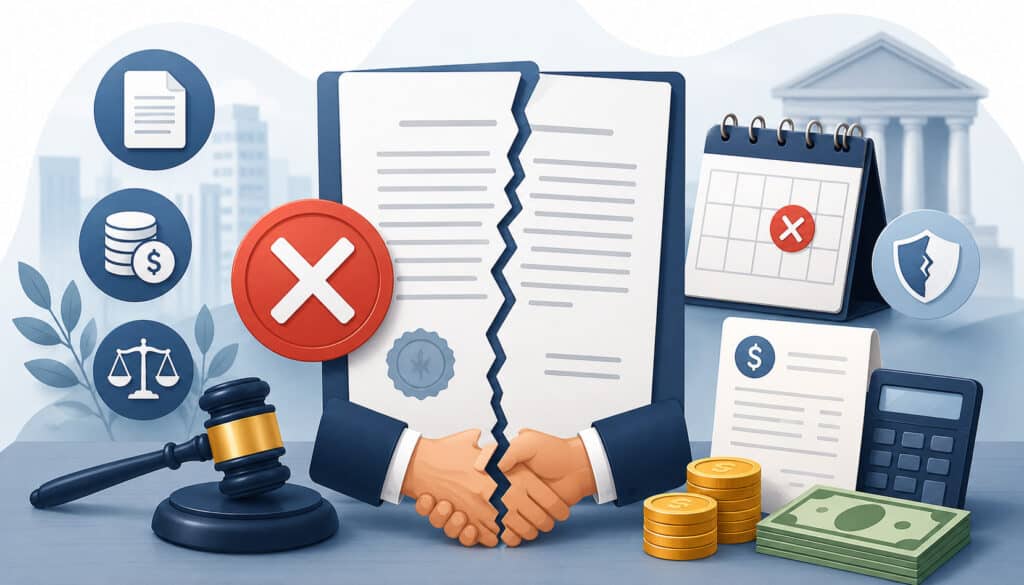
An early termination fee is a charge that may apply if the merchant cancels the merchant services contract before the agreed term ends. It may be a fixed amount, a formula, or a liquidated damages provision.
A fixed early termination fee is usually easier to understand because the amount is stated. A liquidated damages clause can be more complicated. It may calculate the provider’s expected lost revenue based on remaining months, average fees, or other contract assumptions. That type of clause should be reviewed carefully because the cost may be higher than expected.
A cancellation clause explains how the merchant can end the agreement. It may distinguish between termination for cause and termination without cause. Termination for cause may apply if one party materially breaches the agreement. Termination without cause may allow cancellation even when no breach occurred, but fees or notice requirements may apply.
Account closure procedures also matter. The provider may require written notice, final fee payment, equipment return, chargeback reserve retention, or continued responsibility for disputes that arise after closure. Chargebacks can occur after the original sale, so some obligations may survive termination.
This area can involve legal interpretation. Businesses should avoid guessing about cancellation wording, especially when liquidated damages, personal guarantees, or equipment leases are involved.
The contract and agreement guidance from the Federal Trade Commission is a helpful general resource, but individual contracts should be reviewed by a qualified professional when risk is material.
Equipment Lease and Terminal Terms
Equipment terms explain how card terminals, POS devices, PIN pads, mobile readers, printers, stands, cash drawers, or related hardware are provided. The business may purchase equipment, rent it monthly, lease it for a fixed term, or receive it as part of a bundled processing package.
The difference matters. Purchased equipment may belong to the merchant, although compatibility can still depend on processor software and encryption keys. Rental equipment may need to be returned when service ends. A terminal lease may be a separate contract with its own term, billing rules, and cancellation restrictions.
Some equipment leases are non-cancellable. That means canceling the merchant account contract may not cancel the equipment lease. The business could continue paying for hardware even after switching processors. This is one of the most important areas to review before signing.
Equipment terms may also cover maintenance, replacement, damage, loss, upgrades, shipping, return deadlines, and reprogramming. A provider may charge for unreturned equipment or equipment returned late. A device may also be locked to a platform, which can limit reuse.
Before signing, ask whether equipment is leased, rented, loaned, financed, or purchased. Confirm who owns it, whether it can be used with another provider, what happens at cancellation, and whether the equipment agreement is separate from the processing agreement.
Payment Gateway and Software Terms
Payment gateway and software terms apply when the merchant uses online checkout, virtual terminal access, invoicing, recurring billing, stored customer profiles, fraud tools, API connections, plugins, or ecommerce integrations.
A gateway fee may be charged monthly, per transaction, per user, per feature, or per account. Some gateways charge extra for advanced fraud filters, account updater, recurring billing, token storage, customer vaults, reporting exports, or API usage. Software subscriptions may renew separately from the merchant account contract.
Gateway terms should explain data access and portability. If the business later changes providers, can it export customer tokens, transaction history, recurring billing schedules, and reports? Are there fees or limitations? This is especially important for subscription businesses that rely on stored payment credentials.
Integration language also matters. An ecommerce seller may use a shopping cart plugin, marketplace connector, accounting sync, or custom API. If the plugin stops working or the business changes platforms, the contract may not automatically adjust pricing or obligations.
Security terms are especially important for online payments. The gateway may support encryption, tokenization, user permissions, fraud screening, velocity controls, and address verification. However, using secure tools does not eliminate the merchant’s responsibility to handle payment data properly.
Review cancellation rules for each software component. Canceling processing may not automatically cancel gateway add-ons, fraud tools, or third-party subscriptions.
Settlement and Funding Terms
Settlement terms explain how authorized transactions become deposits in the merchant’s bank account. Funding language may describe batch processing, cutoff times, deposit timing, fee deductions, reserve deductions, funding delays, and reporting.
Batch processing is the process of submitting approved transactions for settlement. Many businesses batch at the end of the day. If a batch is not closed properly, funding may be delayed. For a deeper operational explanation, see this guide on how batch processing works for merchants.
Funding schedules may vary by business type, risk profile, bank cutoff time, transaction method, and account status. Card-present retail transactions may fund differently from ecommerce transactions, keyed transactions, or higher-risk sales. Weekend and holiday timing may also affect deposits.
Deposits may be net or gross. A gross deposit means processing fees may be billed separately. A net deposit means fees, chargebacks, reserves, refunds, or adjustments may be deducted before funds reach the bank account. This is why deposit amounts may not match daily sales totals.
Settlement reports are important for bookkeeping. Merchants should reconcile batches, deposits, refunds, chargebacks, processing fees, and reserve activity. If deposits seem short, the answer may be in the statement or settlement report rather than the bank feed alone.
Reserve, Hold, and Risk Review Clauses
Reserve, hold, and risk review clauses allow the provider or acquiring bank to manage potential losses connected to chargebacks, refunds, fraud, financial instability, or rule violations. These clauses can affect cash flow, so merchants should read them closely.
A reserve clause may allow the provider to withhold funds from deposits. The reserve may be fixed, rolling, or triggered by risk events. A fixed reserve holds a set amount. A rolling reserve withholds a percentage of processing volume for a period before releasing it later.
A funding hold may delay deposits temporarily while the provider reviews account activity. Triggers may include unusual sales spikes, high refund volume, excessive chargebacks, suspicious transactions, customer complaints, incomplete documentation, unsupported products, or changes in business model.
Risk review language may allow the provider to request invoices, shipping proof, financial statements, bank statements, supplier information, website updates, refund policy details, or fulfillment records. The merchant may need to respond quickly to avoid longer delays.
These clauses exist because payment providers can face losses if a merchant cannot cover refunds or chargebacks. However, broad or vague language can create uncertainty for the business.
Merchants should understand what may trigger a reserve, how the amount is calculated, how long funds may be held, and when funds may be released.
Rolling Reserves
A rolling reserve temporarily withholds a percentage of processed volume to cover potential future chargebacks, refunds, or other losses. For example, a provider might hold a portion of each deposit and release it after a defined period, assuming no unresolved risk remains.
Rolling reserves are more common for businesses with higher chargeback risk, longer delivery timelines, subscription billing, large average tickets, travel-like fulfillment patterns, custom goods, trial offers, or limited processing history. They may also be added after account activity changes.
The practical issue is cash flow. A rolling reserve does not necessarily mean the funds are permanently lost, but the business cannot use those funds while they are held. That can affect inventory purchases, payroll, advertising spend, and vendor payments.
Before signing, merchants should ask whether a reserve is required at approval or can be added later. They should also ask how reserve release works, whether interest is paid, what events can extend the hold, and what happens after account closure.
Funding Holds
A funding hold delays deposits that would otherwise be released to the merchant. It may be temporary while the provider investigates activity, requests documents, reviews risk, or resolves disputes.
Funding holds can happen when processing activity looks different from the approved profile. A sudden increase in volume, unusually large transaction, spike in refunds, increase in chargebacks, suspicious order pattern, or product change may trigger review. Holds may also occur if the provider cannot verify business information or suspects prohibited activity.
Merchants can reduce hold risk by keeping account information current, notifying the provider before major changes, maintaining clear refund and fulfillment policies, and responding quickly to document requests. Clean records matter. Invoices, tracking numbers, signed agreements, customer communications, and delivery confirmations can help during review.
The contract should explain the provider’s rights, but the merchant should also ask practical questions before signing: What triggers holds? Who reviews them? How are merchants notified? What documents are usually required? How quickly are funds released after review?
Chargeback and Dispute Terms
Chargeback terms explain how customer disputes are handled and what responsibilities the merchant has. A chargeback may occur when a cardholder disputes a transaction through the issuing bank. Reasons can include fraud claims, non-receipt, billing errors, duplicate charges, product dissatisfaction, cancellation disputes, or unrecognized descriptors.
A merchant services agreement may state that the merchant is responsible for chargebacks, dispute fees, retrieval requests, evidence submission, and negative balances. The provider may debit the merchant account or bank account for disputed amounts and related fees.
Chargeback fees may apply even if the merchant wins the dispute. Evidence deadlines are strict, and missed deadlines can result in automatic loss. Evidence may include receipts, order records, signed invoices, delivery proof, refund policy acceptance, customer communication, usage logs, cancellation records, or AVS and CVV results.
Representment is the process of responding to a chargeback with evidence. The agreement or processor portal may explain how documents must be submitted and by when. Some providers offer dispute tools, alerts, or chargeback prevention services for added fees.
Consumer dispute rights are explained from the cardholder side by resources such as the Consumer Financial Protection Bureau’s dispute guidance. Merchants should understand that disputes are part of the card system and must be managed with documentation, clear policies, and timely responses.
For more on dispute risk tools, this article on chargeback insurance may be useful.
Refund and Return Policy Terms
Refund and return policy terms matter because unclear customer policies can lead to disputes, chargebacks, complaints, and underwriting concerns. A merchant agreement may require the business to disclose refund policies clearly and process refunds through the approved payment system.
A refund policy should match how the business actually operates. Ecommerce sellers should address returns, shipping, damaged goods, delivery timelines, and refund timing. Restaurants and hospitality businesses may need cancellation and no-show policies.
Service providers should explain deposits, completed work, appointment cancellations, and partial refunds. Subscription businesses should explain renewal timing, cancellation steps, free trials, and recurring billing authorization.
Underwriting teams may review refund policies during approval and later risk reviews. A vague or hard-to-find policy can make a business appear riskier, especially if customers regularly claim they did not understand the terms.
Refunds should generally be issued back to the original payment method through the processing system. Cash refunds for card purchases can create recordkeeping and dispute problems. The contract may also prohibit refunding one card for a purchase made on another card.
Good refund practices protect both customers and merchants. They reduce confusion, help support staff respond consistently, and create documentation if a dispute occurs.
PCI Compliance and Data Security Terms
PCI compliance and data security terms explain the merchant’s responsibility to protect cardholder data. These terms may refer to PCI DSS, secure storage, encryption, tokenization, access controls, vulnerability scans, breach notification, password practices, employee access, and approved payment applications.
The PCI Security Standards Council explains that PCI DSS applies to entities that store, process, or transmit cardholder data, as well as entities that can affect the security of that environment. Merchants can learn more from the council’s merchant security resources.
A merchant services contract may require the business to validate PCI compliance through a questionnaire, scan, portal, or attestation. It may also include PCI compliance fees or PCI non-compliance fees. These fees do not replace the merchant’s responsibility to maintain proper security practices.
Data security terms may prohibit storing sensitive authentication data, sharing card data through insecure channels, writing full card numbers in notes, or allowing unauthorized staff access. Ecommerce merchants should pay attention to hosted checkout, tokenization, plugins, admin credentials, and third-party integrations.
If a breach occurs, the contract may describe notification duties, investigation costs, forensic review, fines, assessments, card replacement costs, or indemnification language. These clauses can be significant and should be reviewed carefully.
Card Network Rules and Acceptance Terms
Merchant agreements often require compliance with card network rules and acceptance standards. These rules may cover authorization, settlement, refunds, receipts, descriptors, surcharging, convenience fees, recurring billing, stored credentials, transaction data, fraud controls, and dispute handling.
Some rules are incorporated by reference, meaning they apply even if they are not fully printed in the contract. The agreement may state that the merchant must follow current and updated network rules. That makes it important to monitor provider notices and operational updates.
Acceptance terms may require the merchant to obtain authorization before completing a transaction, submit transactions only for legitimate sales, avoid splitting transactions improperly, use accurate descriptors, issue refunds correctly, and maintain receipts or transaction records.
Surcharging, convenience fees, and cash discount programs can be especially sensitive. Rules may vary by card type, location, disclosure method, receipt wording, and customer choice. Merchants should not rely on verbal assumptions in this area. Written guidance and qualified review are important.
Recurring billing also has specific expectations. Merchants may need clear customer authorization, cancellation access, renewal disclosures, and documentation. Poor recurring billing practices often lead to chargebacks.
In short, the merchant account contract is not the only rulebook. It connects the merchant to broader payment ecosystem obligations.
Personal Guarantee Terms
A personal guarantee is a contract term that may make an individual owner or signer responsible for certain business obligations under the merchant services agreement. This can include unpaid fees, chargebacks, refunds, negative balances, equipment obligations, or losses tied to account activity.
Personal guarantee language is common in some merchant account contracts, especially where the provider wants additional assurance that obligations will be paid. It may appear near the signature section, within the application, or in the terms and conditions.
This clause matters because it can connect business liabilities to a person rather than only the business entity. For example, if a merchant account closes with unresolved chargebacks or unpaid fees, the provider may seek recovery under the guarantee if the contract allows it.
Merchants should identify exactly who is signing, in what capacity, and whether the signature creates individual responsibility. Owners of corporations or limited liability entities should not assume the business structure alone eliminates every contract obligation.
Because personal guarantee language can have legal and financial consequences, it deserves careful review by a qualified professional. A signer should understand the scope, duration, and release conditions before signing.
Prohibited Activities and Restricted Business Terms
Prohibited activities and restricted business terms explain what the merchant may not process through the account. These restrictions may relate to products, services, sales methods, transaction types, marketing practices, fulfillment models, or business categories.
A provider approves a merchant account based on underwriting information. That may include website content, product descriptions, refund policy, delivery timeline, ownership, average ticket, expected monthly volume, industry category, and processing history. If the business later processes something outside the approved profile, it may trigger review or account closure.
Restricted activity language can vary widely. Some agreements prohibit illegal transactions, misleading marketing, unsupported high-risk categories, certain regulated goods, third-party processing, factoring, transaction laundering, unauthorized recurring billing, or sales made on behalf of another business.
Businesses should pay attention to business model changes. Adding subscriptions, selling new products, launching a marketplace, accepting payments for another entity, moving into a higher-risk category, or changing fulfillment timelines may require approval.
Merchant Category Codes can also affect risk expectations and monitoring. This resource on Merchant Category Codes explains how classification can influence underwriting, pricing, reporting, and rule enforcement.
Account Closure and Termination Rights
Account closure and termination rights explain when the merchant or provider can end the processing relationship. The provider may have rights to close or suspend an account for risk, rule violations, excessive chargebacks, suspected fraud, unsupported products, inaccurate information, inactivity, negative balances, or failure to maintain compliance.
The merchant may also have termination rights, subject to notice requirements, contract term language, early termination fees, equipment return rules, and final account obligations. Canceling the merchant account may not automatically cancel gateway subscriptions, software tools, or equipment leases.
Post-termination obligations are important. The merchant may remain responsible for chargebacks, refunds, fees, reserve balances, investigations, and equipment return after closure. Since disputes can arise after a sale, account closure does not always end financial exposure immediately.
Some contracts allow the provider to hold funds after termination to cover potential chargebacks or losses. Merchants should review how long reserves may be held, when remaining funds are released, and what documentation is required.
A business closing, selling, or changing ownership should plan ahead. Ownership changes may require a new application, underwriting review, or account transfer process. Do not assume the merchant account can automatically move to a buyer.
Change of Terms and Rate Adjustment Clauses
Change of terms clauses explain whether the provider can update pricing, fees, services, rules, or contract obligations. These clauses may allow changes after notice through a statement message, email, portal update, website posting, or written communication.
Rate adjustment language matters because payment processing fees can change. Network costs may change, provider markup may change, monthly fees may be added, PCI fees may be adjusted, or new pass-through costs may appear. Some changes may be outside the provider’s direct control, while others may be provider decisions.
Merchants should review how notice is delivered and whether continued processing after notice means acceptance of the change. The agreement may also explain whether the merchant has a right to cancel if changes are unacceptable.
Monthly statement review is the best defense against unexpected cost drift. Compare current statements to the original pricing schedule. Look for new monthly fees, increased transaction fees, changed discount rates, new pass-through items, PCI non-compliance charges, and unexpected gateway add-ons.
Merchant Services Contract Review Table
Use this review table before signing a merchant account contract or renewing an existing processing relationship.
| Review Area | Questions to Ask | Possible Risk | Practical Action |
| Pricing schedule | Are all rates and fees listed in writing? | Hidden or misunderstood costs | Request a complete written fee schedule |
| Pricing model | Is pricing flat-rate, interchange-plus, tiered, or blended? | Hard-to-compare offers | Ask for examples using your transaction mix |
| Contract term | How long is the initial term? | Unwanted long commitment | Mark the end date immediately |
| Renewal | Does the agreement auto-renew? | Missed cancellation window | Calendar the notice deadline |
| Cancellation | What steps are required to cancel? | Invalid cancellation attempt | Follow the required method exactly |
| Early termination | Is there an early termination fee or liquidated damages? | Unexpected exit cost | Ask for the fee formula in writing |
| Equipment | Is hardware leased, rented, loaned, or purchased? | Ongoing lease after cancellation | Review equipment documents separately |
| Gateway | Are software and gateway fees separate? | Continued billing after account closure | Confirm cancellation for each service |
| Settlement | When are funds deposited? | Cash flow delays | Review cutoff times and funding schedule |
| Reserves | Can funds be held or reserved? | Working capital disruption | Ask about triggers and release timing |
| Chargebacks | What are deadlines and fees? | Lost disputes and added costs | Build an evidence process |
| PCI | What validation is required? | Non-compliance fees or security risk | Assign responsibility internally |
| Changes | Can fees or terms change? | Cost increases over time | Review statements and notices monthly |
Common Fees to Review Before Signing
Common fees in a merchant services contract can include both visible and less obvious charges. Merchants should ask for all fees in writing before signing and compare them against actual statements after processing begins.
Key fees to review include:
- Monthly fee
- Transaction fee
- Discount rate
- Interchange markup
- Assessment-related pass-through charges
- PCI compliance fee
- PCI non-compliance fee
- Gateway fee
- Virtual terminal fee
- Batch fee
- Statement fee
- Chargeback fee
- Retrieval fee
- Equipment fee
- Terminal lease payment
- Monthly minimum fee
- Annual fee
- Setup fee
- Voice authorization fee
- Address verification fee
- Account updater fee
- Fraud tool fee
- Cancellation fee
Some fees are predictable, such as monthly account charges. Others depend on activity, such as chargeback fees, batch fees, authorization fees, or cross-border fees. A merchant with many small transactions may care more about per-item fees. A merchant with high ticket values may care more about percentage markup.
Ask whether fees are deducted daily, monthly, or from deposits. Also ask whether fee billing is gross or net. This affects bookkeeping and cash flow.
A good review process compares total estimated cost, not just one rate. Use realistic transaction volume, average ticket, card mix, online vs in-person percentage, refund rate, and chargeback history.
Common Contract Red Flags
A red flag does not always mean a contract is unacceptable, but it does mean the merchant should slow down and ask questions. Merchant service contract terms should be clear enough for the business to understand its responsibilities and costs.
Common red flags include unclear pricing, missing fee schedules, broad rate change language, large early termination fees, liquidated damages clauses, long auto-renewal periods, non-cancellable equipment leases, vague reserve rights, unclear gateway cancellation rules, and verbal promises that do not appear in writing.
Another red flag is pressure to sign before reviewing all documents. A merchant processing agreement can affect fees, funding, risk, equipment, and cancellation. Businesses should have time to read the full contract stack.
Inconsistent answers are also concerning. If the salesperson says there is no contract, but the application references a multi-term agreement, rely on the written document. If the proposal says equipment is free, but the lease shows monthly payments, ask for clarification before signing.
Pricing Red Flags
Pricing red flags include missing schedules, vague “qualified” rates, unexplained pass-through fees, unclear processor markup, and bundled charges that cannot be reconciled. A quote that highlights only one low rate may not show the full cost.
Tiered pricing deserves careful review because many transactions may not qualify for the lowest tier. Rewards cards, keyed payments, corporate cards, ecommerce transactions, or missing data can move transactions into higher categories.
Watch for recurring charges that are easy to overlook, such as monthly minimums, PCI fees, statement fees, gateway fees, annual fees, and software add-ons. These can matter greatly for lower-volume businesses.
Ask for sample statements and cost examples. A provider should be able to explain how merchant account fees apply to your likely transaction mix.
Cancellation and Equipment Red Flags
Cancellation red flags include long notice windows, unclear delivery requirements, auto-renewal terms that extend the agreement, high early termination fees, and liquidated damages formulas that are hard to estimate.
Equipment red flags include separate terminal leases, non-cancellable lease terms, unclear ownership, return penalties, and hardware that cannot be used elsewhere. A processing agreement and terminal lease may have different end dates.
Merchants should also confirm what happens to gateway access, recurring billing profiles, stored tokens, and reporting after cancellation. Losing access too quickly can create bookkeeping and customer service problems.
Before signing, ask for the exact cancellation process in writing. Save it with the contract.
Questions to Ask Before Signing a Merchant Services Agreement
Before signing a merchant services agreement, ask practical questions that connect contract language to daily operations. The goal is not to challenge every clause, but to understand what the business is accepting.
Useful questions include:
- What pricing model is used?
- Are all fees listed in writing?
- Is there a contract term?
- Does the agreement auto-renew?
- What is the cancellation process?
- Are there early termination fees?
- Is there a liquidated damages clause?
- Is equipment leased, rented, loaned, or purchased?
- Are gateway fees separate?
- Are software subscriptions separate?
- How are chargebacks handled?
- What are dispute response deadlines?
- Can funds be held or reserved?
- What may trigger a risk review?
- How are rate changes communicated?
- What happens if my business model changes?
- What happens if ownership changes?
- How are refunds processed?
- What PCI compliance steps are required?
- What happens after account closure?
Ask these questions before signing, not after a problem occurs. The answers should match the written agreement. If the answer is important, request written clarification.
Merchants should also involve the right internal people. Owners may focus on cancellation and guarantees. Bookkeepers may focus on statements and deposits. Operations teams may focus on equipment, gateway access, refunds, and chargebacks.
How to Review a Merchant Processing Agreement Step by Step
Reviewing a merchant processing agreement is easier when you follow a structured process. Start with the pricing schedule because it directly affects cost. Identify the pricing model, discount rate, transaction fee, monthly fees, gateway fees, PCI fees, chargeback fees, and any minimums or annual charges.
Next, review the term and renewal clause. Find the initial term, renewal period, auto-renewal clause, cancellation window, and notice method. Add key dates to your calendar before the agreement is filed away.
Then review cancellation requirements. Look for early termination fees, liquidated damages, termination for cause, termination without cause, account closure steps, and post-termination obligations.
Review equipment terms separately. Confirm whether the terminal is purchased, rented, loaned, or leased. Check ownership, return requirements, replacement fees, compatibility, and whether the equipment lease is non-cancellable.
Confirm gateway and software fees. Identify charges for payment gateway access, virtual terminal tools, recurring billing, plugins, fraud filters, account updater, token storage, and reporting.
Review settlement terms. Understand batch processing, cutoff times, funding schedule, net deposits, reserves, and funding holds. Then check chargeback rules, PCI compliance obligations, data security terms, prohibited activities, and personal guarantee language.
Finally, compare verbal promises with written terms. Ask questions before signing and save a complete copy of every document.
Best Practices for Managing Merchant Service Contract Terms
Managing merchant service contract terms does not end after signing. Businesses should treat the processing agreement as an active operating document.
Store the contract, pricing schedule, gateway terms, equipment documents, PCI records, and cancellation instructions in a secure shared location. Make sure more than one person knows where to find them.
Review statements monthly. Compare actual merchant account fees against the pricing schedule. Look for new fees, changed rates, PCI non-compliance charges, chargeback fees, and unusual adjustments. Monthly review helps catch problems before they become expensive.
Track renewal dates and cancellation windows. Calendar reminders should be visible to owners, finance staff, or administrators responsible for vendor relationships.
Reconcile deposits regularly. Match batches, refunds, fees, chargebacks, reserves, and funding holds to bank deposits. This helps identify missing deposits, short funding, or reporting issues.
Monitor chargebacks and refunds. High dispute activity can trigger fees, monitoring, reserves, or account review. Clear descriptors, responsive customer service, strong refund policies, and good documentation can reduce avoidable disputes.
Keep PCI compliance current. Update staff training, access controls, software, passwords, plugins, and security procedures. Review PCI status before non-compliance fees appear.
When unclear terms arise, ask for written clarification and consult qualified professionals when appropriate.
What are merchant service contract terms?
Merchant service contract terms are the rules and obligations included in a payment processing relationship. They explain pricing, settlement, chargebacks, refunds, PCI compliance, equipment, cancellation, reserves, risk review, account closure, and merchant responsibilities.
These terms may appear in several documents, including the merchant services agreement, pricing schedule, merchant account contract, gateway agreement, equipment lease, and program guide. Merchants should review all documents together before signing.
What is a merchant services agreement?
A merchant services agreement is the contract that allows a business to accept card and electronic payments through a provider. It explains how transactions are processed, how fees are charged, how deposits are funded, and what rules the merchant must follow.
The agreement may also include underwriting requirements, prohibited activities, data security obligations, dispute procedures, and termination rights. It is a core document for any business that accepts card payments.
What should I review in a merchant processing agreement?
Review the pricing schedule, contract term, auto-renewal clause, cancellation clause, early termination fee, equipment terms, gateway fees, settlement terms, reserve clause, chargeback rules, PCI compliance requirements, prohibited activities, and personal guarantee language.
Also compare any verbal promises with the written agreement. If a promise is not written, it may be difficult to rely on later.
What is an early termination fee?
An early termination fee is a charge that may apply if a merchant cancels before the contract term ends. It may be a fixed fee or calculated using a formula.
Some contracts include liquidated damages language, which may estimate the provider’s lost revenue for the remaining term. Merchants should review this carefully and seek qualified guidance when the amount or formula is unclear.
What is an auto-renewal clause?
An auto-renewal clause allows a merchant services contract to renew automatically if the merchant does not cancel within the required notice window. The renewal may be month to month or for a longer period.
Merchants should calendar renewal dates and notice deadlines. Missing the cancellation window may extend the agreement or create additional cancellation costs.
What is a rolling reserve?
A rolling reserve is a temporary holdback of a percentage of processing volume. The provider holds the reserve for a defined period to help cover potential chargebacks, refunds, or losses.
Rolling reserves can affect cash flow because the merchant cannot use the withheld funds until they are released. Merchants should ask how the reserve is calculated, what triggers it, and when funds are returned.
What is a personal guarantee in a merchant agreement?
A personal guarantee may make an individual owner or signer responsible for certain business obligations, such as unpaid fees, chargebacks, refunds, negative balances, or equipment costs.
Because this clause can affect the signer personally, it should be reviewed carefully. Businesses should consult a qualified professional if they do not fully understand the scope of the guarantee.
Are equipment leases separate from merchant contracts?
They can be. A terminal lease or equipment lease may be separate from the payment processing agreement. This means canceling the merchant account may not cancel the equipment obligation.
Before signing, confirm whether equipment is purchased, rented, loaned, or leased. Review ownership, return rules, lease length, cancellation rights, and compatibility.
What fees should be listed in a merchant services contract?
A merchant services contract should clearly list relevant fees, including discount rate, transaction fee, monthly fee, gateway fee, PCI compliance fee, PCI non-compliance fee, batch fee, statement fee, chargeback fee, retrieval fee, equipment fee, monthly minimum, annual fee, setup fee, and cancellation fee.
Not every fee applies to every business, but all possible fees should be disclosed clearly enough for the merchant to estimate total cost.
Can merchant service contract terms change?
Many agreements include change of terms or rate adjustment clauses. These clauses may allow pricing, fees, rules, or services to change after notice.
Merchants should review how notices are delivered and whether continued processing means acceptance. Monthly statement review is important because fee changes may appear there.
Conclusion
Merchant service contract terms shape how a business accepts payments, pays fees, receives deposits, handles chargebacks, manages equipment, protects payment data, and exits the processing relationship. A merchant services agreement is not just an application; it is an operating framework for a major part of the business.
Before signing, review the pricing schedule, settlement terms, cancellation clause, auto-renewal clause, reserve clause, gateway terms, equipment lease, chargeback process, PCI compliance requirements, prohibited activities, and personal guarantee language. Ask for written clarification when anything is unclear.
A careful review can help businesses compare total costs, avoid unexpected payment processing fees, protect cash flow, prepare for disputes, and manage account responsibilities. Read the agreement carefully, keep complete records, track renewal dates, review statements monthly, and seek qualified advice when contract language could create meaningful risk.