
By Thomas Brandt October 6, 2026
Credit card refund rules for merchants generally require an approved refund to follow the original card transaction or payment credential where applicable, while allowing defined exceptions when that route is unavailable. Merchants should also distinguish refunds from voids, verify processor-specific fees and timing, and check whether a card dispute already exists before sending a second credit.
For an ecommerce seller, clicking “refund” looks simple. Behind the button, however, are separate rules involving the card network, issuing bank, acquiring bank, payment gateway, processor, merchant agreement, and sometimes consumer law.
The most useful approach is not to memorize one supposed universal rule. It is to know which layer controls each decision.
Credit Card Refund Rules for Merchants: The Short Version
If you need the operational answer first, use these rules:
- Locate the original transaction before issuing money back.
- Refund through the original transaction or payment credential where the applicable network requires it.
- Do not assume an expired physical card makes a card refund impossible.
- If the original account is genuinely unavailable, follow the network and processor-supported exception process.
- Use a void or authorization reversal where appropriate before settlement.
- Use a refund or credit after the purchase has settled.
- Process an agreed refund promptly rather than confusing dispute deadlines with refund deadlines.
- Tell the customer that refund initiation and issuer posting are separate events.
- Check your merchant agreement for refund fees and treatment of the original processing expense.
- Document partial refunds and legitimate refund denials.
- Check whether a chargeback or dispute is already underway before issuing another credit.
- Reconcile every refund against the gateway, processor report, order system, and bank credit card refund rules for merchants activity.
These credit card refund rules for merchants prevent several expensive mistakes: duplicate reimbursement, refunding the wrong account, treating store credit as a card refund, and promising a customer a posting date the merchant cannot control.
Why Refunds Usually Go Back Through the Original Payment Method
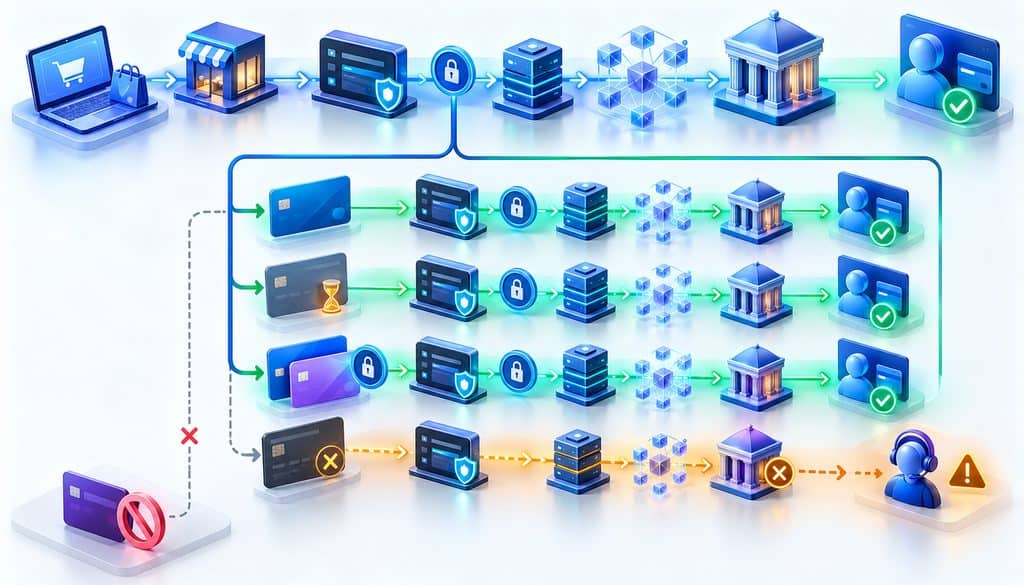
The refund to the original payment method rule exists for more than bookkeeping.
The Visa Core Rules and Visa Product and Service Rules state that when a merchant refunds a previous purchase, the merchant must, to the extent possible, process the credit to the same payment credential used for the original transaction. Visa also provides defined alternatives when the original credential cannot be used.
That language is important.
It does not mean that the exact physical card must still be in the customer’s wallet. It also does not mean a merchant can casually ask for any other card number and transfer money there.
The original transaction creates a traceable connection between:
- customer;
- payment credential;
- merchant;
- original purchase;
- refund;
- settlement record; and
- possible future dispute.
Keeping that connection intact helps with fraud control, customer-service research, accounting, processor reconciliation, and dispute evidence.
Visa specifically prohibits using a credit transaction simply as a way to deposit unrelated money into a cardholder account.
For online sellers, the practical rule is therefore simple: start with the original payment transaction rather than inventing another way to send the customer money.
What if the card has expired?
An expired physical card does not automatically mean the refund cannot be processed.
A replacement card may have been issued while the underlying customer relationship remains active. Tokenized payment credentials and issuer-side account-management systems can also affect how a credit reaches the correct account.
The merchant usually should not tell the customer:
“Your card expired, so we cannot refund you.”
Instead, initiate the supported refund against the original transaction and let the processor/acquirer and issuing side determine whether it can be routed successfully.
This distinction makes the refund to original payment method rule more accurate: the objective is proper payment-system routing, not matching the expiration date printed on an old piece of plastic.
What if the customer’s original account is closed?
A genuinely closed account requires an exception workflow.
Use this sequence:
- Locate the original transaction.
- Attempt the supported refund where your processor instructs you to do so.
- Review the authorization or refund response.
- If the credit cannot be completed, contact the processor or acquirer.
- Keep proof of the failed credit attempt.
- Follow the processor/network-supported alternative.
The Visa Core Rules expressly permit specified alternatives in defined circumstances, including certain situations where the original credential is no longer available.
For example, a secondary payment credential can be used under applicable conditions when the original credential is unavailable because an account was closed, transferred, lost, or stolen, or when a credit authorization receives a decline. Visa also permits certain alternate refund methods under specified conditions.
The takeaway is not “refund to another card whenever you want.” It is escalate through the supported process when the normal route fails.
Void, Authorization Reversal, and Refund Are Different Actions

One of the most important credit card refund rules for merchants is knowing whether there is actually a settled transaction to refund. Understanding the difference between authorization, capture, settlement, and funding also makes it much easier to decide whether the correct action is a void, reversal, or refund. See Payment Authorization vs Settlement Explained for a detailed breakdown of each payment stage.
| Action | Typical timing | Settlement status | Practical result |
| Void | Before the transaction completes settlement | Usually unsettled | Stops a transaction from completing where supported |
| Authorization reversal | After an authorization is no longer needed | Pre-settlement lifecycle | Tells the payment system the authorization hold should be released/reduced |
| Refund/credit | After the purchase has settled | Original transaction settled | Creates a separate credit transaction |
Your gateway may use different labels. A “void” button may initiate an authorization reversal behind the scenes, for example.
For a deeper explanation of the lifecycle, Payment Authorization vs Settlement Explained is a useful internal reference because it shows how authorization, capture, clearing, settlement, refunds, and reconciliation fit together.
That distinction can also reduce unnecessary refund costs. Canceling an unsettled order may be operationally different from refunding a transaction after settlement.
How Long Do Merchants Have to Issue a Refund?
The question how long do merchants have to issue a refund sounds as though it should have one number.
It does not.
At least six different rules or clocks can affect the answer:
- Your published ecommerce refund policy.
- Applicable consumer law.
- Card-network requirements.
- Your processor or acquirer agreement.
- Gateway technical limits.
- Card-dispute deadlines.
A common mistake is taking a dispute timeframe from Visa or Mastercard and presenting it as the merchant’s universal refund deadline.
For example, Visa has a “Credit Not Processed” dispute framework that includes timing requirements for issuers when an expected merchant credit has not appeared. That does not mean a merchant universally has that same amount of time to decide whether to issue an already-approved refund.
So, how long do merchants have to issue a refund?
The safest practical answer is: once your business has determined that a refund is owed, process it promptly under your disclosed policy, processor procedures, applicable law, and relevant network requirements.
Avoid promising customers that every card-network refund must be initiated within some universal “30-day” period unless a rule applicable to that specific situation actually says so.
How Long Does a Credit Card Refund Take to Appear?
Credit card refund processing time is another area where merchants often make promises they cannot control.
A refund can move through several stages:
Merchant initiates refund → gateway accepts request → processor/acquirer processes credit → network routes it → issuer receives it → issuer posts it → customer sees it
Those events are not necessarily simultaneous.
A processor may provide an estimated customer-facing timeframe, but that processor estimate should not be presented as a universal Visa or Mastercard guarantee.
The merchant controls when it initiates the credit. It generally does not control the issuer’s final display and posting behavior.
That gap creates familiar customer-service problems:
- “Where is my refund?”
- duplicate refund requests;
- unnecessary calls;
- premature disputes;
- duplicate reimbursement risk; and
- accusations that the merchant never refunded the sale.
Customer-service message for a pending refund
A useful response is:
“Your refund was submitted on October 6, 2026 through the original card transaction. The refund has left our payment workflow, but your card issuer controls when the credit becomes visible in your account. We have kept the refund confirmation and can trace it with our processor if it does not appear after your issuer’s normal posting period.”
This message separates merchant initiation from issuer posting time without making a promise you cannot guarantee.
Refund Fees: What Merchants Get Back and What They May Lose

Searches for refund fees merchant account often produce overly broad answers such as:
“Processing fees are always returned.”
or:
“Merchants never receive their processing fees back.”
Neither statement is safe as a universal rule.
A single ecommerce transaction may involve:
- interchange;
- network assessments;
- processor markup;
- authorization fees;
- per-transaction processing fees;
- gateway fees;
- refund transaction fees; and
- account-level fees.
Network economics and the amount ultimately billed to the merchant are not the same thing.
Your processor’s pricing model and merchant agreement determine which adjustments are actually passed through to your business.
If the statement makes it difficult to separate interchange, network assessments, processor markup, gateway charges, and transaction fees, review Understanding Merchant Service Pricing Models before comparing the economics of a refund with a chargeback.
This is why online sellers should document their own refund fees merchant account treatment rather than relying on generic assumptions.
For more context on those pricing layers, see Understanding Merchant Service Pricing Models, which breaks down percentage charges, transaction fees, authorization fees, gateway charges, chargeback fees, and other processor pricing components.
Worked refund-cost example
Suppose an ecommerce merchant processes a $200 order.
For illustration only, assume:
- original processing expense: $6.20;
- portion not recovered after refund: $3.50;
- refund transaction charge: $0.25.
The customer receives:
$200
The merchant’s remaining payment-related cost is:
$3.50 + $0.25 = $3.75
Now suppose the merchant instead allows a clearly valid complaint to become a chargeback and incurs:
- $200 disputed amount;
- hypothetical $20 dispute fee;
- hypothetical $15 employee handling cost.
If the merchant loses, the economic impact is materially greater.
These figures are hypothetical examples, not Visa or Mastercard fee schedules. Your processor agreement controls your actual merchant-level pricing.
Partial Refunds: What Online Sellers Can Do
Partial refunds are useful when only part of the transaction needs to be reversed.
Typical examples include:
- one item returned from a multi-item order;
- damaged merchandise;
- shipping adjustment;
- partial service delivery;
- negotiated customer accommodation; or
- a price correction.
A partial card refund should remain connected to the original purchase.
Merchants should also track the total value of multiple partial refunds so staff do not accidentally create duplicate or excessive credits.
Can you refund more than the original purchase?
Do not assume so.
The Mastercard Transaction Processing Rules define and regulate refund transactions associated with a previous purchase, including controls around refund amounts, authorization, clearing, corrections, and related transaction handling.
The rules generally tie the refund amount to the original purchase, while recognizing defined exceptions and corrections.
Your gateway may enforce an even tighter technical restriction, such as preventing cumulative refunds from exceeding the captured amount.
If you legitimately owe a customer more than the processor allows through the linked refund function, escalate the situation instead of attempting to bypass refund controls.
Can Store Credit Replace a Card Refund?
Sometimes store credit can be a legitimate outcome. It is not automatically the same thing as a payment-card refund.
Consider four different situations:
| Situation | Store credit appropriate? |
| Properly disclosed store-credit-only policy | Potentially, subject to law and network requirements |
| Customer voluntarily accepts store credit | Potentially |
| Merchant promised a card refund | Store credit is not the same transaction |
| Network/process requires card credit | Follow the required payment route |
A merchant should never tell a customer that a card has been refunded when the business actually issued only store credit.
Your refund policy also cannot eliminate rights created by applicable law or valid card-network dispute rights.
Refund vs Chargeback for Merchants: Which Costs Less?
The refund vs chargeback for merchants should consider more than the amount of the order.
| Factor | Merchant refund | Chargeback |
| Money returned to customer | Yes | Usually if dispute succeeds or provisional credit applies |
| Refund/processing costs | Processor-specific | Original transaction economics plus possible dispute costs |
| Chargeback fee | Normally not caused by the refund itself | May apply under processor/acquirer pricing |
| Staff workload | Usually low to moderate | Often higher |
| Formal evidence package | Usually unnecessary | Required if merchant contests |
| Monitoring impact | Ordinary refund is not itself a chargeback | Qualifying disputes may affect monitoring |
| Recovery possibility | Merchant chooses to give funds back | Merchant may recover funds if it wins |
| Duplicate-credit risk | Low if handled before dispute | Can rise after a dispute begins |
The right question is therefore not:
“Are refunds cheaper?”
It is:
“Given the evidence, transaction value, fees, staff time, customer relationship, and risk impact, is refunding this particular transaction economically better than defending it?”
Example: refund before chargeback
Consider a hypothetical $150 ecommerce transaction.
Scenario A: merchant issues refund
- Customer refund: $150
- Remaining refund/processing cost: hypothetical $4
- Chargeback fee: $0
- Formal representment workload: none
Scenario B: merchant contests a chargeback
- Disputed amount: $150
- Hypothetical dispute fee: $20
- Staff cost: hypothetical $15
- Possible monitoring impact
- Potential recovery if representment succeeds
If the merchant obviously failed to fulfill the order, Scenario A is probably economically stronger.
If the order was delivered, the customer’s claim is demonstrably incorrect, and compelling evidence is strong, fighting the dispute may make more sense.
That is the practical refund vs chargeback for merchants calculation.
Why Chargebacks Matter Beyond One Order
Refunds and disputes also affect how processors view an ecommerce merchant’s risk profile.
Repeated disputes can contribute to:
- risk reviews;
- reserve decisions;
- delayed funding;
- underwriting scrutiny;
- requests for corrective action;
- card-network monitoring; and
- account-continuation decisions.
Processors can also review refund patterns, unusually high transaction volume, ticket-size changes, settlement behavior, and chargeback activity as part of ongoing merchant risk monitoring. Your First 90 Days on a New Merchant Account explains how refunds, disputes, funding delays, reserves, and changes in actual processing behavior can trigger additional underwriting attention.
Visa’s current Visa Acquirer Monitoring Program (VAMP) consolidates Visa’s earlier dispute and fraud monitoring framework for the relevant card-not-present environment. Visa calculates the merchant VAMP ratio using specified fraud and dispute counts against settled card-not-present VisaNet transactions, subject to stated exclusions and methodology.
Visa measures a count-based VAMP ratio using specified fraud and dispute counts divided by settled card-not-present VisaNet transactions, with defined exclusions.
For AP, Canada, Europe, and the United States, Visa’s official VAMP material states that the excessive-merchant VAMP ratio threshold was reduced from 220 basis points to 150 basis points effective April 1, 2026, together with the applicable monthly count requirement.
That makes outdated references to the old VDMP/VFMP system unsuitable for a current 2026 article.
Mastercard also maintains merchant compliance programs and publishes its current rules from its official rules portal.
For background on why processors may react to unusual refund or dispute activity even after account approval, Your First 90 Days on a New Merchant Account explains how actual processing volume, refund activity, chargebacks, ticket size, and fulfillment behavior can trigger additional review.
When a Refund Is Usually the Better Business Decision
A refund is usually worth serious consideration when:
- the merchant clearly failed to ship;
- the wrong merchandise was sent;
- the customer canceled according to the disclosed policy;
- a duplicate charge is confirmed;
- the merchant already promised a refund;
- the order was canceled before fulfillment;
- evidence supporting representment is weak; or
- defending a low-value transaction costs more than resolving it.
Those situations are different from automatically refunding every customer who threatens a chargeback.
When fighting the dispute may make more sense
A refund may not be the best decision when:
- the transaction has already been refunded;
- the dispute has already progressed and a second credit could duplicate reimbursement;
- delivery or usage evidence is strong;
- the claim is objectively inconsistent with the transaction record;
- refund abuse is documented;
- the customer failed to meet a lawful, clearly disclosed return condition; or
- the disputed amount materially justifies representment effort.
The merchant needs a consistent policy, not an emotional decision made by whichever employee receives the complaint.
What to Do When Your Refund Policy Legitimately Denies the Request
A legitimate refund denial should be documented as carefully as an approved refund.
Keep:
- order record;
- product or service description;
- checkout disclosures;
- refund and cancellation policy;
- evidence of policy acceptance where available;
- shipment tracking;
- delivery confirmation;
- customer communications;
- RMA history;
- product-condition evidence where relevant;
- refund-request date;
- reason for denial;
- employee notes; and
- any accommodation offered.
A merchant refund policy does not automatically defeat a cardholder’s dispute rights or applicable consumer law.
Sample internal refund-denial note
- Order: 48327
- Purchase date: August 8
- Delivery date: August 12
- Refund requested: September 18
- Policy reviewed: Published return requirements accepted at checkout
- Evidence reviewed: Order record, policy record, carrier tracking, customer emails
- Decision: Refund denied because stated return eligibility requirements were not satisfied
- Customer notified: September 18
- Supporting evidence retained: Yes
Keep this record factual. Avoid emotional descriptions of the customer.
Gateway Settings That Can Reduce Unnecessary Refund Costs
Ecommerce merchants should review gateway settings before treating every canceled order as a post-settlement refund.
Useful controls include:
- authorization-only workflows;
- delayed capture;
- automatic capture timing;
- same-day void capability;
- authorization reversal;
- partial-refund permissions;
- employee refund permissions;
- cumulative refund limits;
- duplicate refund detection;
- refund webhooks;
- refund-status reporting;
- reconciliation controls; and
- fraud review before capture.
Refund permissions and transaction routing also depend on how the ecommerce payment environment is configured. A merchant ID can be connected to specific gateways, settlement accounts, transaction-routing rules, reporting tools, and refund permissions, which is why configuration errors can sometimes cause failed refunds or reconciliation problems.
See Merchant ID Configuration Explained for the operational relationship between the MID, gateway, settlement account, refunds, and transaction routing.
Same-day void vs next-day refund
Consider these two workflows.
Before settlement
Customer orders → authorization approved → order canceled → void/reversal
After settlement
Customer orders → transaction captured → transaction settles → customer cancels → refund/credit
The customer may eventually receive the same economic result, but settlement reporting, available credit, processing expense, transaction records, and reconciliation can differ.
Exact economics depend on your processor, gateway, and merchant agreement.
A Practical Ecommerce Refund Workflow
Use this workflow for card-not-present refund requests:
- Locate the original payment. Match the order, transaction ID, date, amount, and customer.
- Check payment status. Determine whether it is authorized, captured, submitted, settled, refunded, or disputed.
- Check for an existing card dispute. Prevent duplicate reimbursement.
- Review refund eligibility. Compare the request with policy, applicable law, and transaction facts.
- Use a void or reversal before settlement when appropriate.
- After settlement, refund through the supported original transaction path.
- Use a partial refund when only part of the purchase is being returned.
- Save the processor confirmation.
- Update the ecommerce/order-management record.
- Send a dated refund acknowledgment to the customer.
- Explain that issuer posting can take additional time.
- Reconcile the refund with processor reports.
- Monitor for a later duplicate dispute.
- Escalate failed credits through the processor rather than improvising another payment.
These steps turn credit card refund rules for merchants into a repeatable operating procedure rather than a customer-service guess.
Refund-Control Checklist for Online Sellers
Use this monthly operational checklist:
- Refund policy is visible before purchase.
- Policy matches actual business practice.
- Staff understand void vs refund.
- Original transaction lookup is mandatory.
- Refund permissions are role-restricted.
- Partial refunds are tracked.
- Cumulative refund amount is monitored.
- Duplicate refunds are flagged.
- Refund status is communicated to customers.
- Failed credits have an escalation path.
- Refund fees merchant account policy is documented.
- Dispute status is checked before substantial refunds.
- Refunds are reconciled daily.
- Refund and chargeback trends are reviewed monthly.
Real-World Ecommerce Refund Example
A customer buys a $425 home-goods order online on Monday.
The merchant authorizes the payment Monday and captures it Tuesday. The transaction settles. On Wednesday, the customer asks to cancel, and on Thursday the merchant approves and submits a refund through the original transaction.
The customer checks the card account immediately and cannot see the credit.
The merchant should:
- confirm that the refund was successfully submitted;
- give the customer the refund confirmation and date;
- explain the issuer-posting step;
- monitor the refund status;
- retain the transaction evidence; and
- avoid sending another manual payment simply because the refund is not yet visible.
Now change one fact.
Suppose the customer canceled Monday while the transaction was still only authorized.
Depending on the gateway and processor setup, the merchant may have been able to void or reverse the authorization instead of allowing settlement and creating a separate refund.
That is why online sellers should understand both the credit card refund rules for merchants and the underlying transaction lifecycle.
Frequently Asked Questions
Do credit card refunds have to go back to the same card?
Usually, merchants should start with the original transaction/payment credential. Visa currently says that, to the extent possible, the credit should go to the same payment credential, but it also provides defined alternative procedures when the original credential is unavailable or a refund authorization declines.
What happens if the original card has expired?
An expired physical card does not automatically stop a refund. Submit the supported refund through the original transaction. The issuer or payment infrastructure may be able to route it to the continuing account relationship.
What happens if the original account was closed?
Follow the processor/acquirer escalation path. Visa provides defined circumstances in which another credential or alternative refund method may be permissible. Do not simply choose an unrelated card without following the supported procedure.
How long do merchants have to issue a refund?
There is no single universal network deadline covering every ecommerce refund. The merchant’s policy, applicable law, network rules, processor agreement, gateway limitations, and transaction circumstances can all matter. Once a legitimate refund is approved, processing it promptly is the safest operational practice.
How long does a credit card refund take to appear?
Credit card refund processing time varies. Merchant initiation, gateway submission, processor handling, network routing, issuer receipt, and issuer posting are separate steps. Give customers a refund confirmation rather than guaranteeing a universal number of days.
Can a merchant issue a partial refund?
Yes, where supported and appropriate. Partial refunds are commonly used for returned items, damaged merchandise, shipping adjustments, or partial service delivery. Track cumulative credits so they remain properly connected to the original purchase.
Can a merchant refund more than the original purchase?
Do not assume so. Mastercard and processor systems place controls around refund amounts, and gateway limits can be stricter. Escalate unusual overpayment situations instead of bypassing linked-refund controls.
Can a merchant give store credit instead of refunding the card?
Sometimes, depending on the merchant’s disclosed policy, applicable law, customer agreement, and network requirements. But store credit is not the same as telling the customer that the original card transaction was refunded.
Do merchants get processing fees back after a refund?
It depends. Refund fees merchant account treatment varies by provider and contract. Some components may be adjusted while processor markup, transaction fees, gateway charges, or other costs may remain. Review your actual merchant statement and agreement.
Final Takeaway
The most useful credit card refund rules for merchants are operational rather than theoretical.
Return an approved refund through the proper original transaction path where required. Use a void or authorization reversal before settlement when appropriate. Process legitimate refunds promptly, but remember that credit card refund processing time continues after the merchant clicks the button.
Document your refund fees merchant account policy, monitor partial refunds, preserve evidence when denying a request, and check dispute status before sending another credit.
For ecommerce sellers, the goal is simple: every refund should be traceable from the original order to the payment system, customer communication, settlement report, and final reconciliation.